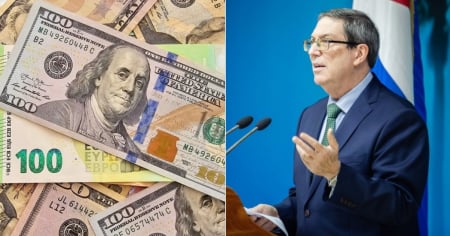
The Cuban economist Pedro Monreal analyzed the recent drop of the U.S. dollar in Cuba's informal market, which fell by 4% in just three days, and suggested that the phenomenon may be linked to expectations of an increase in remittances following Hurricane Melissa.
In a post on X, the researcher explained that after natural disasters, there is often a temporary increase in remittances to Caribbean countries, and that this expectation may have contributed to the recent decline of the USD against the CUP.
"In the 4% drop of the USD against the CUP in three days in the informal market, several factors may have played a role. One working hypothesis is that the expectation of an increase in remittances, which is typical in Caribbean countries after natural disasters, would further reinforce the decline of the USD," wrote Monreal.
The comment sparked reactions among users on the platform, including @arcamachoX, who pointed out that the effects of remittances "do not usually translate so quickly" to the informal Cuban market, and that market volatility could be a more immediate cause.
Exchange Rate Evolution
Monreal clarified that his hypothesis did not suggest an immediate effect, but rather a potential influence within a broader set of factors.
"The hypothesis is not that a potential increase in remittances has already had an effect on the rate, but rather that it could have one. The current downward movement is due to various factors, including subjective ones, and is part of a long-term downward trend caused by economic deterioration," the economist specified.
From the account @arcamachoX, the platform elToque was criticized for failing to "quantify the sample size in its report."
In this regard, he added: “When five provinces are disconnected, due to force majeure, you must have a significant geographical bias in your data. The trend of the depreciation of the CUP has never been downward.”
Monreal responded with a brief phrase: "Good observation."
However, there is another reason that should also be considered: the possibility of a social media campaign to artificially create a supply of dollars at reduced prices.
The recent decline of the dollar occurs within a context of prolonged economic tension in Cuba, where the informal market continues to be the main reference for the real value of the Cuban peso (CUP).
Exchange rates, particularly for the dollar and the euro, fluctuate based on cash availability, remittances, demand for private imports, and social expectations.
On this subject, the Cuban Foreign Minister Bruno Rodríguez Parrilla recently made a strong accusation against the informal foreign exchange market, which he attributes to a campaign orchestrated from the United States aimed at provoking an economic crisis in Cuba.
According to the official, this is a deliberate strategy of "destabilization" that resorts to currency speculation, psychological manipulation, and illicit financing through U.S. federal resources.
The report, published this Saturday on their official account on the social media platform X, has sparked a wave of reactions, reigniting the debate over the causes of inflation and the depreciation of the Cuban peso.
Filed under: