
Related videos:
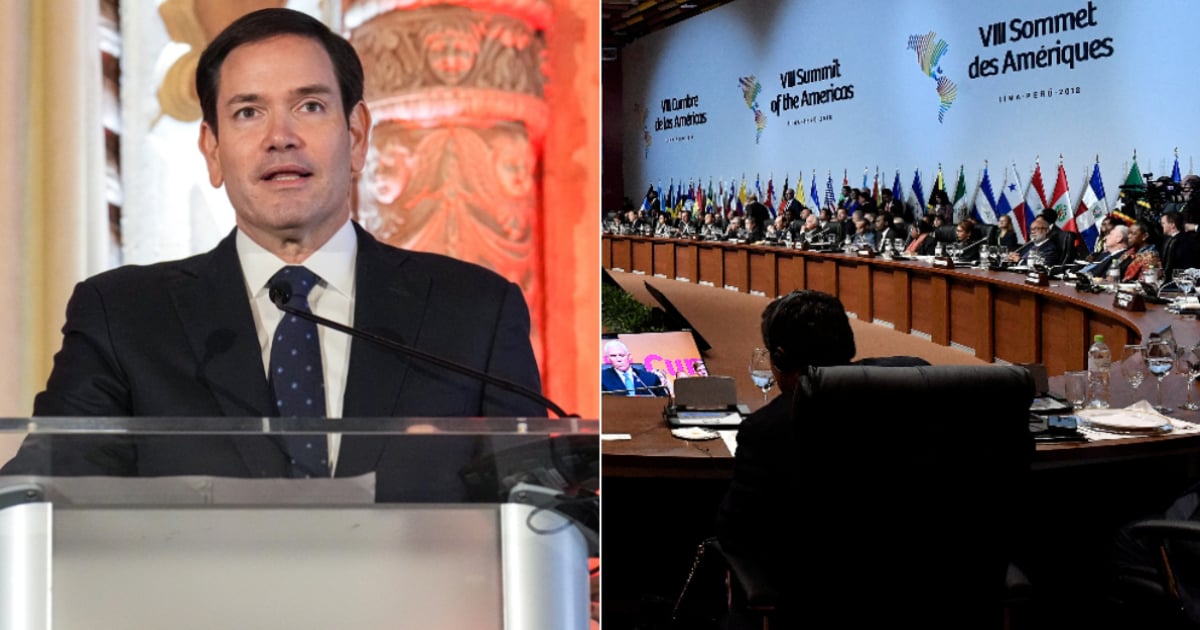
The Dominican Republic confirmed the suspension of the Tenth Summit of the Americas, which was to be held from December 1 to 5 in Punta Cana, after determining that "the appropriate conditions do not exist" for the convening of the hemispheric forum.
The decision, announced by the government of Luis Abinader, was made after consultations with regional partners and has the support of the United States, the main promoter of the event.
The U.S. Secretary of State, Marco Rubio, expressed his support for the measure through a message on the social media platform X, where he thanked "the friendship and willingness" of the Dominican president and assured that Washington will work alongside Santo Domingo and other countries "to organize a productive event in 2026 focused on strengthening alliances and improving the security of our citizens."
Although the postponement was officially justified by "regional divergences" and the impact of recent natural disasters in the Caribbean, diplomatic sources quoted by El Tiempo and CNN argue that the real reason lies in the delicate political and military context the hemisphere is experiencing, marked by the deployment of U.S. forces in the Caribbean and the deterioration of relations with Venezuela.
Since August, Washington has deployed more than ten warships and several combat aircraft in Caribbean waters as part of a "anti-drug" operation that, according to press reports, includes 14 bombings against suspect vessels, resulting in at least 62 deaths.
While the White House insists that these are actions against drug trafficking, various governments and analysts believe that the campaign aims to increase military pressure on the regime of Nicolás Maduro.
The president Donald Trump himself has stated that “all options are on the table,” a declaration that reignites tensions with Caracas and raises alarms among Venezuela’s allies, particularly Russia, which has described the U.S. deployment as “an excessive use of force” and confirmed its ongoing commitments to cooperate with the Venezuelan government.
In that context, holding a multilateral summit in Santo Domingo under the auspices of the Organization of American States (OAS) —and just a few miles from the area where U.S. naval forces operate— was politically explosive.
A Dominican diplomat, cited by Listín Diario, admitted on condition of anonymity that “there were no guarantees of safety or political neutrality; Santo Domingo would have been at the eye of the storm.”
Moreover, the summit was already marked by diplomatic controversies. The Dominican Republic had decided not to invite Cuba, Nicaragua, and Venezuela, following the line adopted by Washington in 2022, when those countries were excluded for human rights violations.
That measure prompted a reaction from several Latin American governments, including those of Mexico and Colombia, whose leaders Claudia Sheinbaum and Gustavo Petro announced that they would not attend the event in protest.
With several leaders absent, the summit risked turning into a half-empty forum, which would have been a political setback for Abinader, who aims to present the image of a stable and mediating country. According to the consulted diplomats, the cancellation was a preventive decision to avoid an anticipated diplomatic failure.
From Washington, sources from the State Department informally acknowledged that the "limited participation" had been a determining factor. A spokesperson stated that the United States "supports the Dominican decision to postpone the Summit until conditions are more favorable for consensus."
Analysts agree that the postponement is a tactical stall by Washington and its allies: a way to buy time while strategies are being redefined in response to the Venezuelan crisis and the political realignment in Latin America.
The electoral landscape in countries such as Colombia and Mexico also plays a role, where the upcoming elections are expected to alter the balance of power in the region.
For now, the Summit is rescheduled for 2026, aiming to rebuild diplomatic bridges and prevent the forum from becoming a stage for open confrontation.
Meanwhile, the tension between Caracas and Washington, the military deployment in the Caribbean, and the political divide among governments on the continent reveal a hemisphere more fragmented than ever.
In the words of a Latin American ambassador in Washington cited by El Tiempo: “It is a bad sign that, in the face of a crisis of this magnitude, the hemisphere cannot even sit down to talk. If dialogue does not take place at the Summit of the Americas, where will it happen?”
Filed under: