
Related videos:
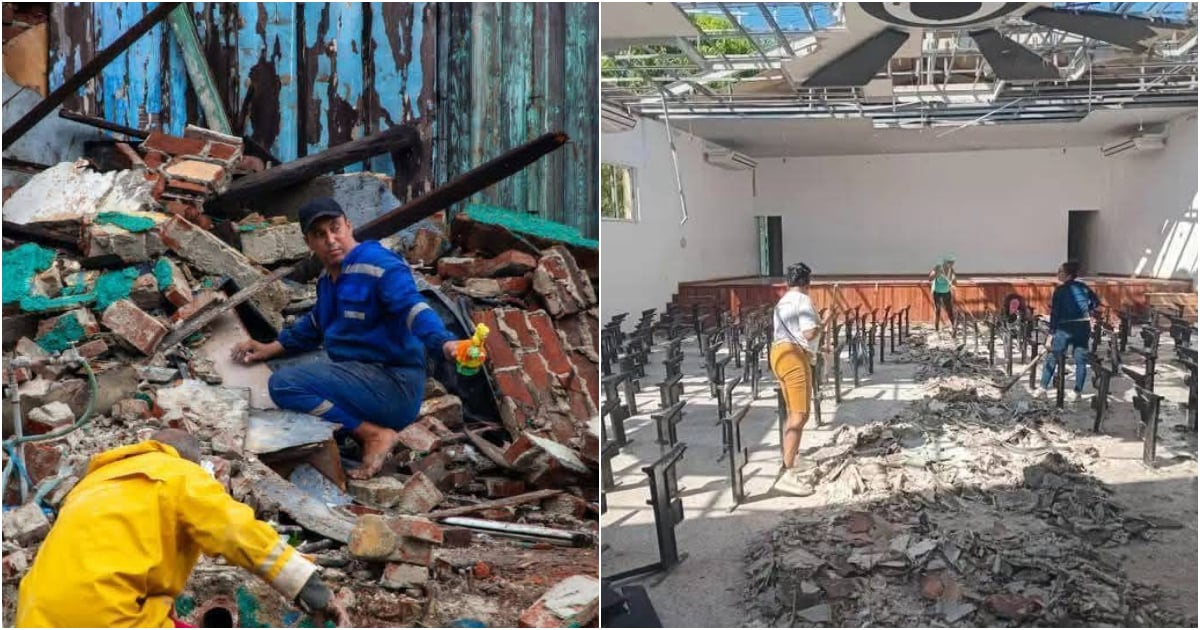
The hurricane Melissa left a devastating toll in Holguín, with around 7,500 damaged homes across all municipalities in the province, including more than 400 total collapses and the remainder with partial damage, according to provincial authorities.
The head of the construction subgroup, Rodolfo Bárzaga Mena, reported that worker brigades are engaged in debris removal, infrastructure rehabilitation, and the provision of construction materials, prioritizing health centers, schools, and families without shelter.
From the provinces of Santiago de Cuba and Las Tunas, 10,000 asbestos and zinc tiles and 5,000 asphalt tiles are being transported, intended for the repair of partial and total collapses, specified the provincial broadcaster Radio Angulo.
On Wednesday, as part of an evaluation visit to the eastern province, the leader Miguel Díaz-Canel, in his capacity as president of the National Defense Council, met with ministers, deputy ministers, and local executives.
In addition to describing the progress of the recovery as "positive," he emphasized the importance of maintaining discipline, control, and transparency in the management of the donations.
"It is necessary to balance the needs of each place and monitor the final destination of resources," he emphasized.
According to the official press, Holguín has recorded over 435,000 damages caused by the heavy rains, winds, and floods that affected all of its municipalities, with the greatest impact in Urbano Noris and Cacocum.
More than 290,000 people were evacuated during the hurricane's passage, and 856 remain sheltered in 16 centers set up in various municipalities, highlighted the official newspaper ¡Ahora!
Until November 5, 94 out of 203 affected electrical circuits had been restored, representing 56.7% of customers (around 197,000 users). Meanwhile, communications were restored to 65.4%.
In the case of water supply, 117 of the 228 damaged pumps were already operational, while 407,000 of the 724,000 customers of the aqueduct had access to the service.
They were also working on the rehabilitation of 51 contaminated loading docks during the event, the source indicated.
The agricultural outlook is likewise critical. Damage has been reported on 31,000 hectares of crops, 13,000 of which belong to the Azcuba group, and the loss of more than 100,000 cans of coffee.
Authorities instructed to save the seeds and replant as soon as possible. "We will eat what we are able to produce," emphasized Díaz-Canel while urging the reactivation of the cultivation of basic foodstuffs.
Díaz-Canel emphasized the importance of ensuring access to drinking water in areas where sources have been contaminated, accelerating waste sanitation, and maintaining solidarity and collaboration among those affected.
Despite this, it was revealed this Friday that a mother with a disability and her minor child live in a “varentierra” in the Holguin town of San Andrés after losing their home due to Hurricane Melissa, while no one from the government or Civil Defense has responded to their situation.
A wave of citizen solidarity managed to rescue Pilar, an elderly woman from the town of Juan Vicente, in the municipality of Mayarí, Holguín, who spent days living among the ruins of her house destroyed by the storm.
Filed under: