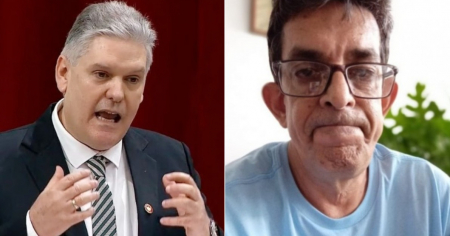
The decision of the Supreme People's Court to hold the trial against Alejandro Gil Fernández behind closed doors for the alleged crime of espionage has not surprised anyone familiar with the Cuban judicial system.
What it has indeed provoked, both inside and outside the country, is a legitimate concern: Who is being protected when the public is prevented from knowing the details of a case involving a former minister of the regime? National security or the power structure that he himself was part of?
The only official attempt to justify the secrecy came from the newspaper Granma, which in recent hours interviewed Dr. Arnel Medina Cuenca, Vice President of the Cuban Society of Penal Sciences and a professor of Criminal Law.
His responses provide a legal framework that, rather than clarifying, confirms the existence of a legality tailored to silence and institutional control.
A judicial "faculty" in a system without independence
“The People’s Supreme Court reported that the trial for espionage against citizen Alejandro Gil Fernández will be held behind closed doors,” introduced Granma. When asked about the reason for this decision, Medina responded:
"That decision corresponds exclusively to the Court, which is the one that analyzes the specific case and has all the elements from the Prosecution and the Defense."
The argument is based on Article 477 of Law 143, which states that trials must be public, except when there are “reasons of national security, morality, public order, or the respect due to the victim or their family members.”
And it is here that the gray area is activated:
“In crimes such as espionage, this restriction is almost a standard. During the debate, information may come to light that, by its very nature, could jeopardize national security if publicly disclosed,” warned Medina.
The key lies in that last sentence: "this restriction is almost a norm."
What should be an exception for extraordinary cases becomes, in practice, the standard way to safeguard processes with high political content.
The argument of protecting "superior legal goods" sounds legitimate on paper, but when applied in a country without a free press or independent judicial oversight, it only reinforces the state's power to operate in secrecy.
National security... or protection of the apparatus?
The case of Alejandro Gil is not just any case. He was the face of the economic adjustment imposed by the regime during the pandemic. While the population suffered from blackouts, inflation, and shortages, Gil was the figure defending the "Tarea Ordenamiento" and other unpopular measures on television.
Its fall not only signifies a political shift but also an internal fracture whose magnitude the government seems determined to conceal.
What is he really being accused of? What information could he have provided and to whom? What other officials are involved? Is this a legal matter or a political settlement?
None of those questions have answers, and they probably won't have any if the trial continues, like so far, in total silence.
The Crime of Espionage: A Legal Framework Designed for Ambiguity
Medina Cuenca explained that espionage is, within the Cuban Penal Code, one of the most serious crimes, with penalties ranging from 10 years in prison to the death penalty.
"Espionage is committed by anyone who, to the detriment of state security, participates, collaborates, or maintains relations with the intelligence services of a foreign state, or provides them with reports, or obtains or seeks to procure information with the intent of communicating it to them," he stated.
But the legislation is not limited to foreign intelligence services. It also includes those who collaborate with NGOs, international institutions, or even "legal or natural persons" if it is interpreted that their actions go against the interests of the State.
In other words, almost any contact with the outside can be criminalized if the political power so decides.
"Even the simple act of clandestinely entering, through deception, violence, or bribery, any of these places is punishable by imprisonment for two to five years," added Medina.
The design of this legal figure seems less oriented towards protecting national security than towards providing a means to punish dissenting or dangerous behaviors to the statu quo.
Presumption of innocence or implicit media condemnation?
Despite the seriousness of the charges, Medina Cuenca insisted that the rights of the accused are guaranteed: “The Constitution and the law establish that every accused person is presumed innocent until a final judgment is rendered against them.”
However, in practice, Alejandro Gil has disappeared from the official discourse. His previously omnipresent image has been erased. He has not had the opportunity to speak publicly, and the closure of the trial reinforces his isolation.
The presumption of innocence, if it exists, only does so within the boundaries controlled by the very system that accuses it.
More than one crime, but only one visible
When the Attorney General of the Republic officially announced the case against Gil, it also mentioned other crimes in addition to espionage. Medina Cuenca explained that this implies the existence of "at least two distinct files" and that the Court chose to start with the more serious one.
“The other offenses, which are believed to involve other individuals, will be judged in due course in a subsequent process,” he indicated.
Here, another relevant question arises: Why divide the causes? Who does this fragmentation of the process protect? Is it an attempt to dissociate responsibilities within the spheres of power?
Silence not only protects Gil. It also shields those who worked alongside him, supervised him, promoted him, or benefited from his decisions. A closed trial also absolves them from having to answer to public opinion.
A legal framework at the service of power
Medina Cuenca concluded his intervention with a message legitimizing the system:
"Our Penal Code, in line with international comparative law, categorizes this crime with all the seriousness it deserves [...] The judicial process is conducted with strict adherence to the law, ensuring both the protection of national security and the rights of the accused. It is a delicate but necessary balance, which Cuban law captures precisely."
However, outside of the official discourse, an uncomfortable reality persists: Cuban law may be stringent, but it is not transparent; it may appear balanced, but only when power is not at stake.
The trial of Alejandro Gil, closed to the public with no access for independent media or the presence of international observers, is another indication that justice in Cuba is dispensed behind closed doors, away from public scrutiny.
The People's Supreme Court of Cuba has scheduled the start of the oral trial against Alejandro Miguel Gil Fernández for this Tuesday, November 11, 2025, at 9:30 a.m., according to an official statement released this Monday.
The process will take place in the Room for Crimes Against State Security, and will proceed under strict confidentiality measures.
The statement noted that, “for reasons of National Security, the parties and individuals authorized by the court will attend the trial”, in accordance with the provisions of Article 153 of the Cuban Constitution and Article 477.1 of the Criminal Procedure Law.
It was also reported that both the defense attorneys and the accused have had access to the case file and the provisional conclusions of the Prosecutor's Office, and that the conclusions of the Defense have also been submitted.
This will be the first of two legal proceedings facing Gil Fernández, and the more serious of the two: an accusation of espionage, a crime for which the Cuban Prosecutor's Office is seeking life imprisonment.
Multiple accusations and an unprecedented political downfall
Gil Fernández was removed from his positions as Deputy Prime Minister and Minister of Economy and Planning on February 2, 2024, and a little over a month later, on March 7, it became known that he was the subject of a criminal investigation.
According to official information, the former minister acknowledged "serious accusations" and submitted his resignation from the Communist Party of Cuba and his seat in the National Assembly of People's Power.
The Attorney General's Office of the Republic confirmed on October 31 that it had filed public criminal charges against Gil Fernández and others involved, following the conclusion of investigations conducted by the Ministry of the Interior's agencies.
La nota fiscal menciona una lista extensa de delitos atribuidos al exministro: Espionaje; Malversación; Cohecho; Evasión fiscal; Lavado de activos; Falsificación de documentos públicos; Sustracción y daño de documentos u objetos en custodia oficial; Tráfico de influencias y Actos en perjuicio de la actividad económica o de la contratación.
Filed under: