
Related videos:
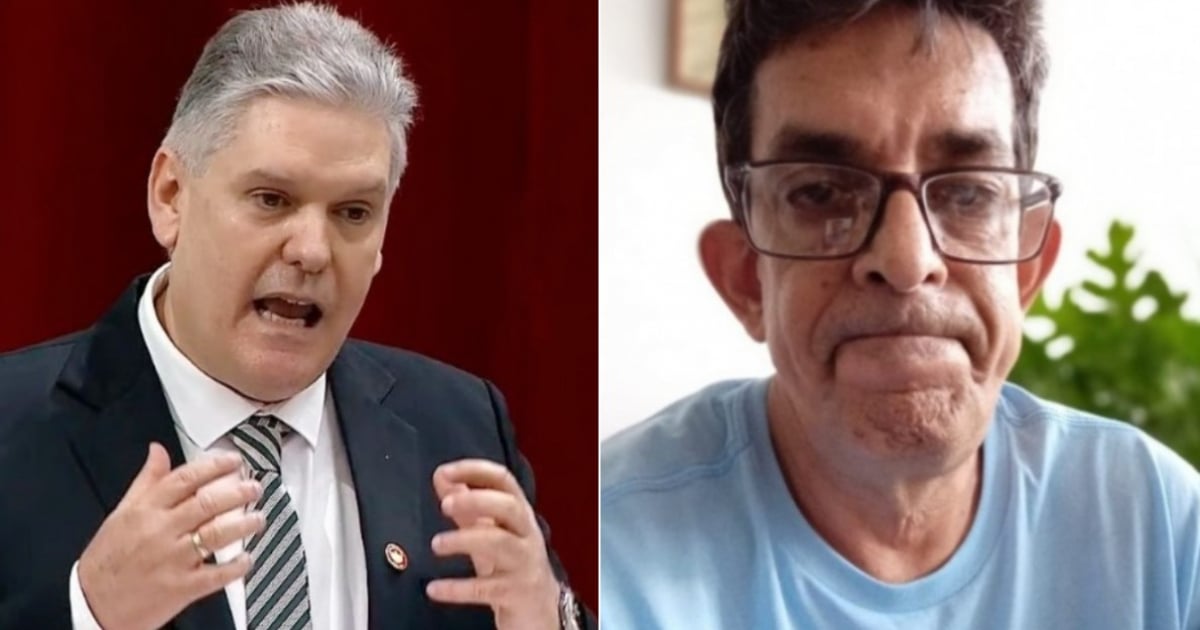
The comedian Ulises Toirac published a post on Facebook, where he analyzes the trial against Alejandro Gil Fernández, former Minister of Economy and Planning, as well as the political and economic context of the country.
Toirac pointed out that corruption is deeply rooted in Cuba, where the political structure allows cases like Gil's to be exceptional rather than the norm that is audited and controlled.
It begins by stating that "in any society, power corrupts," and that everywhere, many high-ranking officials, when interacting with businesses, stakeholders, or social sectors, inevitably become recipients of gifts.
"The mechanisms are conducive to the flourishing of corruption... 'One hand washes the other and both...,'" he wrote.
The actor criticizes the concentrated power and its lack of oversight, especially in Cuba, where since 1959 the official discourse has been one of "austerity, sacrifice, and equality."
"To make matters worse, there is a party above the State and the Constitution. It has unaccountable power and an indisputable decision," he questioned.
Despite this, he asserts that the corruption in Cuba is significant enough for there to be many more trials.
Finally, Ulises criticized the selectivity of Cuban justice, recalling that Gil's arrest occurred only after "jumping a hare" that was impossible to conceal.
According to the comedian, "the betrayal is threefold: to the sustained discourse of austerity and sacrifice of which they have been spokespeople, to the State, and to peers who might end up in that dock and know that there are reasons."
On Tuesday, the trial against Alejandro Gil began in Havana on charges of espionage, for which he faces a life sentence.
Gil, who promoted the Tarea Ordenamiento - which triggered the economic crisis currently affecting the country - is also accused of embezzlement, bribery, tax evasion, money laundering, and influence peddling, in a second case involving more than 20 individuals.
The secrecy surrounding his trial reinforces the perception that judicial transparency is a foreign concept to the system, and that corruption remains deeply entrenched at the highest levels of power.
Last week, Ulises Toirac described the case as "a puzzle missing pieces", and it is surrounded by silences and calculated timings.
His analysis was not limited to the judicial process; rather, it focused on the political context and the way information is managed from those in power: the lack of transparency and the manipulation of the moments when the government decides what to reveal and what to withhold.
His statement thus became a critique of the power structures in Cuba and its institutional control system, characterized by a lack of real accountability mechanisms.
Toirac also assessed the social impact of the Gil case and concluded that, far from generating trust, it has reinforced widespread skepticism.
"It has provoked (and it was predictable) the popular feeling of 'everyone does the same thing,'" he warned.
Filed under: