
Related videos:
The United States Department of State defended its disaster response capability and stated that the closure of the United States Agency for International Development (USAID)—the largest foreign assistance entity in the world—did not affect the country's effectiveness in responding to humanitarian crises like the one caused by the hurricane Melissa, which resulted in damage in Jamaica, Cuba, Haiti, and the Bahamas.
The powerful hurricane represented the first major test of the new foreign aid model implemented by the government of Donald Trump, following the official dismantling of USAID in July 2025.
"The alarmists claimed that the closure of USAID would be disastrous. They were mistaken," said Deputy Spokesperson of the State Department, Tommy Pigott, to , highlighting that the new model enables "an agile and coordinated response, guided by regional experts and aligned with U.S. diplomatic objectives."
An "efficient" model, according to Washington
The elimination of USAID, a move heavily criticized by governments and humanitarian organizations, was presented by the Trump administration as part of a "government efficiency reform."
Secretary of State Marco Rubio justified the decision by stating that USAID had become “a symbol of inefficient spending.”
“This era of government inefficiency has come to an end,” he said in July. “Americans should not pay taxes to fund failed governments in distant lands.”
Since then, the agency's functions were absorbed by the State Department, which now directly coordinates humanitarian aid through its regional bureaus. In the case of Hurricane Melissa, the response was led by the Bureau of Western Hemisphere Affairs, in collaboration with Southern Command (SOUTHCOM) and the Department of Defense.
Limited assistance in the face of massive devastation
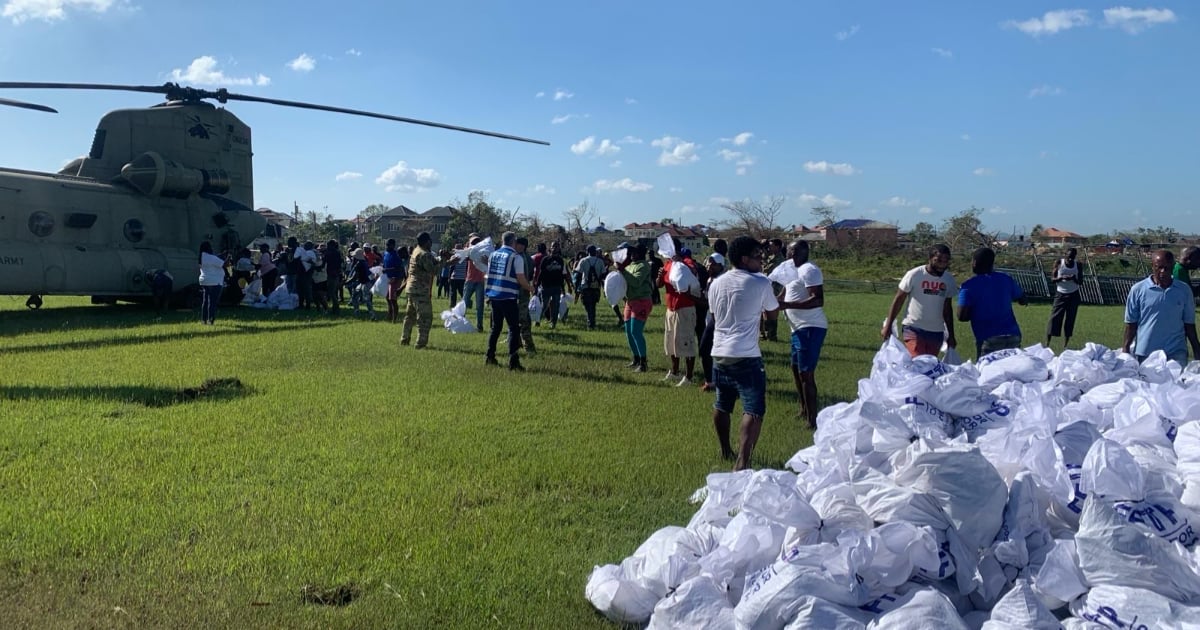
Washington approved a assistance package of 24 million dollars, allocated as follows: 12 million for Jamaica, 8.5 million for Haiti, 3 million for Cuba, and 500,000 dollars for the Bahamas.
In partnership with the World Food Programme (WFP), the United States delivered 5,000 food packages in Jamaica—enough to support families of four—and 18 metric tons of emergency food to Haiti.
Despite this, the magnitude of the catastrophe remains enormous. According to the United Nations Development Programme (UNDP), Jamaica was the most affected country, with up to 90% of buildings damaged in provinces such as St. Elizabeth and Westmoreland. In total, the country faces 4.8 million tons of debris blocking roads and hindering access to hospitals, schools, and markets.
“Entire communities are surrounded by rubble,” warned Kishan Khoday, resident representative of UNDP. “Removal is critical to begin recovery and restore essential services.”
NGOs and experts warn of deadly consequences from the closure of USAID
While the U.S. government insists on portraying its new model as “efficient and strategic,” the effects of the USAID closure are being felt around the world.
A report from the Impact Metrics Dashboard and an article by physician and former agency official Atul Gawande, published in The New Yorker, estimates that the disappearance of USAID has already caused more than 600,000 global deaths, primarily among children under five years old affected by the suspension of health and nutrition programs.
“It was an unprecedented blow that transformed American cooperation into a public death machine manufactured by man,” Gawande wrote.
The report data indicate 198,000 adult deaths and 412,000 childhood deaths, at a rate of 88 deaths per hour, due to the disruption of programs against malaria, HIV/AIDS, tuberculosis, and childhood malnutrition. In the area of malaria alone, there have been over seven million additional cases and 53,000 deaths due to lack of treatment.
In Kenya, the documentary Rovina’s Choice depicts the human tragedy in the Kakuma refugee camp, where a 60% reduction in food supplies has skyrocketed levels of malnutrition and overwhelmed local clinics.
From global cooperation to diplomatic control
Before its closure, USAID was responsible for maintaining health systems in war-torn countries, controlling epidemic outbreaks, and reducing child and maternal mortality in dozens of nations.
An analysis published in The Lancet estimated that the agency saved more than 92 million lives over two decades, at a cost of just 24 dollars annually per U.S. taxpayer.
The dismantling of the agency also included the elimination of monitoring systems and the dismissal of inspectors general, which, according to Gawande, aims to conceal the true extent of the damage.
Experts compare this opacity to the censorship of data during Mao Zedong's "Great Leap Forward," when millions of deaths were omitted from official records.
A historical setback in health and cooperation
Analysts warn that the consequences of the closure of USAID will take years to be fully measured, as many deaths from HIV, tuberculosis, or preventable diseases will manifest progressively.
The consensus among experts is that the decision has reversed decades of progress in public health and international cooperation, becoming one of the greatest humanitarian catastrophes caused by political decision-making in peacetime.
Filed under: