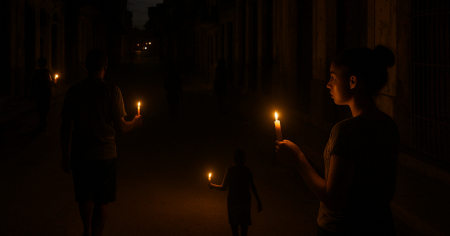
The hurricane Melissa left the eastern part of Cuba without electricity for several days, resulting in a less visible but devastating effect: the massive loss of food in households that already suffer from chronic shortages.
The Food Monitor Program (FMP) describes this reality as “a silent tragedy,” where the lack of energy for refrigeration accelerates the spoilage of the few products that families manage to preserve amidst the tropical heat.
The organization warns that in a country where “every lost piece feels like a defeat”, prolonged blackouts not only wipe out stored goods but also increase the risk of food poisoning and worsen nutritional insecurity.
In practice, when a hurricane strikes, it doesn't just destroy roofs or crops: it also ruins the little that is stored in refrigerators, leading to losses that directly impact the most vulnerable households.
According to the FMP, weather events like Melissa are becoming increasingly frequent and intense due to climate change, a pattern that hits particularly hard on already stressed systems.
The loss of refrigeration after the storm exposes families to spoiled food, illnesses, and an immediate reduction in their daily diet, especially when access to basic products is more difficult due to disruptions in services and logistics.
The report places this emergency within a network of preexisting vulnerabilities: a fragile economy, collapsed services, and limited community resilience.
Under these conditions, a power outage becomes a trigger for cascading impacts: from the loss of household supplies to health deterioration caused by consuming spoiled food or the inability to replace it in the short term.
The FMP even shares experiences from families that illustrate how the extended blackout empties refrigerators and limits the food supply for children and adults.
For the organization, wasted food is not just a climate issue: it is also a reflection of a collapsed system.
That’s why, he emphasizes, talking about climate resilience in Cuba involves more than just repairing poles or restoring lines: it requires dignity, stability, and food security so that the next storm does not translate again into hunger and illness in households.
Cuba's Electric Union (UNE) reported on Tuesday that the country is facing a generation deficit exceeding 1,460 megawatts (MW), a figure that does not include the additional impacts of over 200 MW reported in the eastern region due to Hurricane Melissa.
The UNE indicated that during the previous day, the service was affected for 24 hours and remained unstable during the early morning today. The maximum impact was 1,542 MW at 7:00 p.m. on Monday, while the provinces from Las Tunas to Guantánamo experienced 250 MW affected due to the damage caused by Hurricane Melissa.
Among the main technical incidents, the UNE reported breakdowns in units 5 and 6 of the CTE Antonio Maceo, unit 2 of the CTE Felton, and unit 5 of the CTE Nuevitas. Additionally, the CTE Antonio Guiteras, unit 2 of the CTE Santa Cruz, and unit 4 of the CTE Carlos Manuel de Céspedes in Cienfuegos are undergoing scheduled maintenance.
On the other hand, 81 distributed generation plants are out of service due to a lack of fuel, representing 651 MW unavailable, while another 106 MW cannot generate due to a lack of lubricants. In total, 757 MW are compromised due to deficiencies in energy resources.
In the eastern provinces, recovery after Hurricane Melissa is still not materializing.
In Holguín, only 81% has been restored; in Granma, 78.24%; in Guantánamo, 96.88%; and in Santiago de Cuba, only 34.01%.
Filed under: