
Related videos:
The military tension in the Caribbean is no longer just a political pulse between Washington and Caracas. According to an analysis published by The Telegraph, a potential military attack by the United States against Venezuela could trigger a global economic earthquake, driving down oil prices and delivering a deadly blow to the Russian economy.
The British journalist Matthew Lynn stated in the pages of the aforementioned outlet that if President Donald Trump ultimately decides to intervene, the impact will not be limited to the military or political sphere: it would completely reorder the global energy map.
A giant sleeping on oil
Venezuela has the largest proven oil reserves in the world —303 billion barrels, according to the U.S. Energy Information Administration— ahead of Saudi Arabia and Iran.
However, after years of corruption, sanctions, and industrial collapse under Chavismo, the country produces only a fraction of what it could.
While Saudi Arabia exports $180 billion annually in crude oil and Russia about $120 billion, Venezuela barely reaches $4 billion. The country, which pumped three million barrels a day in the 1990s, now barely exceeds 700,000.
Based on that data, Lynn pointed out that if a regime change opens the doors to Western investment, the flow of Venezuelan oil could resume within months. "Everyone knows where the oil is and how to extract it; all that's missing is a functional government," he noted.
That energetic rebirth, driven by a potential pro-democratic administration led by María Corina Machado —winner of the Nobel Peace Prize 2025 and a symbol of resilience—, would plunge oil prices to historic lows, possibly below 30 dollars per barrel.
Trump faces his greatest geopolitical dilemma
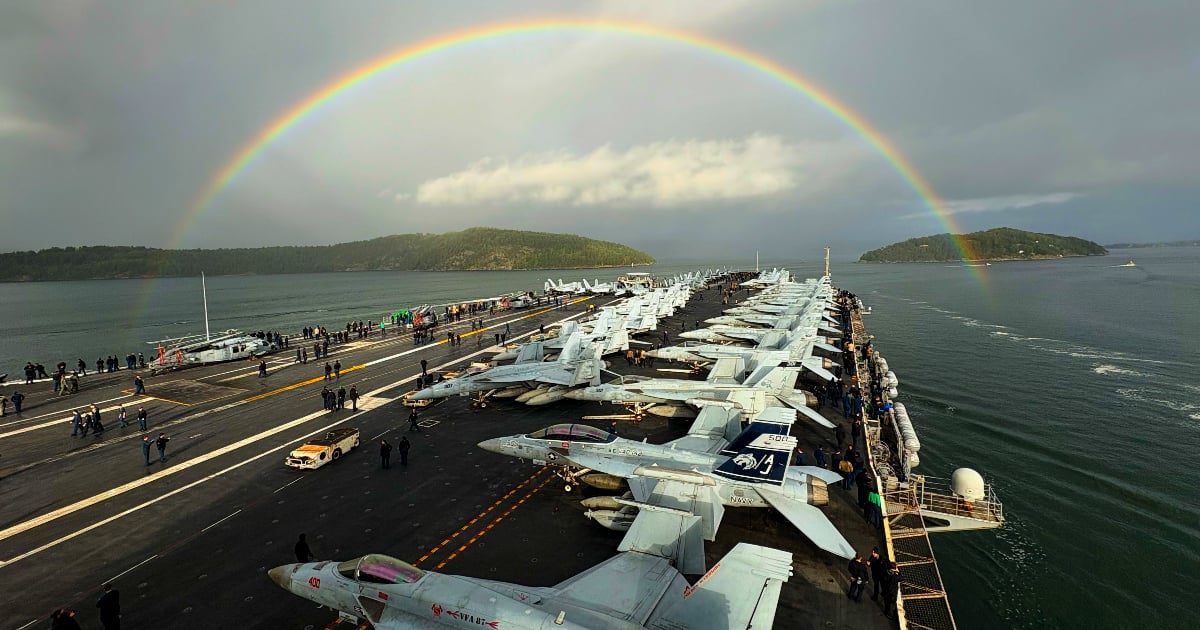
The analysis from Telegraph coincides with the largest U.S. military deployment in the Caribbean since the Gulf War: the aircraft carrier USS Gerald Ford is on its way, while several destroyers and nuclear submarines are operating off the coast of Venezuela.
Trump has warned that he wants to see "dead cartels" operating from Venezuela, a stance that Congress has backed, undermining the resolution that sought to limit his powers of action under the War Powers Resolution.
According to the article, a combined intervention —without a massive ground invasion, but with air and naval support— could overthrow Nicolás Maduro, who is weakened and accused of drug trafficking by Washington.
The most optimistic scenario: a negotiated transition with opposition support and international legitimacy, which would usher in a new democratic phase and reconstruction.
But the economic backdrop is the real driving force. Trump could justify his offensive not only in the name of hemispheric security but also as a masterstroke to lower oil prices and financially strangle the Kremlin.
The domino effect: Russia, Saudi Arabia, and Latin America
Lynn's theory is clear: a free and producing Venezuela, outside of OPEC, would unleash a global oversupply of oil.
The result would be devastating for the major exporters—especially Russia and Saudi Arabia—but beneficial for the rest of the world, as it would reduce inflation and energy costs.
"Putin could not sustain his war in Ukraine with oil at $30 a barrel," noted the economist. Furthermore, the Kremlin would lose a strategic ally in Latin America, also weakening Cuba and Nicaragua, whose regimes rely on financial and logistical support from Caracas.
In parallel, Saudi Arabia, facing a growing fiscal deficit, would be forced to cut spending and subsidies, while Western economies would experience some relief.
A chess move or a leap into the void
The question remains whether Trump will dare to execute the plan. The president himself has publicly expressed doubts about the risks of direct intervention, aware that a military failure—like the Bay of Pigs in 1961—could strengthen his enemies and damage his legacy.
However, if the operation is successful, it could represent the boldest move of his second term: overthrowing a Moscow-aligned dictator, reopening the Venezuelan oil market, and, in the process, collapsing Putin's economy and exhausting his main source of resources for the aggressive imperialist war he is waging in Ukraine.
The board is set. All that’s left is for the U.S. president to decide to move the piece that could change —once again— the global balance of power.
Filed under: