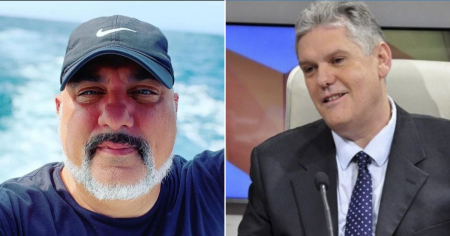
The espionage trial against the former Minister of Economy, Alejandro Gil Fernández, has developed under a veil of secrecy, extreme surveillance, and family exclusion.
For those close to him, the process—held behind closed doors and without guarantees of transparency—seems predetermined.
The sister of the accused, former television presenter and lawyer María Victoria Gil, who has closely followed the case, acknowledges that the legal horizon now only includes three possible scenarios, although she resigns herself to the fact that all seem to follow a logic already laid out: guilt.
In recent statements to the YouTuber Darwin Santana -after the conclusion of the second day of the trial this Wednesday- María Victoria Gil issued a warning filled with distress:
"I think, unfortunately, that it is a sentence already issued. God willing, I am wrong."
Their testimony sets the tone of a family that feels excluded and betrayed by a judicial system that does not provide minimum guarantees of transparency or justice.
“A closed trial, without transparency”: The testimony after the second day
María Victoria Gil gave a poignant summary of the experience her family went through during the two days of the trial held at the Marianao Court, overseen by the People's Supreme Court, as is appropriate for crimes classified as attacks against state security.
"The trial was held for two days behind closed doors, with a significant security presence for both the public and the press, and it was conducted with complete secrecy," he reported.
"My niece has not been allowed to enter... only my nephew has been able to go in, and he hasn't said anything at all," she clarified.
The lawyer expressed her personal confidence in the president of the Supreme Court, Rubén Remigio Ferro: "He is a person I admire and in whom I trust completely."
He also spoke respectfully about the defense attorney: “Doctor Abel Solá… currently considered one of the greatest criminal lawyers in Cuba and a specialist in the crime of espionage.”
However, that institutional confidence coexists with a bitter disappointment: “All my hopes that a dismissal of the case would occur prior to the trial due to lack of evidence… did not happen. I asked God for this so much, but it did not come to pass.”
According to María Victoria Gil, from now on there are only three possible scenarios:
1-That the Prosecutor's Office elevates its provisional conclusions to definitive ones and maintains its request for life imprisonment.
“One option —he said— is for the Prosecutor's Office to uphold its request for life imprisonment.”
2-That the Public Prosecutor's Office modifies its conclusions and requests a lesser sentence.
“Another option is for the Public Prosecutor's Office to present more moderate conclusions and seek a lesser sanction.”
3-That the Prosecutor's Office withdraw the accusation entirely.
“The third option is for the Prosecutor's Office to withdraw the accusation… that's like asking God for something impossible.”
"I swear to you by the most sacred that I have no information," he insisted.
"I think, unfortunately, that it is a sentence that has already been pronounced," he concluded.
"This is a typical case of brutal savagery": Pre-interview with Javier Díaz
Days before the trial, María Victoria Gil had already publicly warned about the conditions of the process and her brother's situation in an interview with journalist Javier Díaz from Univision.
There, he denounced the isolation imposed on the family and described the process as a punishment with political motivations.
"The trial is completely sealed off... I have no communication because my niece and nephew have had their internet cut off and their WhatsApp blocked since yesterday," she stated, highlighting the level of control and isolation imposed since the announcement of the trial date, a detail that the family learned about from state television.
He described the process as persecution with emphasis: “This is a typical case of brutal ruthlessness.”
And he pointed out that his brother was not pursued for treason against the State, but for wanting to reform it: “I highly doubt that my brother was capable of becoming a spy. What I do think is that he wanted to change things… he became bothersome because he wanted to change things within the economic structure of Cuba.”
In his view, the reforms that Alejandro Gil defended during his ministerial position—opening up to private property and the non-state sector—placed him in an uncomfortable position within the power structure, making him a target.
Humiliating treatment and physical deterioration
Beyond the legal charges, María Victoria described an alarming physical condition: “She is suffering… experiencing humiliating treatment… she has lost 50 pounds, has no hair, and has stress-induced alopecia areata.”
Gil Fernández has been detained in a high-security prison for over a year. His daughter, Laura María Gil, reported that she was unable to attend the trial and described the accusations as "a complete manipulation."
"Nothing will change my mind that he is not a spy," he expressed. His son, Alejandro Arnaldo Gil González, was also present at the hearing, although he did not make any statements.
"Speak, don't fold."
One of María Victoria's most moving calls was directed straight to her brother, encouraging him not to remain silent or sacrifice himself for others: “I told my brother... speak up, don’t fold, don’t be afraid... it’s better to die with dignity than to live humiliated.”
"Dignity has no price... freedom has no price... truth has no price."
In that same tone, he emphasized that it wasn't worth protecting anyone who didn't deserve it: "Don't watch someone's back when they don't deserve it... put everything on the line."
And it concluded with a statement of great symbolic weight: “To die for a true cause in which you have exposed all the corruption of a Castro regime… it is worth dying and becoming a hero of the homeland.”
The trial, which is taking place under strict security measures, has not allowed access to the press, independent observers, or family members outside of those selected. The prosecution is pursuing a charge of espionage—an offense deemed "against state security"—and has requested life imprisonment as the penalty.
Beyond the legal aspect, what strongly emerges from María Victoria Gil's statements is the awareness of being faced with a closed and predetermined process: “It is a verdict that has already been rendered.”
Filed under: