
Related videos:
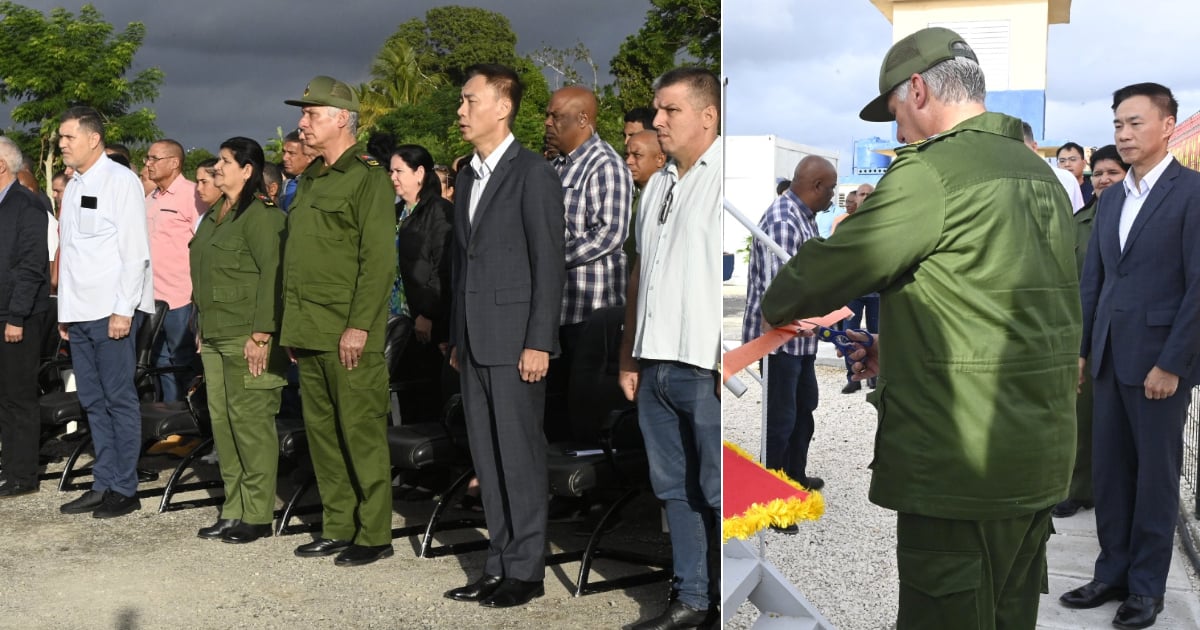
The recent event led by Miguel Díaz-Canel in the province of Artemisa, to inaugurate the photovoltaic park "Mártires de Barbados II", has generated critical and ironic reactions among Cubans on social media, where many expressed frustration at the ongoing power outages and the lack of concrete results in the electrical system.
The park, with a power of 5 megawatts (MW), is part of a donation from the government of China that includes seven similar facilities in its first stage, within a total project of 120 MW. During the event, the head of state expressed his gratitude “to the sister nation for its firm and constant cooperation in this sector, and for being there in difficult times,” while official media such as Cubadebate and the Unión Eléctrica (UNE) presented the project as a step towards energy sovereignty.
However, users responded with skepticism and sarcasm. "Every time they announce the inauguration of a solar park, blackouts increase," wrote one of them, while another quipped that "5 MW is the average consumption of Canel's house." There were also comments suggesting that "they will need sunlight 24 hours a day" or that "this is enough for the party, the government, and a few small businesses, as long as there's sunshine."
Others pointed out the contrast between official propaganda and everyday reality: "In the same municipality where the park is located, there is a blackout due to a shortage," wrote one user, while another summarized: "A political act for 5 MW."
Critics also pointed out the welfare-oriented nature of these types of projects. "They rely on donations and gifts," commented one internet user, while another added that "Cuba is not alone... a country always appears willing to lend a hand when it knows that Cuba can't pay them back for 20 years." A third user expressed a harsh opinion: "Cuba's problem is not energy-related; the problem is the mobsters in power."
There were also messages reflecting fatigue due to the lack of real solutions: “Look, we’ve been here in the same province for 17 hours without electricity,” one comment pointed out; another claimed, “every time they do one, the blackout gets longer,” and yet another described the situation as “shameful and pitiful; we are nothing now, not even compared to Haiti.”
Although some supportive messages were also read—such as "Let's aim for more, my president, always making revolution," "Cuba is not alone, there are many countries reaching out their helping hands for a sincere friend," or "Thank you to China for its assistance and solidarity with our people"—the overall tone of the reactions was one of criticism and distrust.
According to the Union Electrica, the seven connected solar parks will contribute 35 MW in this first phase, and a second stage will add another 85 MW. The Chinese ambassador, Hua Xin, stated that the project will allow for "saving about 18,000 tons of fuel per year." However, the announcement comes amid widespread blackouts and a generation deficit exceeding 1,500 MW daily, which keeps a large part of the country experiencing constant power outages.
The general sentiment of the users was captured in a comment that summed up the prevailing tone: “They talk about light, but we are still in the dark. There’s no electricity, no water, and they still celebrate donations as if that were progress.”
Filed under: