The Cuban government and the International Solar Alliance (ISA) signed a Country Framework Agreement in Havana to promote seven projects focused on renewable energies, aimed at food and medicine production, as well as electrification in rural areas, among other areas.
This was announced by the director of Renewable Energies at the Ministry of Energy and Mines (Minem), Rosell Guerra, during the closing of a workshop with state organizations and business representatives.
The agreement aims to broaden cooperation between both parties, review the participation of sectors of the Cuban economy, and strengthen the technical training of specialists, reported the state agency Prensa Latina.
Guerra highlighted that the ISA has made donations and provided equipment, in addition to certifying the Photovoltaics Laboratory at the University of Havana as a Resource Center for Solar Technology Applications (STAR Center), the first of its kind in Latin America.
The center has already conducted four courses for Cuban technicians and training for officials from 14 countries in Latin America and the Caribbean, with support from the Latin American Energy Organization.
The visit to the island by Ashish Khanna, the General Director of ISA, was presented as a demonstration of the organization's commitment to Cuba's "energy transition."
The regional head of the ISA for Latin America and the Caribbean, Hugo Morales, announced that they will assess specific modalities for implementing the projects after listening to the Cuban organizations involved.
Khanna, for his part, asserted that the new strategy, titled “Moving from Ambition to Action,” aims to establish a detailed plan to define which projects will be executed and within what timelines, acknowledging that, despite the existing technical capacity, it is necessary to incorporate experiences from other countries and improve management practices.
ISA is an intergovernmental organization established to promote the use and development of solar energy globally, particularly in countries with high solar radiation.
It was officially launched in 2015 during the Paris Climate Summit (COP21), driven by India and France. Although it was initially focused on countries located between the Tropics of Cancer and Capricorn, today its membership is open to any interested nation.
Its mission is to facilitate investments and reduce the cost of solar energy, promote joint infrastructure projects, share technology and knowledge, and accelerate the energy transition by reducing dependence on fossil fuels.
Among its areas of focus are the development of smart electrical networks, rural electrification projects, financing programs to attract private investment, and technical training to support these changes.
This agreement is announced as the country faces one of the worst energy crises in recent decades, with daily blackouts lasting up to over 20 hours due to technological obsolescence, lack of fuel, and almost total dependence on imports to maintain electricity generation.
The Cuban government is committed to expanding the use of renewable energy, which currently accounts for less than 5% of the national energy matrix. In fact, authorities claim that the island will soon be among the top three countries in the world making the fastest progress in the transition to clean energy.
In this regard, the investment budget for 2025 reflects a partial shift in spending priorities, with a significant increase in renewable energy and debt repayment.
During the last few months, several solar parks have been inaugurated. However, Cubans, increasingly skeptical, do not perceive "even a slight improvement".
This is how they express it on social media, where they harshly question the real usefulness of these investments. Others ironically suggest that the solar panels seem to only serve to fuel the government's narrative, not the needs of the people.
Likewise, the authorities have emphasized the inauguration of electric tricycle routes in several Cuban cities, although the lack of charging stations equipped with solar panels keeps these means of transportation reliant on fossil fuel generation, calling into question their profile as “eco-friendly.”
The ruler Miguel Díaz-Canel
However, this measure comes with a significant limitation: the lack of batteries to store the generated electricity, which means that solar energy can only be used in real-time, during the day, with no possibility of meeting nighttime demand, when the highest consumption occurs.
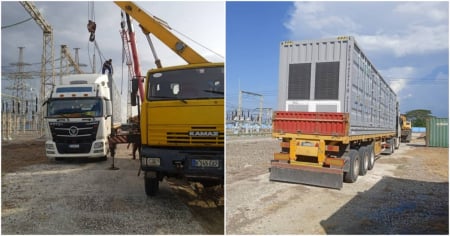
However, at the beginning of August, authorities announced the installation of solar energy storage batteries at the electrical substations of Cueto 220, Bayamo 220, Cotorro 220, and Habana 220.
At the end of June, the Ministry of Finance and Prices (MFP) issued Resolution 169 dated May 30, 2025, and published in the Official Gazette No.60, which updated the tax framework related to the importation and use of technologies associated with renewable energy sources (RES).
This measure was presented as support for Decree Law 345 "On the Development of Renewable Sources and the Efficient Use of Energy," dated March 23, 2017, and the government program to recover the National Electroenergetic System.
Frequently Asked Questions about Cuba's Energy Agreements with the International Solar Alliance
What agreements did the Cuban government sign with the International Solar Alliance?
The Cuban government signed a Country Framework Agreement with the International Solar Alliance to promote seven projects focused on renewable energy, food and medicine production, and electrification in rural areas. This agreement aims to expand cooperation, review the involvement of sectors of the Cuban economy, and strengthen the technical training of specialists.
How does the International Solar Alliance contribute to the development of solar energy in Cuba?
The International Solar Alliance (ISA) has made donations, provided equipment, and certified the Photovoltaics Laboratory at the University of Havana as a Resource Center for Solar Technology Applications (STAR Center). This center has offered courses for Cuban technicians and training for officials from other countries, with the support of the Latin American Energy Organization.
What is the current state of the energy system in Cuba?
Cuba faces one of the worst energy crises in decades, with daily blackouts lasting over 20 hours due to technological obsolescence, lack of fuel, and dependency on imports. Although several photovoltaic parks have been inaugurated, the population remains skeptical about the real improvement of the national electrical system.
What future projects have been promised to address the energy crisis in Cuba?
The Cuban government has promised the installation of 55 solar parks with a capacity of 1,200 MW by the end of 2025. However, the effectiveness of these projects is in question due to the lack of batteries to store the generated electricity, which limits the use of solar energy in real-time during the day.
Filed under: