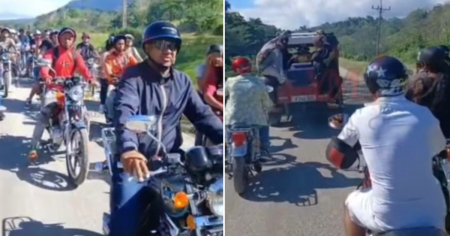
The Cuban doctor and content creator known as Luisi, who documents his daily life in Havana, recently shared in a video the extreme difficulties in keeping a motorcycle or bicycle operational in Cuba.
In a YouTube video, the doctor referred to the scarcity of basic parts and the economic and time wear involved in going out day after day to look for a simple replacement in the markets of the capital.
In the material titled “The Problem of Maintaining a Vehicle in Havana, Cuba,” the doctor recounts how he has been traveling around different parts of the city for weeks in search of an aluminum manifold for his motorcycle.
To avoid mistakes, always carry a rubber sleeve as a sample, with the idea of finding an identical piece but made of metal: same design, same holes, same diameter.
Yet, he admits that he has had to go “where I was yesterday and the day before”, unsuccessfully, resigned to the fact that he will have to keep searching “until he succeeds.”
The doctor explains that much of the search takes place among crowded markets and workshops, where often he can't even record because people get nervous.
He mentions that a “facilitator” —whom he calls Andrés— will make him a custom part if he manages to find the right model, illustrating how the repair of a vehicle in Cuba often relies on makeshift solutions and the goodwill of others, rather than on a stable supply system for parts.
The journey of maintaining the vehicles is further complicated by the urban and climatic environment, which works against any efforts to keep the means of transportation in good condition.
The doctor comments, somewhat ironically, that the thorough cleaning he gave his bicycle only lasted 20 hours: a light drizzle made everything dirty again.
In contrast, Valora highlights a component that protects the motorcycle's battery and allows it to be used in light rain without damage, because at least "it's easier to clean than the bicycle and it protects the battery," an example of how every technical detail becomes crucial when resources for repair or replacement are limited.
The video blends that daily struggle with his professional life. During a round trip through Havana in search of the manifold, the doctor prepares to go on duty in an emergency service.
He admits that he arrives "just in time" at the hospital, still dragging the fatigue from the chikungunya he suffered from weeks earlier, and he reflects that the recent cold seems to have slightly reduced the number of fever cases, which could mean a calmer shift.
But the physical effort of maintaining the vehicle, navigating the city, and working long hours eventually takes its toll.
In their daily life, one can notice the constant clash between the lack of time, illness, and scarcity.
In order to continue getting around, he has to plan every outing: wait for the heavy rain to stop, coordinate with a friend—Yuri—to take him to visit the same markets again, take advantage of any opportunities for bargains, and in the meantime, keep working at the hospital.
In one of the anecdotes, he recounts amidst laughter how, having resolved "practically nothing" with the motorcycle, he at least had fun crossing the street and "holding up traffic" while recording, a way to inject humor into a structural problem that is beyond his control.
The domestic context is not exempt from that precariousness. At home, the doctor shows how his dog destroys seats and furniture and acknowledges that it makes no sense to repair anything just yet: only when the animal turns three years old—following the advice of a relative—will he consider investing in new seats.
The logic is the same as that which applies to motorcycles and bicycles: there is no room for repeated fixes, so every maintenance decision is measured to the millimeter.
The result is a very concrete portrait of what it means today to maintain a vehicle in Cuba: weeks lost searching for a simple spare part, dependence on informal markets and "facilitators", makeshift solutions so that the rain doesn’t ruin the investment, all while the owner faces exhausting shifts in the healthcare system and the aftermath of diseases like chikungunya.
Far from being just a personal blog, the doctor's testimony serves as a daily snapshot of the transportation and supply crisis that impacts the lives of thousands of Cubans who, like him, rely on a motorcycle or a bicycle to get to work.
Filed under: