
Related videos:
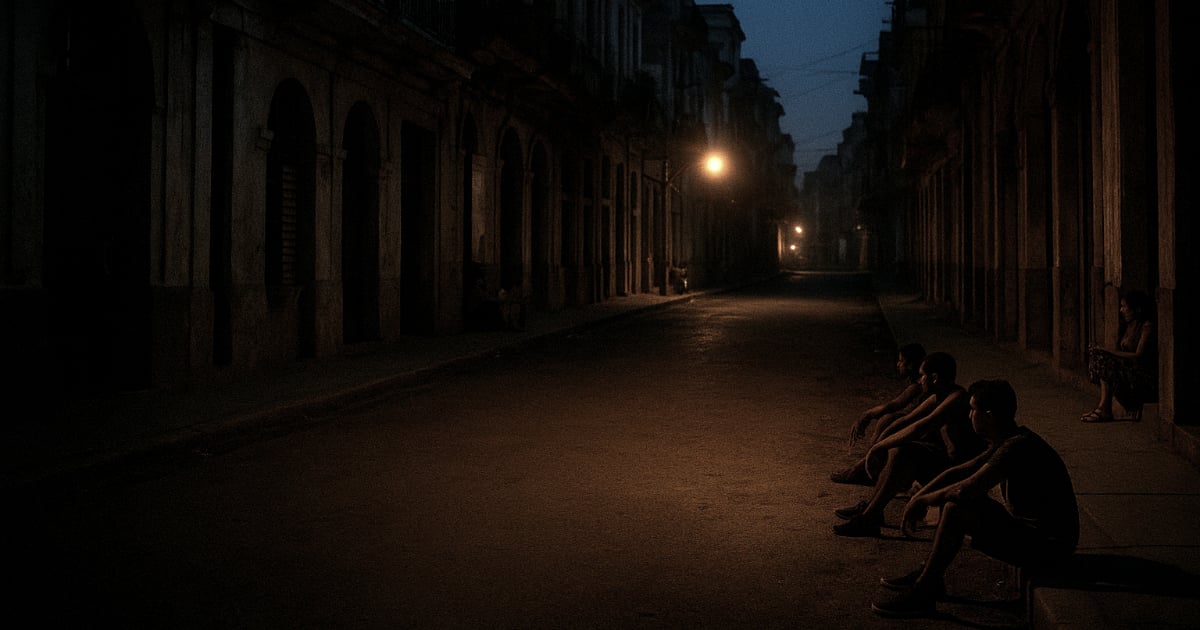
Cuba woke up this Sunday caught in another cycle of endless blackouts that once again highlight the deep deterioration of the National Electric System (SEN) and the government's inability to stop a crisis that has been worsening for years.
The statement from Unión Eléctrica (UNE) confirms a situation that has become part of everyday life: outages lasting over 20 hours, structural deficits, and plants shutting down faster than the State can repair them.
The previous day passed almost without service: from 5:10 am until 2:07 am the following day, the country was affected. Just three hours later, at 5:44 am, the supply was interrupted again.
The highest impact due to generation capacity deficit was 1,326 MW at 6:40 PM.
In addition, 144 MW were reported affected in the provinces of Holguín, Granma, and Santiago de Cuba due to the passage of Hurricane Melissa, along with another 50 MW in Granma and 20 MW in Guantánamo due to high transfers and low voltage in the area.
For millions of Cubans, that means another day without refrigeration, without pumped water, without electric transportation, and without the basic services that rely on a crumbling system.
An exhausted system that can’t even meet minimal demand
This morning, the actual availability of the SEN was 1,550 MW, while demand rose to 1,840 MW. That gap—which indicates the difference between the electricity the country can generate and what it needs to function at a minimum—already left 400 MW of early impact.
But the worst of the day is yet to come: starting at noon, interruptions are expected to reach 750 MW.
The deterioration is not a temporary issue nor a result of the impact of Hurricane Melissa. The majority of the collapse stems from accumulated failures, technological obsolescence, and a lack of sustained investments.
The thermal power plants, the backbone of national generation, remain out of commission.
Four units remain out of service: two from Renté (Antonio Maceo), one from Felton, and another from Nuevitas.
Two other units at the Santa Cruz CTE and the Carlos Manuel de Céspedes CTE in Cienfuegos are undergoing maintenance that, rather than being planned efficiently, end up coinciding and leaving the country without support.
Even the plants that should be resilient carry chronic limitations that diminish their strength day by day.
A country paralyzed by a lack of fuel and lubricants
The UNE note includes a fact that summarizes the absolute precariousness: 802 MW are out of service due to a lack of fuel and lubricants. In other words, nearly a third of what the country needs during peak hours is not being generated because the State does not have the most basic supplies to sustain operations.
More than 80 distributed generation plants, crucial for stabilizing the National Electric System, are either shut down or operating at minimal capacity. Additionally, 109 MW have collapsed due to a lack of lubricants.
This energy deficit is not surprising: it is the direct result of years of improvisation, extreme dependence on low-quality domestic crude, and international agreements that have failed to secure consistent supplies.
An impossible overnight peak to cover
The UNE announced the "anticipated" entry of unit 6 from Renté with 45 MW, a symbolic figure in light of the magnitude of the problem.
With that minimal recovery, the availability during peak hours would be 1,595 MW, while the demand would rise to 3,000 MW. The result is a gap of 1,405 MW, which would translate into a real impact of 1,475 MW.
In practice, this means that more than half of the country will be without electricity during peak hours, when families are trying to cook, pump water, or simply relax.
And although the Government tries to present solar parks as a success—31 installations contributed 2,452 MWh the previous day—the reality is that this production only covers a minimal fraction of the structural deficit and does not compensate for the decline of the thermal system or the lack of fuels.
Havana: an apparent relief that does not change reality
The Electric Company of Havana reported that the capital experienced 9 hours and 45 minutes of blackouts on Saturday, with a peak of 140 MW affected.
Although the service was restored before 9:00 PM and there were no outages during the early morning, this relative "normality" does not reflect the country. Havana is usually the last to experience outages and the first to recover, but stability in the rest of the territory is practically nonexistent.
A crisis sustained by inefficiency
Beyond the technical figures, what this report reveals is an electrical system that has become a ticking time bomb.
Every day there are more malfunctioning plants than operational ones, more fuel absent than available, and more official promises than concrete solutions.
The government insists on referring to "temporary impacts," but Cubans have been living in a crisis for years that is no longer just a temporary situation: it is structural and a direct result of poor management.
The UNE publishes daily reports, but it does not provide a realistic strategy or a credible timeline to restore the SEN.
Meanwhile, the population is facing reality without alternatives: food that spoils, children who can't sleep due to the heat, patients without functional medical equipment, and a completely paralyzed economy.
Cuba is not just experiencing blackouts: it is undergoing the progressive collapse of its energy system, a crisis that cannot be resolved with official statements or minor solar contributions, but rather requires profound decisions that the government has been unable to make.
Filed under: