
Related videos:
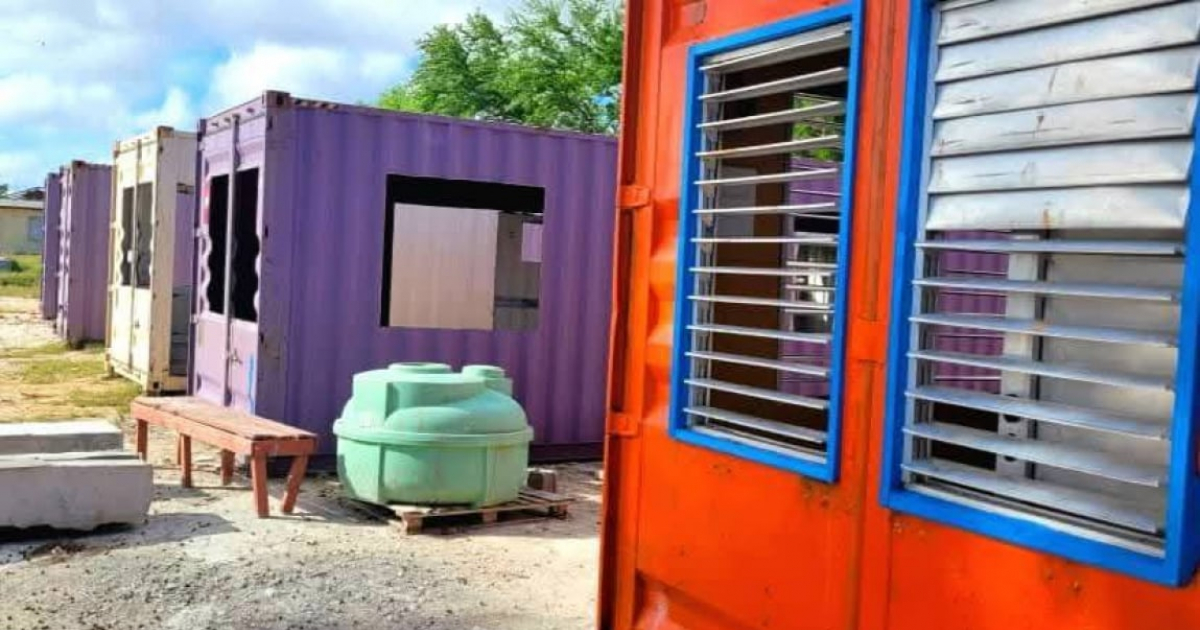
A month after the devastating impact of the hurricane Melissa, as thousands of families in Holguín continue to try to rebuild their lives among the ruins, the provincial government presented the delivery of homes constructed from shipping containers as a "housing solution."
The idea, enthusiastically promoted by the newspaper Ahora, has sparked a wave of rejection among the people of Holguín, who see these metal modules as confirmation of the historical failure of the State to guarantee decent housing for its population.
The state-run newspaper described the works as expressions of creativity and technological advancement, resulting in "safe, resilient, and dignified homes."
According to their account, the province is "a hotbed of effort and solidarity," and in the hardest-hit neighborhoods, "the hopeful rhythm of metal and tools" prevails, while local factories, military companies, and the KTP work "without improvisations."
However, for many citizens, those words could not be further from reality.
"Solar ovens": the popular rejection of the supposed "dignified housing"
Reactions on social media to the publication of the weekly Ahora were immediate and overwhelming.
Engineers, mothers, art instructors, and residents from various provinces agreed on one essential point: living in a metal container in a climate like Cuba's is an extreme display of precariousness, not of innovation.
"That is cooking a person alive, with the sun so strong that it beats down daily here," warned a mother.
"They are solar ovens, and if they are not anchored properly to the ground, any flooding or hurricane will take them away," commented an engineer.
Others recalled that, although in other countries there are houses made from containers, these are fully insulated, climate-controlled structures designed to meet housing standards that are not even mentioned in Cuba.
"Calling a refurbished container a dignified home is a disrespectful act, lacking ethics and even basic human qualities. If they are so dignified, they should start by giving them to the leaders and hand over their houses to the people," demanded a resident of Camagüey.
A "recycled" solution... and now officially failed
Popular sarcasm has its roots: last week, the Government acknowledged the failure of its national housing program made with shipping containers, which was announced with great fanfare just a year earlier as an "economic and ecological" alternative to tackle the country's severe housing deficit.
According to information published on X by the official Government account, more than 1,700 containers have been released, but the project is practically stalled due to the slow pace of their extraction and adaptation.
The evaluation meeting, led by Manuel Marrero, also highlighted failures in other basic sectors—from garbage collection to funeral services—serving as a reminder that the country's structural crisis impacts all levels of daily life.
Marrero acknowledged the lack of control and inefficiency in adhering to regulations and attempted to justify the shortcomings by requesting "sensitivity and promptness" in addressing the needs of the population. However, in practice, families continue to wait.
Melissa exacerbates an already unsustainable housing crisis
Hurricane Melissa only deepened a drama that was already chronic.
Thousands of homes were destroyed or severely damaged, and thousands of families lost not only their houses but also their furniture, appliances, and essential goods, which are impossible to recover in a country where wages do not suffice for survival.
Instead of providing free materials to those affected, the government continues to charge and regulate resources, even for people who have lost everything.
And now it presents as an "alternative" metal structures without thermal insulation, without proper design, and without real safety guarantees.
The contrast between official triumphalism and the real despair of affected families highlights the magnitude of the crisis: overcrowded shelters, shored-up houses, makeshift roofs, and endless waiting lists for state aid.
While the propaganda speaks of "reinventing the way to create homes," in the affected neighborhoods a bitter question prevails:
how can a government that failed to build container homes for a year now do it for thousands of victims who lost everything in a matter of hours?
A province that "is rising," but at the expense of its own people
In its publication, Ahora highlighted the presence of the first secretary of the Party in Holguín, Joel Queipo Ruiz, overseeing the work "from the first dawn after the hurricane."
But for the population, the problem has never been the lack of officials on televised rounds, but rather the absence of real, sustainable, and humane solutions.
The provision of containers as housing in a country subjected to decades of deterioration and disinvestment seems like yet another makeshift solution to conceal a housing collapse that has gone unaddressed for years.
There is nothing innovative about it: just the most visible evidence of a state that, in the midst of an emergency, is once again arriving late, poorly, and with responses that the population openly rejects.
In Holguín, as in all of Cuba, the victims of Melissa continue to wait for what should be fundamental: a safe home, not a hot, uninsulated container disguised as progress.
Filed under: