
Related videos:
More than a month after the devastating passage of Hurricane Melissa through eastern Cuba, the transportation situation - especially rail transport - remains far from normal.
Authorities insist that recovery efforts are progressing, but official reports continue to reveal a collapsed infrastructure, accumulated effects over the years, and a country facing this crisis with a vulnerability that the storm has only further exposed.
The Minister of Transport, Eduardo Rodríguez Dávila, shared on Facebook an update on the work in the eastern region.
The message, signed by First Deputy Minister Luis Roberto Rosés, outlines ongoing actions and immediate projections.
But it also confirms, between the lines, the deep deterioration of the railway system and many roads, which already showed serious deficiencies before the cyclone and now face an unprecedented level of destruction.
Railways: promises of connection while the destroyed sections remain
According to the report, "within the next 48 hours," the province of Santiago de Cuba should be connected with Guantánamo and Granma, specifically with Bayamo.
For its part, the operation of the national trains -interrupted due to the damage in several segments of the Central Line- is expected to resume "in the coming days."
At the beginning of November, almost all national trains were canceled due to the severe damage caused by Melissa. Only the Havana–Holguín route remained operational, running one trip every four days.
Rodríguez Dávila announced that the route between Bayamo and Camagüey will be the next section to be restored, in order to reconnect with the Central Line, which serves the national route from Havana to Bayamo/Manzanillo.
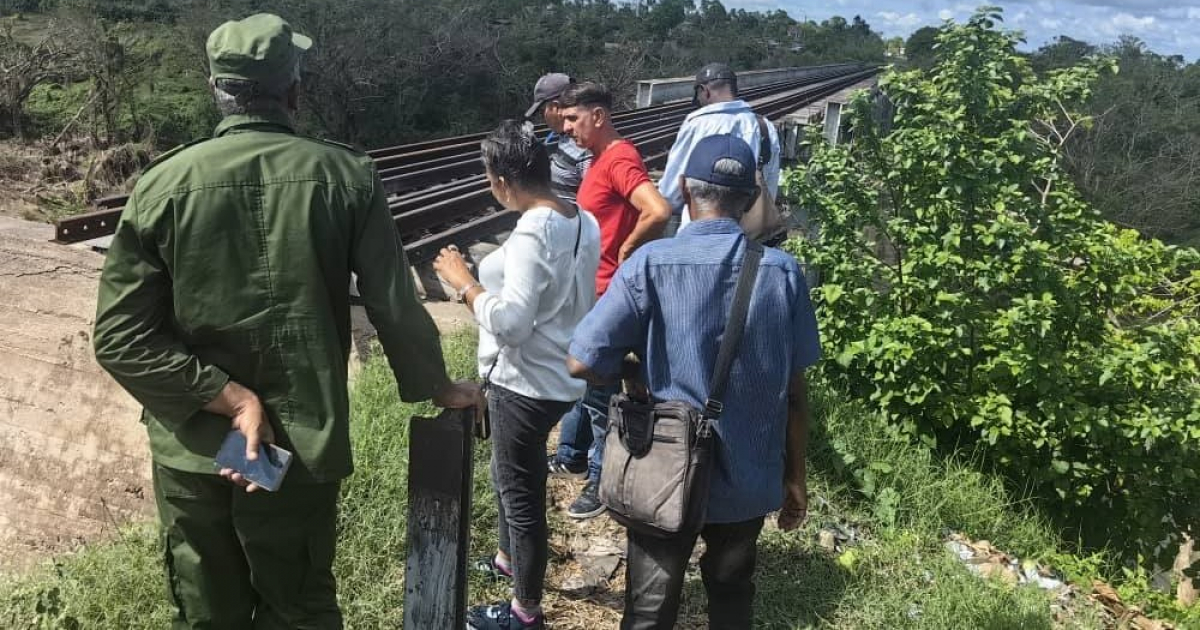
The reported damages from the hurricane include destroyed embankments, rails hanging over open ditches, and undermined bridges.
The images released by the minister in the previous weeks displayed complete sections of the railway in Santiago "in the air", as happened between kilometers 833 and 834.5, and the total collapse of the embankment at kilometer 205.8 in Palma Soriano.
At this moment, authorities confirm that the train stations are being prepared to receive trains soon, with a focus on the Senén Casas terminal in Santiago de Cuba, where services are provided for train passengers, as well as those of Ómnibus Nacionales and Vía Azul.
But the extent of accumulated damage—both prior to and following the cyclone—suggests that recovery will be slow and uneven.
Roads: announced works, persistent damages
In his update, the leader reported on a joint plan with the Ministry of Construction to restore roads of national and local significance, and affirmed that the program has "the necessary resources."
Among the planned actions is a second blasting in Babujal, Guamá, where the landslide from the mountain to the sea rendered the road completely impassable.
The maneuver aims to permanently move the coastal route to prevent extreme phenomena from repeatedly destroying it.
At the same time, the repair of an internal road in Palma Soriano was mentioned, with eight affected points, and its rehabilitation is crucial for transporting water, moving people, and ensuring the harvest.
The minister's own description of the work—dependent on stonework, leveling, and extensive manual effort—reveals the level of structural precariousness that existed even before the hurricane.
Although some urban and municipal routes remain active "where access is possible," the limitations continue to be severe.
The difficulties in movement not only impact essential services such as the transportation of hemodialysis patients but also general mobility in a region where many communities have remained partially isolated since the end of October.
On November 10th, technical assistance arrived from Venezuela, with specialists in bridges, roadways, civil works, and electrical services, as well as additional resources through the ALBA mechanism.
Ports and external aid: vital operations amid the emergency
The port sector has kept operating. Two ships were in the process of unloading: one with donations from Venezuela and another with 13,000 tons of rice. After the departure of the latter, the arrival of a ship with sugar is expected.
The ship would also return to its country to collect new supplies intended for road recovery and construction works.
Melissa: a devastating impact on an already weakened infrastructure
Hurricane Melissa made landfall on October 29 on the southern coast of Guamá, in Santiago de Cuba, classified as "extremely dangerous."
Its passage left almost the entire eastern region of the country without communication, with damage adding to a transportation system that was already suffering from deep deterioration before the event.
The consequences were immediate: the suspension of almost all national trains, devastated roads, collapsed railway sections, and entire towns without land connectivity. The population was left exposed for days, with no access routes or guaranteed basic services.
A month later, the situation remains critical.
Although the government insists that recovery is progressing and that there are resources to complete the work, the figures, visible damage, and the slow pace of restoration reveal a different reality: the country is confronting this emergency with infrastructure at its breaking point and insufficient response capacity.
The transportation crisis in Cuba did not begin with Melissa, but the hurricane starkly highlighted the true state of the system. Recovery will be long, expensive, and—given the complexity of the damages—far from being resolved within the timeframes announced by the authorities.
Filed under: