
Related videos:
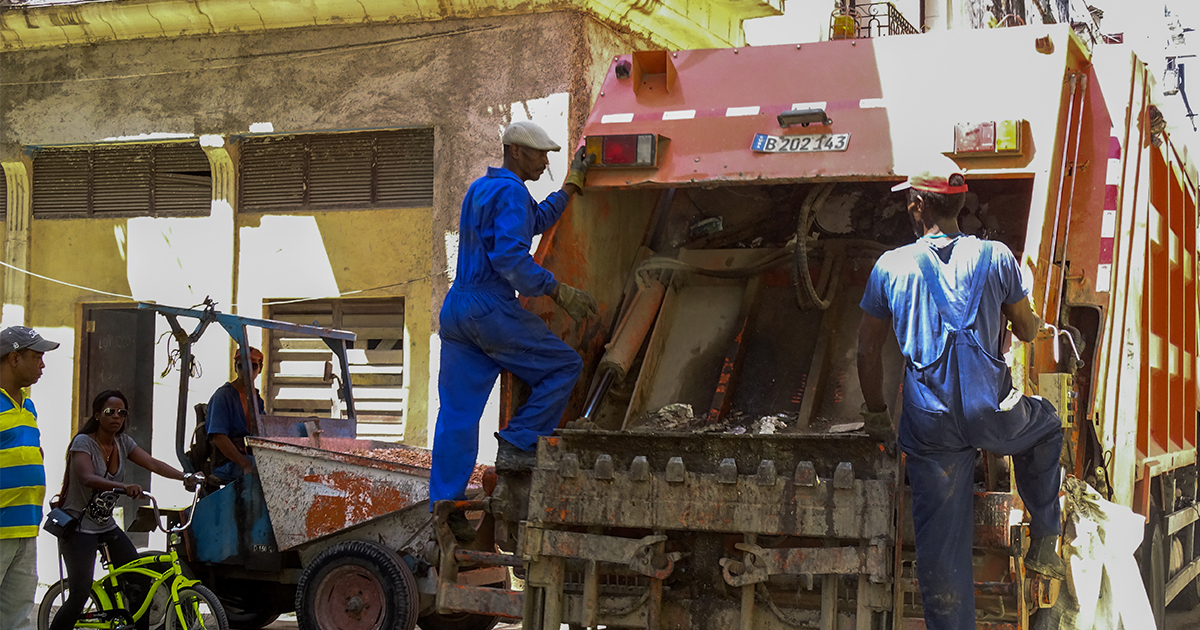
The Cuban regime acknowledged this week that it cannot ensure the cleanliness of Havana nor provide a decent salary for the street sweepers, amid the deep service crisis affecting the capital.
The admission occurred during a meeting led by Miguel Díaz-Canel and Prime Minister Manuel Marrero, where issues regarding garbage collection, water supply, and the epidemiological situation were discussed.
The report was published by the official newspaper Granma, which revealed that three of the most central municipalities in the city —Marianao, Centro Habana, and Plaza de la Revolución— do not meet the minimum standards of efficiency in waste collection.
According to Marrero, while in some areas trucks make up to five trips daily to the landfill, in others they barely reach two.
The justifications range from vehicle breakdowns and lack of fuel to staff shortages, all amid an epidemic of dengue and chikungunya that is putting the population at risk.
Marrero himself acknowledged that the nearly 900 street sweepers operating in the capital earn "low wages considering what they face," an unusual admission in a context where the regime avoids mentioning the effects of the economic collapse.
The prime minister's directive was to explore possible "exceptional" measures to improve compensation, although without committing to specific resources.
The government also admitted that it scarcely has the resources to work with. Out of the 126 garbage bins planned, the domestic industry has only been able to produce 31, and of the thousand promised carts for street cleaners, only 40 have been completed.
The governor of Havana, Yanet Hernández, noted that they are working "with the available resources," without offering timelines or structural solutions.
The official discourse again shifted the responsibility to the "organization of work" and local leaders, while avoiding mention of the lack of budget, corruption, or state inefficiency that have left the capital transformed into an open-air dump.
The images of garbage piled up in streets, avenues, and residential areas contrast sharply with the regime's rhetoric about "cleanliness as a strategic theme of the country."
The deterioration of sanitation services in Havana is not a new issue. The fuel shortage, the collapse of public transportation, and the massive loss of workers in the sector have turned waste collection into a chronic problem.
This is compounded by the precariousness of the staff, who lack protective equipment, basic tools, and adequate working conditions.
While the government acknowledges that it cannot pay or manage the work of those who keep the city minimally clean, the population continues to face an unhealthy environment, with the proliferation of mosquitoes, unpleasant odors, and the risk of diseases.
Failure in something as fundamental as public cleanliness has become another reflection of the collapse of the Cuban state system, unable to manage even the most basic services.
The Cuban regime has acknowledged its inability to ensure urban cleanliness in Havana, a situation that not only affects the city's aesthetics but also exacerbates health risks amid a crisis due to arboviruses.
The official acknowledgment that it cannot afford to pay street cleaners decently or produce basic equipment is compounded by inefficient management that has turned the streets into open-air dumps.
The government has admitted that it does not know how much garbage is piling up in Havana, which highlights the institutional disarray of a system unable to measure its own collapse.
The lack of updated statistics, planning, and resources has left many neighborhoods in a state of permanent unsanitary conditions, with direct consequences for the health of their residents.
In historical areas like Old Havana, the situation reaches absurd levels. Residents are forced to take their trash directly to the landfill due to the complete ineffectiveness of the waste collection service.
This improvised measure puts at risk the elderly, children, and vulnerable individuals who must navigate through rubble and waste to fulfill a task that falls to the state.
Filed under: