
Related videos:
The delivery of supposed social aid to an 86-year-old man in the San Luis municipality of Santiago de Cuba has sparked a wave of outrage among neighbors, family members, and social media users, highlighting once again the failed state assistance system and the humiliating treatment that individuals in extreme vulnerability receive.
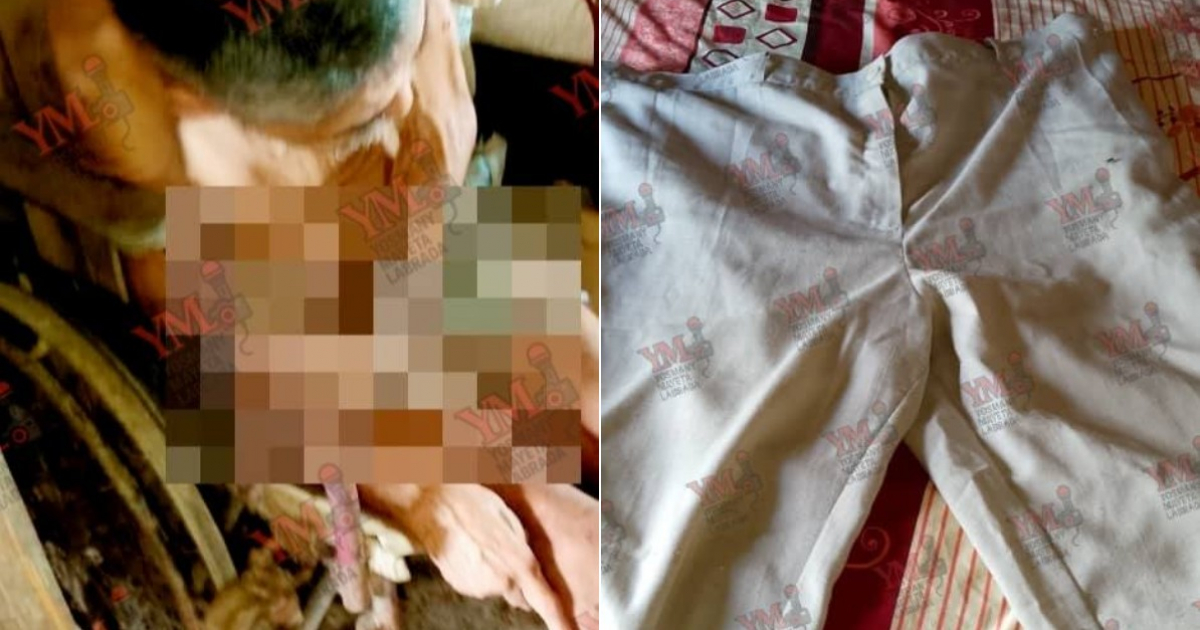
The case was reported by independent journalist Yosmany Mayeta Labrada, who informed that Roberto Flores Baños, a resident of the Leonor community in Dos Caminos de San Luis, received a "donation" arranged by a social worker that consisted solely of a worn-out jacket and an old pair of pants, both with visible stains and tears.
The circulated images show the extremely thin elderly man, barefoot, sitting in a worn wheelchair in a very impoverished home.
The complaint on Facebook adds that the social worker demanded the signing of four documents without explaining their content or allowing them to be read clearly.
Given that Flores Baños has physical limitations and relies entirely on others for his paperwork, family members are now asking: What was really being authorized? Why are four documents required to deliver two pieces of used clothing? What irregularities lie behind this procedure?
Cubans report that these types of practices have become common: aid that arrives incomplete, resources that are delivered in poor condition or that never reach those who truly need them, while social workers manage the processes with complete opacity.
Lack of sensitivity, audacity, and suspicions of theft
The comments on the post reflect a deep civic discontent.
Several residents in Santiago and other provinces condemned what happened as a disrespectful act towards human dignity, pointing out the complete lack of sensitivity towards the elderly.
A neighbor expressed that in her community "the social workers did the same," handing out used and damaged clothing. Another stated that the incident "should be punished."
There were those who questioned the inaction of local organizations.
"And what did the CDR and the FMC do?" asked a young woman, stressing that the documents should be reviewed to verify the authenticity of the delivery.
Other comments were even more emphatic, directly accusing social workers of appropriating aid intended for those in need.
"Surely they took the help from the gentleman and gave him those things," wrote a woman.
For everyone, this case is another example of a web of corruption that takes advantage of the most vulnerable population.
A problem that is not isolated
The episode occurs just weeks after another public accusation also originating from Santiago de Cuba.
At the end of November, a mother claimed that the food donations for vulnerable children and the elderly are not reaching their intended recipients, and that part of those resources ends up in the hands of officials and social workers.
The woman, Yurisleidis Remedios, reported that the food provisions were only being delivered to children aged 0 to 4 years, leaving older children without assistance, which she described as "child theft."
He emphasized that by excluding these minors, "the government is stealing food" from those who should also receive it, denouncing that while the people are suffering from hunger, "the tyranny and the structures of social assistance are profiting."
Remedios also recounted the case of a woman who was mobilized to distribute multipurpose pots and induction cookers to vulnerable families, who, according to her account, would have kept several of the items for herself.
The complaint even included questions about whether executives from Asistencia Social were aware of or benefiting from these irregularities.
A reality that repeats itself
The case of Roberto Flores Baños once again highlights the serious shortcomings in state care for the elderly.
What was meant to be assistance to alleviate poverty ended up revealing the profound decline of a system that, far from protecting its most vulnerable citizens, leaves them helpless, exposed to arbitrary procedures, corruption, and a daily indignity that has become normalized.
Meanwhile, the elderly man continues to live in extreme conditions, with no institution having publicly responded to what happened or clarified the real fate of the donations intended for the vulnerable.
Filed under: