
Related videos:
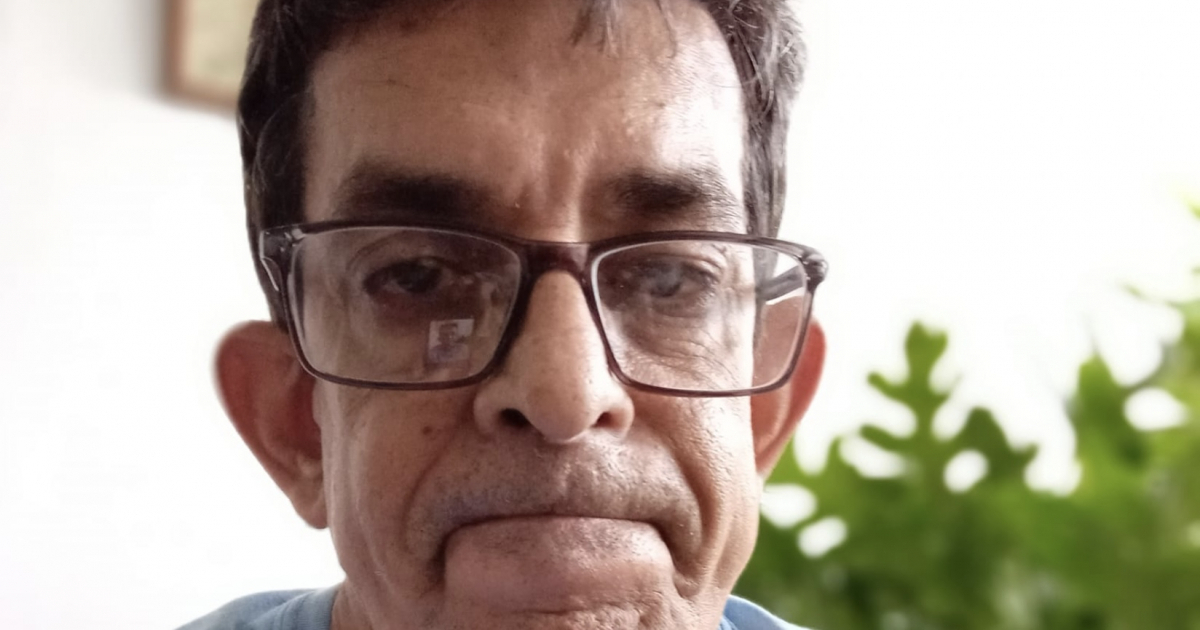
The comedian Ulises Toirac has once again stirred up social media with a direct, uncomfortable, and deeply critical reflection on the donation of 4.5 million dollars from Qatar to rehabilitate part of the National Electro-Energy System in Havana, Artemisa, and Mayabeque.
His message, published on Facebook, dismantles the official celebrations and illustrates, with a simple and powerful metaphor, the root of the problem: the SEN is not "broken by a little hole," but "so messed up that it only works when tied up with rope."
Toirac begins by recognizing the importance of assistance—“4.5 million aren't just lying around on the street”—and expresses gratitude for the Qatari contribution, which he assures reflects "the sentiment of many."
But from there, his analysis turns into a stark portrait of decades of wear and tear, improvisations, and stopgap measures applied by the Cuban government to the electrical system.
With a domestic comparison—a pair of shoes that break and instead of being properly repaired are glued, sewn, and finally tied with rope until they become unusable—the actor describes a cycle of negligence that has brought the SEN to a point of irreversible collapse.
"The shoes have settled, man," he declared. "That's how it goes with the SEN. Not even with a rope around it anymore."
The actor emphasizes that, being an electro-energy system infinitely more complex than a pair of shoes, the solution requires a substantial amount of money, a comprehensive plan lasting over seven years, and strong political will, none of which has been present.
"But focus and make it happen, because without electricity, there is no country. It's a must," he emphasized.
For Toirac, the 4.5 million from Qatar is barely equivalent to "the shoemaker for the first little hole," at a time when one needs to roll up the whole shoe.
And he ends by asking the government to be less enthusiastic: "Have the party you want. Be happy… You don't have shoes, did you hear?".
Qatar's donation: another international lifeline for a collapsed system
The Qatari grant -administered by the United Nations Development Programme (UNDP)- was introduced as part of a humanitarian initiative to restore essential services in areas affected by a hurricane in the western part of the country.
The project, as announced by the Qatar Fund for Development, would benefit over 2.2 million people.
However, this assistance once again reveals a familiar dynamic: the Cuban regime's dependence on international funds to sustain deteriorating state infrastructures, without generating long-term solutions or structural transformations.
The resources, although managed by multilateral organizations, ultimately reinforce a state apparatus incapable of independently maintaining the electrical grid, healthcare services, or production chains.
Meanwhile, the population continues to face daily power outages, hospitals without resources, and an energy system on the brink of collapse.
A recurring pattern
The Qatari donation adds to other recent aid, such as the rations delivered by the World Food Programme, distributed under complete government control and without independent oversight mechanisms.
For many critics, these new financial injections act as a temporary palliative that allows the State to justify its inaction, postpone inevitable reforms, and continue managing the crisis as if it were just a passing circumstance.
In that context, Toirac's voice stands out because it breaks away from the official rhetoric of "gratitude" and addresses the issue that no one in power wants to acknowledge: it's not just a lack of money; there is a lack of a real project.
And while that project does not exist, each foreign donation will be just another patch on a system that can no longer be held together, even by a rope.
Filed under: