
Related videos:
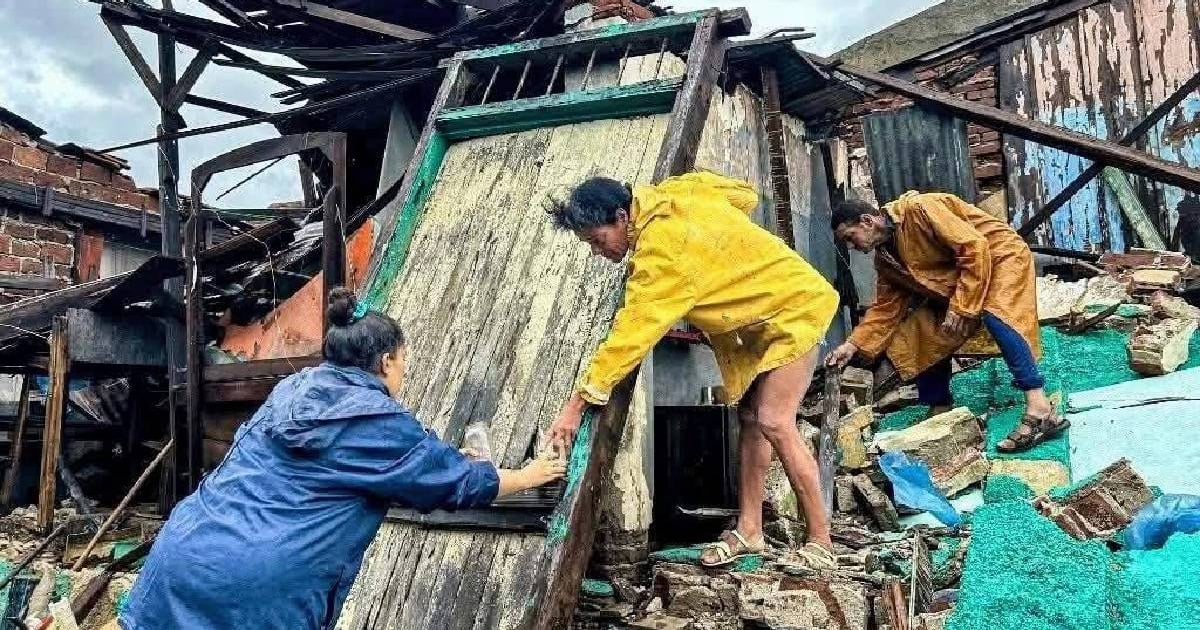
Thirteen years after Hurricane Sandy, Santiago de Cuba is facing an aggravated housing crisis, as the 6,000 pending cases since 2012 have been added to by more than 137,000 homes damaged after Melissa passed through at the end of October, in a scenario of slow processing and insufficient resources.
Hundreds of thousands of residents of Santiago are engaged in what is now commonly known as “the Melissa procedures,” a process that includes damage assessment, certification of impacts, and the distribution of construction materials to the occupants of more than 137,000 homes affected by the hurricane, acknowledged the official newspaper Sierra Maestra.
Reactions to the disaster vary widely and are shaped both by the magnitude of the losses and by previous experience.
According to data from the Provincial Defense Council, of the 137,554 preliminary affected homes, nearly 90,000 have already been visited by the commissions established in the 127 Defense Zones, although there are still significant delays in municipalities such as Santiago de Cuba, Palma Soriano, and Contramaestre, where the housing stock was severely impacted.
The authorities acknowledge that the eastern province was the most affected by the cyclone, with more than 22,000 total collapses and over 66,000 partial roof damages.
Although more than 114,000 tiles have been distributed, mostly intended for housing, only about 5,000 families have received the necessary resources so far, a minimal figure compared to the scale of the disaster.
The process includes donated materials and other means of acquisition through cash payments, bank credits, or bonuses that can reach up to 99%, with a state subsidy of 50% of the price.
However, the accumulation of processes, the lack of electricity at sales points, the shortage of staff, and the scarcity of supplies such as cement and steel are slowing down a recovery that has been announced as a priority, but is progressing slowly, the media outlet admitted.
This crisis adds to the 6,000 pending cases since Hurricane Sandy, which have now been added to the total number of those affected by Melissa with formal priority, although for many families, that priority remains a promise delayed for over a decade.
It is not easy to see your home destroyed; it reaches into the depths of your being, shared Orlando Orive Silva, whose house had already suffered severe damage during Sandy's passage in 2012.
Others, like the young Obed Estrada Núñez, tried to recover part of their roofs with the help of neighbors, while older individuals, like María Ramos Ferrer, are still waiting for the visit of the committees responsible for evaluating and channeling the delivery of resources.
The management of damage is not without tensions and contradictions. Maricel Cabrales Toro, a resident of Los Negros in Contramaestre, recounted that her house suffered a total collapse, one of the hardest blows of her life.
Although he acknowledged the initial attention from the Office of Procedures, he expressed his disappointment with the performance of the technicians responsible for certifying the damages, whom he accused of lacking sensitivity and failing to provide clear explanations during the inspection.
According to what he explained, during the visit he was informed that, due to a lack of available resources for classifying a total collapse, the technical report would not be filed at that moment.
Later, upon visiting the relevant office, he was asked to sign a document in which his case was recorded as “total roof collapse,” a category that, he claims, does not reflect the reality: “there was nothing left of our house, just the floor”.
The episode illustrates the cracks in the administrative process, where the shortage of resources ultimately redefines the damage on paper, even when the material loss is absolute.
While the Government insists on reorganizing labor and on alternative solutions such as type IV housing, adaptation of premises, or residential containers, the reality in the neighborhoods is a blend of waiting, weariness, and distrust.
For thousands of residents of Santiago, the emergency did not begin with Melissa nor did it end with Sandy; it is a permanent state that exposes the chronic deterioration of the housing stock and the structural inability to prevent the next catastrophe.
Filed under: