
Related videos:
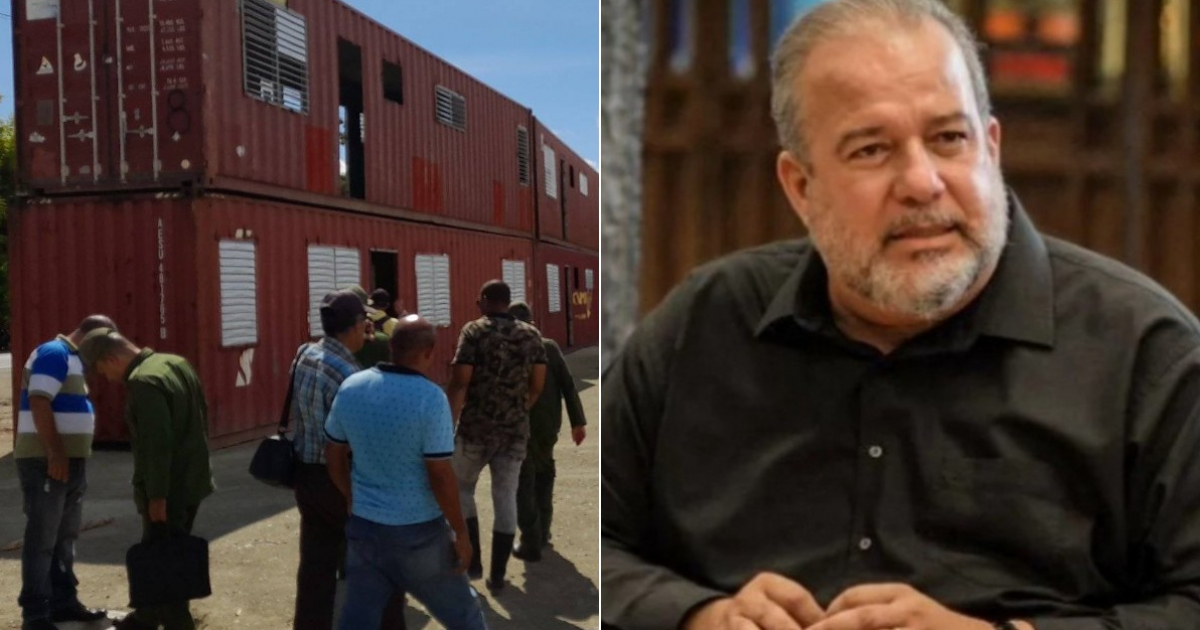
The Cuban government is once again presenting the conversion of shipping containers as a response to the housing crisis that is suffocating the country.
This time, the call comes directly from the Prime Minister Manuel Marrero Cruz, who urged to promote and accelerate this modality in the province of Granma, according to the newspaper Granma.
The announcement comes as thousands of families continue to live among landslides, overcrowding, and temporary shelters that have become permanent, while authorities persist in relying on emergency solutions that do not address the structural root of the problem.
The eastern province joins the state program to convert shipping containers into homes as part of the strategy from the Ministry of Construction (Micons) to address the housing shortage.
In Jiguaní, five housing units have been established using containers, designed with a living room, dining-kitchen area, bathroom, and two bedrooms.
The Granma Construction and Assembly Company assured that each module will have main and service entrances and that they will be assigned to families considered "priority": those affected by hurricanes, mothers with three or more children, and workers from "essential" sectors.
The authorities defended the so-called "cargotectura" as a "quick" and "sustainable" solution, arguing that these metal structures—designed for extreme conditions—allow for reduced construction times compared to traditional methods and fit within a circular economy approach.
They also emphasized that technical quality will be key to ensuring "comfort," although they did not specify standards, control mechanisms, or actual delivery timelines.
Marrero himself requested to use all available containers to expedite the plan, in a context where demand far exceeds state capacity.
However, the announcement comes at a time of national expansion of a policy that has already sparked opposition in several provinces.
The government insists that containers are an "immediate alternative," despite the fact that, in the Cuban climate, these structures become extremely hot spaces and require a level of thermal insulation that the authorities do not guarantee.
The measure adds to the improvised race already underway in Santiago de Cuba, where the collapse of more than 137,000 homes - exacerbated by the passage of Hurricane Melissa - has forced the government to accelerate the conversion of containers into "emergency housing".
During a government visit led by Miguel Díaz-Canel on December 5, officials acknowledged that demand exceeds any installed capacity and that critical cases are on the rise. Nonetheless, they refrained from providing specific goals or timelines regarding how many modules will be enabled or when the actual crisis might be alleviated.
Recent episodes demonstrate the growing citizen rejection.
An article from the newspaper Ahora, in Holguín, which described these structures as "safe, resilient, and dignified housing," sparked a wave of criticism: from mothers who claimed that "it's like cooking someone alive" to engineers who warned that, without insulation or anchoring, they are "solar ovens" vulnerable to hurricanes and floods.
Users also recalled that, although in other countries there are homes made from containers, these adhere to strict insulation and climate control standards that are not even mentioned in Cuba.
The Government admitted weeks ago the failure of the national housing program using containers, despite having released more than 1,700 units for this purpose and that the work is progressing at an extremely slow pace.
Even with that recognition, he continues to insist on expanding the same formula.
Meanwhile, the housing crisis continues to deepen, and thousands of families are still waiting for real solutions.
In light of this situation, the official commitment to convert containers into permanent homes not only highlights the lack of a structured and sustainable plan but also perpetuates a cycle of makeshift responses that fail to address the deterioration accumulated over decades.
Filed under: