
Related videos:
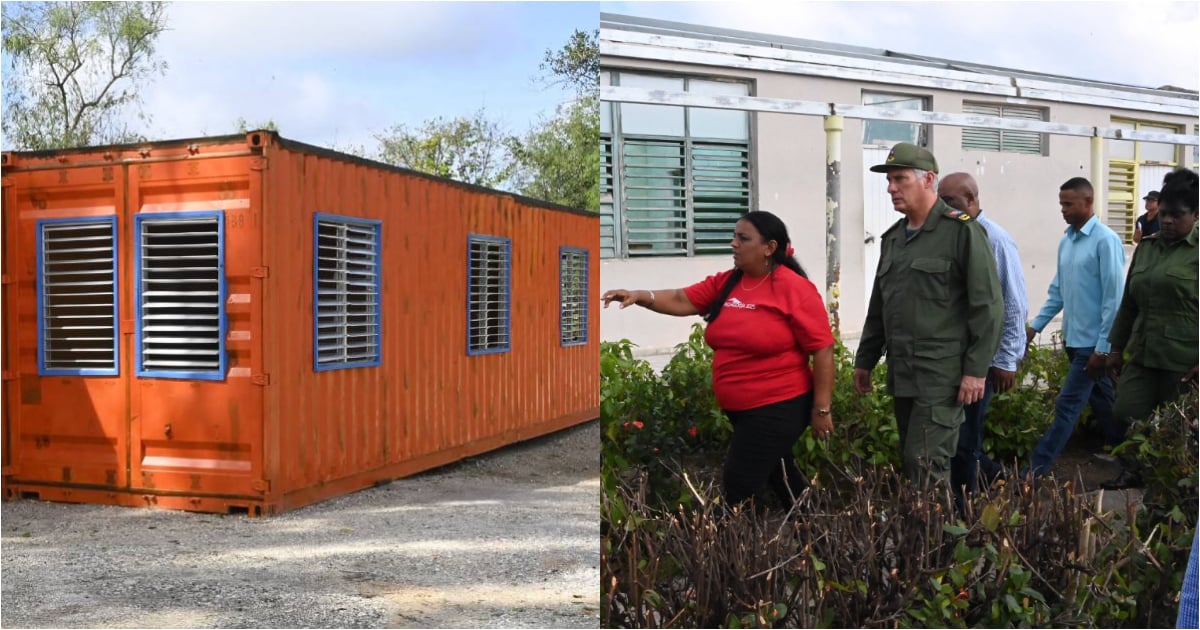
Authorities in Santiago de Cuba have confirmed that they will expedite the conversion of shipping containers into temporary housing in response to the worsening housing crisis that keeps thousands of families at risk, especially after the passage of Hurricane Melissa.
The decision emerged during the most recent government visit led by Miguel Díaz-Canel, on December 5, a tour that highlighted the extent of the structural deterioration in the province and amplified complaints about collapses, leaks, and overcrowding.
“In the case of housing, with more than 137,000 affected homes, the conversion of containers into houses becomes a priority, particularly for the municipalities of Segundo Frente and Santiago de Cuba, where there are still people in shelters,” reported the official newspaper Granma.
Local officials acknowledged that the demand exceeds any installed capacity and that critical cases continue to rise, especially in neighborhoods that have experienced accumulated challenges for decades.
In this context, the provincial administration advocated for the use of containers as a "quick solution," although it did not specify how many units could be made available or under what criteria they would be assigned.
The authorities insisted that these modules would shorten timelines, but they refrained from committing to specific goals regarding deliveries or the rehabilitation of the existing housing stock.
Amid slogans and calls for unity, Díaz-Canel insisted on working with existing resources and not neglecting the environment, while provincial authorities outlined partial progress in electricity, telecommunications, and access roads.
The water supply still affects about 20,000 people and several systems remain damaged.
Although the official narrative emphasizes the idea of resistance and recovery, the data presented reveals a harsher reality: vast areas continue to lack stable services and the reconstruction of homes will rely on emerging solutions like containers, a clear indicator of the extent of the damage that Melissa left in the eastern province.
It is noteworthy that on December 5th itself, Díaz-Canel celebrated Builder's Day in Cuba, with a message on X where he called for building, rebuilding, and beautifying the homeland, which he described as having been mercilessly battered for six decades.
Far from acknowledging the government's responsibility for the marked deterioration of the urban landscape in Cuba and the increase of extreme poverty in the country, the leader preferred to blame the external enemy, once again.
The government has maintained a triumphant discourse, presenting containers as a quick and innovative alternative to address the severe housing deficit on the island, as well as a housing solution to cope with the damages caused by Melissa.
However, such a solution has faced rejection and criticism from the population because, in the Cuban climate, they are deemed inadequate and uninhabitable without proper thermal insulation, turning into solar ovens.
Moreover, the lack of adequate infrastructure and the insecurity posed by extreme weather events reinforce criticisms of these metal structures.
The Government admitted weeks ago the slow progress of adapting those structures as housing, despite having released more than 1,700 containers.
Filed under: