
Related videos:
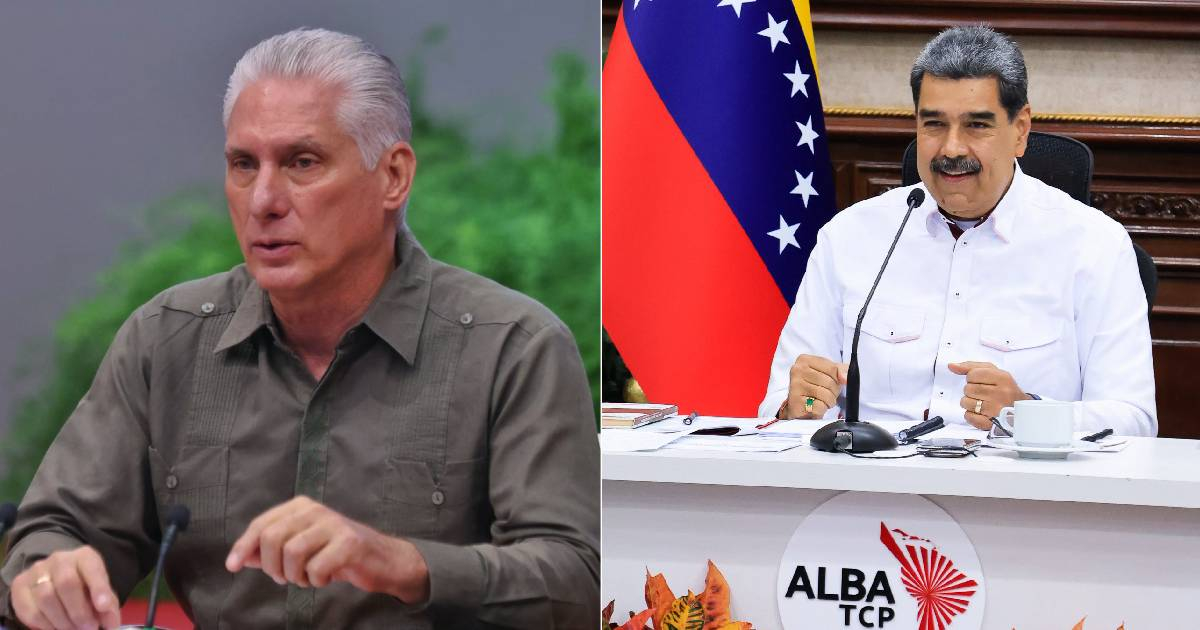
The Cuban ruler Miguel Díaz-Canel called for unity among Caribbean countries and the Bolivarian Alliance for the Peoples of Our America (ALBA) to confront what he termed a “hegemonic ambition” of the United States against Venezuela.
During his video conference speech at the XXV ALBA Summit, Díaz-Canel urged the governments of the bloc to "continue fighting for a common goal: the unity, peace, and sovereignty of our peoples," and warned about the current context of tensions in the region.
According to his statement, the Caribbean must remain vigilant in the face of what he described as a dangerous escalation driven from Washington, reported the agency EFE.
Criticism of the U.S. military deployment in the Caribbean
The Cuban leader condemned the naval deployment of the United States in the Caribbean, calling it “ostentatious, exaggerated, and unjustified,” and stated that it represents a “deliberate military threat” against Venezuela. In his view, this scenario reveals a “hegemonic and criminal purpose” that should alert the governments and peoples of the continent.
"It is a danger that must be denounced in the most resolute manner. From Cuba today, at this ALBA summit, we condemn it in the strongest and most categorical terms," emphasized in statements reported by the official website of the regime.
Report on the seizure of an oil tanker
Díaz-Canel also referred to the recent seizure of an oil tanker by U.S. forces, an action he described as "an act of piracy and theft of the resources of the Venezuelan people" and a serious violation of international law.
According to the Cuban leader, the measure contravenes the principles of freedom of navigation and free trade, and it not only harms Venezuela but also has negative implications for the international community as a whole.
Explicit backing for Maduro and a call for "united resistance."
In line with the statements of Venezuelan president Nicolás Maduro, who proposed a "united resistance" against the United States, Díaz-Canel reiterated Cuba's "strongest support" for Venezuela and its leader.
The statements come against a backdrop of rising geopolitical tension in the Caribbean, marked by U.S. military operations, sanctions, vessel seizures, and an increasingly confrontational rhetoric between Washington and the allied governments of Caracas.
Maduro proposes an "energy mission" to support Díaz-Canel's regime amid the electrical collapse in Cuba
Maduro proposed to the Bolivarian Alliance of the Peoples of Our America (ALBA) to create an international energy and electricity mission to rescue Cuba – and its dictatorship – which is going through one of the worst energy crises in its recent history due to constant breakdowns in its thermal power plants and a lack of fuel.
According to the agency EFE, the Venezuelan dictator announced the initiative during the XXV Summit of the bloc, broadcast by the state channel Venezolana de Televisión, where he stated he had communicated to the member countries the proposal to create an “International Energy and Electricity Support Mission for the People of Cuba,” inspired —he said— by the former Miracle Mission.
He assured that the goal would be to support the island "extraordinarily" in its struggle "against the blockade and the impact on all matters related to energy and electricity," without providing specific details about the type of assistance or the resources involved.
The Cuban Foreign Minister, Bruno Rodríguez, immediately supported the proposal, calling it a demonstration of "solidarity and cooperation among brotherly nations" on platform X, highlighting ALBA's role as a mechanism of resistance against the United States.
Cuba is facing blackouts of up to 20 hours a day in various regions of the country due to the obsolescence of its generating plants, the shortage of foreign currency, and lack of maintenance.
According to EFE, independent specialists attribute the crisis to poor state management and decades of structural underinvestment in the national electrical system, which has been fully controlled by the Government since 1959.
The regime of Miguel Díaz-Canel, for its part, blames U.S. sanctions and Washington's "energy blockade," as protests over power outages and food shortages multiply in several provinces.
Maduro's proposal aims to strengthen the political and economic alliance between Caracas and Havana at a time when both governments are facing internal and external pressures, attempting to showcase regional cohesion against what they perceive as an "imperial threat."
Filed under: