
Related videos:
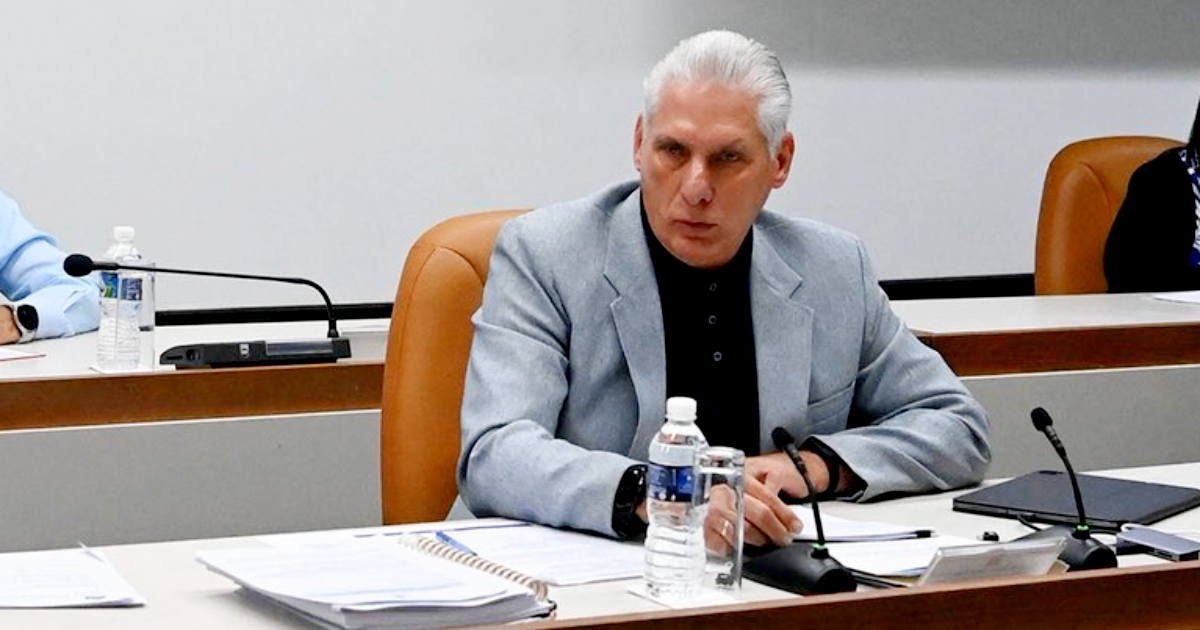
During his speech at the XI Plenary of the Communist Party, Miguel Díaz-Canel emphasized that “correcting distortions and reinvigorating the economy is not just a slogan, it is a concrete battle for the stability of everyday life.”
He acknowledged a drop in the Gross Domestic Product exceeding 4%, rampant inflation, and a crisis-stricken energy system. However, his solution was the same as always: more control, more centralization, and more rhetoric about the “socialist state enterprise” as the engine of development.
The leader described a country that is functioning on the brink of collapse, but without questioning the model that produced it. According to his speech, the solution lies in combining “economic rigor with social justice,” something that, as he stated, “can only be guaranteed by the socialist Revolution.”
The proposal seems like a joke that, when faced with reality, reveals itself to be in very poor taste: the so-called "socialist revolution" that is presented as a guarantor of justice is the same one that has created the highest inequality in the recent history of the country.
The Cuban paradox is evident. The regime proclaims a defense of equity while consolidating a two-speed system: those who have access to foreign currency —through tourism, remittances, or the informal market— and those who survive on a salary in devalued pesos.
The former can buy food in MLC or acquire basic products; the latter depend on rationing and the black market. The discourse on social justice sounds hollow in an economy that has institutionalized exclusion.
Díaz-Canel spoke about "making a leap in the management of state-owned enterprises" and "enhancing efficiency," but he avoided mentioning the factors that hinder that leap: the lack of autonomy, political interference, and administrative corruption.
The Cuban state-owned enterprise does not respond to market logic or that of public good, but to that of ideological control. Executives are appointed based on political loyalty, not management merits; goals are set from above and adjusted according to political convenience; losses are socialized, but profits are distributed opaquely.
In theory, the designated ruler advocates for a "controlled autonomy" for MIPYMES and non-agricultural cooperatives. In practice, these entities survive under a system of permits, licenses, and restrictions that limit any real growth.
The State fears that a successful private sector will undermine the Party's economic monopoly, which is why it regulates its expansion based on political rather than economic criteria. Thus, each attempt at reform becomes an act of institutional self-censorship.
The insistence on maintaining the prominence of the state enterprise also has an ideological dimension. Admitting that the State is inefficient would equate to acknowledging the failure of the revolutionary narrative, according to which Cuban socialism is morally superior to capitalism.
Therefore, instead of accepting the collapse of the centralized model, the regime's discourse chooses a leap forward: promising changes without changing anything.
Even when Dr. Díaz-Canel speaks of "innovation," the economic environment continues to be characterized by scarcity, bureaucracy, and distrust towards private initiative. Entrepreneurs are tolerated as long as they don't grow too much, farmers remain without resources, and exports are hindered by a lack of incentives and state mediation. In this context, discussing efficiency is little more than rhetorical.
The Cuban regime is facing a structural crisis that cannot be resolved with slogans or "correction plans." What the country's economy needs is not a technical adjustment, but a political liberation. Without effective private property, without real competition, without institutional transparency, and without the rule of law, efficiency is impossible.
Díaz-Canel called to "organize the accounts, tackle inflation, and protect the most vulnerable." However, these tasks cannot be carried out from a model that denies autonomy and punishes productivity. What the leader of "continuity" refers to as the "battle for stability" is, in fact, a war against the evidence: the Cuban socialism, as it is conceived, does not work.
What Díaz-Canel said was, in summary, that the so-called "revolution" will resolve the crisis. What Cubans heard, however, is that they will remain in despair.
Because, as long as power continues to confuse control with stability, the economy will keep plummeting, and Cubans, seeking creative ways to resist against a despotic power, with the increasingly clear goal of paving the way for genuine change that empowers them.
Filed under: