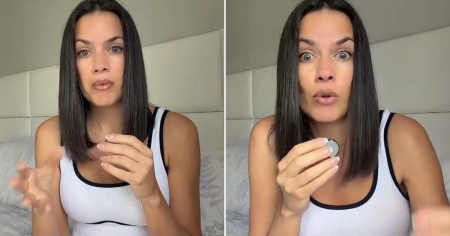
A Cuban mother in Madrid, identified on TikTok as Yexela González, shared on social media what she considers the most difficult moment she has experienced since emigrating to Spain with her husband and two children.
"This is a question I was just asked privately, and I thought I would take the opportunity to respond publicly," explained @yexelagonzlez in the video. "Upon our arrival in Madrid, nine months ago, one of the first actions we took was to ensure our children were enrolled in school. It hadn't even been two weeks, and our children were already attending their school."
She recounted that the incident occurred during her oldest son's first birthday party, when he was seven years old. "My husband went to the party, and while he was there, I called him to ask how everything was going. He told me: 'It's really difficult, the kids don't want to play with him, and he's basically following all the other kids around, and he's really very affected by it,'" she said.
The mother indicated that the call remained open and that she heard the child's voice saying, "I don't want to play with you, look at me, pay attention to me."
"I cried a river that day because I realized it was going to be a difficult process and because we didn't have the tools or could not save him from that situation," he added. "We had to wait for time to pass and for him to find his way."
González clarified that he did not believe the other children were acting with malice. “Not because his classmates were doing it on purpose, but simply because it was already an established group and he was new,” he explained. He also talked about the cultural contrast between Cuban and Spanish education: “A Cuban child has a culture because their parents behave in a way that is not the same as Spanish parents. And suddenly, we put them on a plane and place them in a different school, with other children, with another culture… and it’s difficult.”
According to him, over the months his son has started to integrate better. “He has a better relationship, a better friend, who is also an immigrant boy, Paraguayan, from a culture similar to his. We continue to face challenges. There are better days and not so great days,” he stated.
"Rejection causes a lot of harm."
Yexela's testimony sparked a wide response among Cuban and Latin American mothers who shared similar experiences. "Our situation as emigrants is hard; I went through so much, especially with my eldest who arrived at 14," wrote one user. Another woman added, "My heart, you have no idea how I have suffered with my little girl since she was young. She's now 16, and the journey is still difficult."
Among the responses, a mother explained that her daughter receives psychological support because “rejection causes great harm to these children who do not understand anything about xenophobia. Children hear it at home. This is something that does not exist for a Cuban child. We teach them to love all children equally. That’s what I miss about Cuba, our social equality.”
Several people expressed their shared pain in seeing their children go through the same experience. "You cried that day, and here I am with watery eyes listening to you, just imagining that scene with the child. Keep going, everything will be alright," wrote a mother. Another commented, "Madrid is very tough, even for adults. Everything operates through closed groups." There were also those who highlighted the strength of the younger generation: "Children are the true heroes of emigration. Despite everything being done for their future, they are the bravest in this process."
Other women shared nearly identical testimonies: “I arrived with my two children, ages 9 and 13. We've been here for 3 years, and I still cry. My son would just stand there staring at the landscape… I'm struggling with my daughter; she has only one friend because many kids here are cruel,” one woman said. Another recounted: “I went through the same thing with my daughter when we got here two years ago. My daughter would come home crying, and she was 10 years old. It was a very tough time. I cried in secret from her.”
"Every age has its challenges."
The Cuban mother responded with empathy to those who left her messages. To a follower who expressed her fear for teenagers, she replied: “That is another fear. There are things here that have nothing to do with our culture. I see teenagers and it terrifies me.”
To another woman who shared that her daughter needed psychological help, she wrote: "You are doing the right thing by seeking help and staying by her side. Don't stop telling her how beautiful, valuable, and intelligent she is."
She also offered words of encouragement to other mothers: “Each age has its challenges… in the end, they are not from here, even if they adapt,” and in another message she added: “All beginnings are tough; you need to have confidence and strength.”
A story of emigration told step by step
The experience of Yexela is part of a series of publications where she has been recounting her life as a Cuban mother in Spain. In one of her most shared videos, she explained the reasons that led her to leave the island: “I was happy in Cuba. I had my home, my business, my husband, friends, love… but when I became a mother, I realized that I had to leave my country,” she said. In that same post, she affirmed that “there are dreams that I will never be able to fulfill for my children in Cuba” and that “I don’t want to be a grandmother imprisoned in Cuba. I want to be just a plane ticket away from my children’s home,” as she recounted in a previous testimony shared on TikTok.
Months later, when her children started the school year in Madrid, she released another video in which she compared her current life to what she left behind in Cuba. “Since becoming a mother, this will be the first time I don’t have to save for several months to buy them a pair of shoes,” she said. She added that it was also “the first time I don’t worry about whether the food at school will be bad and insufficient” and that “things as simple as school snacks are a challenge for a Cuban parent; mundane things like providing a decent pair of shoes and some white socks are almost a utopia,” as she expressed in another message posted on social media.
Like many Cuban mothers, Yexela has learned that emigrating is not just about changing countries, but about rebuilding a new life with love and patience.
Filed under: