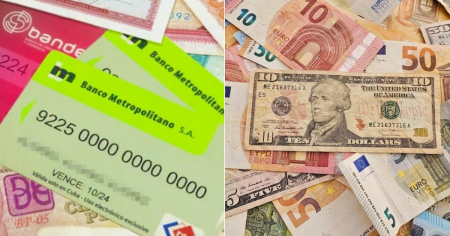
The informal currency market in Cuba wakes up on this December 21 with a new development: The price of the Freely Convertible Currency (MLC) skyrockets.
Early this Sunday, the digital currency used by the Cuban regime has risen from 310 to 320 CUP, representing a ten peso increase compared to its value from the previous day.
Currently, the MLC is the only currency in Cuba that has reacted in the informal market to the introduction of the "floating" official exchange rate on December 18, which promised stability for the Convertible Currency and aimed to dispel predictions of its potential disappearance.
In the case of the dollar and the euro, there are no changes today: the US currency remains valued at 440 CUP and the European currency at 480 CUP, according to the daily report from the independent outlet elTOQUE, which documents the fluctuations in currency prices in Cuba.
Exchange Rate Evolution
For the fourth consecutive day, the dollar and the euro remain stable in the Cuban informal market.
At the moment, the so-called "floating rate" of the Cuban government has not succeeded in influencing the parallel market for the two most important currencies operating on the island.
According to the independent outlet elTOQUE, the dollar and euro have maintained similar values for several days, reflecting stability despite the government announcement.
Exchange rate today 12/21/2025 - 6:51 a.m. in Cuba:
Exchange rate of the dollar USD to CUP according to elTOQUE: 440 CUP.
Exchange rate of the euro EUR to CUP according to elTOQUE: 480 CUP.
Exchange rate of MLC to CUP according to elTOQUE: 320 CUP.
Equivalence of United States Dollar (USD) to Cuban Peso (CUP), according to the exchange rates of December 21:
1 USD = 440 CUP.
5 USD = 2,200 CUP.
10 USD = 4,400 CUP.
20 USD = 8,800 CUP.
50 USD = 22,000 CUP.
100 USD = 44,000 CUP.
Equivalence of Euro (EUR) banknotes to Cuban Peso (CUP):
1 EUR = 480 CUP.
5 EUR = 2,400 CUP.
10 EUR = 4,800 CUP.
20 EUR = 9,600 CUP.
50 EUR = 24,000 CUP.
100 EUR = 48,000 CUP.
200 EUR = 96,000 CUP.
500 EUR = 240,000 CUP.
Floating rate in effect
Since last Thursday, Cuba has introduced a new currency exchange system. The Central Bank activated a floating rate for individuals and private entities as part of a gradual reform aimed at reducing informality and reorganizing the flow of foreign currency.
Individuals can sell currencies at the new official rate and purchase up to 100 USD through digital appointments. The supply remains limited: only what is collected through legal means (remittances, exports, etc.) is sold.
Self-employed workers and SMEs can acquire foreign currency from fiscal accounts, up to 50% of their quarterly gross income, without the need to resort to the informal market.
The new system is structured into three segments:
Segment I (1x24 CUP): essential state operations.
Segment II (1x120 CUP): companies with external income.
Segment III (floating rate): for individuals and small and medium enterprises, published daily by the BCC.
As of the closing of this note, the value of the official floating exchange rate for this Sunday has not been disclosed.
Reform or resignation?
The introduction of the floating rate effectively represents a validation of the informal market, which for years has determined the true value of the Cuban peso.
The redesign does not replace the lack of confidence in the state financial system. Without transparency, liquidity, and structural reforms, this measure risks being just another band-aid on a model that has lost credibility.
The regime's Macroeconomic Stabilization Program aims to move toward an eventual currency unification, but it faces skepticism due to a lack of transparency and cash shortages.
With an average salary equivalent to 16 dollars per month at the official exchange rate, Cubans continue to rely on the informal market to access foreign currency and basic goods.
The implementation of the floating rate, rather than an attempt at control, seems to be an implicit validation of the informal market, which for years has reflected the true value of the Cuban peso.
Without structural reforms or liquidity guarantees, the measure could become another band-aid within an exhausted economic model disconnected from the everyday reality of the country.
Filed under: