The informal currency market in Cuba started the week with a new shake-up: the Convertible Currency (MLC) surged to 350 Cuban pesos (CUP), setting a historical record and confirming its role as a barometer of the economic crisis.
Meanwhile, the US dollar (USD) and the euro (EUR) remained unchanged at 440 and 480 CUP, respectively.
The rise of the MLC reflects widespread distrust in the government’s monetary policy and the lack of real access to cash foreign currency, despite the implementation of the new official floating exchange rate scheme announced by the Central Bank of Cuba (BCC) on December 18.
Informal exchange rate in Cuba Monday, December 22, 2025 - 06:00
Exchange Rate Evolution
- Exchange rate of the dollar (USD) to Cuban pesos CUP: 440 CUP
- Exchange rate of the euro (EUR) to Cuban pesos CUP: 480 CUP
- Exchange rate from (MLC) to Cuban pesos CUP: 350 CUP
The increase in the digital currency used in state-run stores for foreign currency comes amid a persistent cash shortage, soaring inflation, and the uncertainty generated by the new exchange system.
Although the BCC introduced the floating rate as a reform "to reflect the real conditions of the market," the measure has not had a tangible impact on the population.
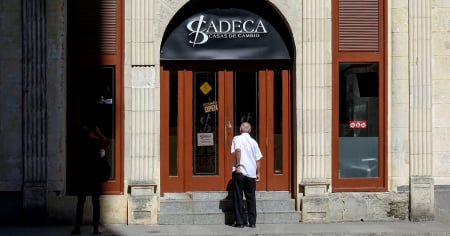
The restrictions on purchasing foreign currency at banks and CADECA, combined with the low availability of dollars and euros, have shifted demand towards the MLC, which is now trading higher than ever.
Official rate as of December 21 (CADECA)
According to state exchange houses, the selling rates this Sunday were as follows: 1 USD = 432.48 CUP; 1 EUR = 506.52 CUP.
These figures confirm that the new "floating rate" scheme does not truly compete with the informal market but rather imitates and legitimizes it.
After years of denying the existence of the black market, the Cuban regime now publishes values that are close to those of the independent observatory elTOQUE, without addressing the underlying issue: the lack of liquidity.
Distrust, inflation, and speculation
Every time the government of Miguel Díaz-Canel announces a new economic measure —such as the monetary reform or the floating exchange rate— the informal market reacts by anticipating a devaluation of the Cuban peso.
Currency exchangers, micro-entrepreneurs, and citizens who hold foreign currency prefer to retain it, anticipating a price increase.
This speculation, combined with panic over inflation and cash shortages, drives the value of the MLC up faster than other currencies, making it the most sensitive barometer of economic distrust.
On social media, the release of the official rates has sparked a wave of criticism and sarcasm. "So much criticism of the Toque to end up the same," wrote a user in reference to the independent portal that has been setting the benchmarks for the informal market for years.
Others claimed that “they publish figures, but no one can buy,” referring to the practical impossibility of accessing foreign currency in Cuban banks.
The floating rate: More makeup than reform
The three-segment system —1x24 for state operations, 1x120 for businesses with foreign income, and a floating rate for citizens and Mipymes— has not resolved the market distortions.
In practice, the rate "floats" on paper, but remains static in the face of the reality of shortages and the lack of dollars in circulation.
Meanwhile, the Cuban peso continues to lose purchasing power. With salaries averaging 4,000 CUP per month, equivalent to less than 10 dollars at the informal exchange rate, the Cuban population remains dependent on remittances, digital payments, and networks of money changers to survive.
Conclusion: The informal market rules
The increase of the MLC to 350 CUP is not an isolated phenomenon, but rather the direct result of a monetary policy lacking credibility and a banking system paralyzed by the lack of foreign currency.
The so-called "floating rate" of the BCC seeks to give the appearance of state control over monetary and exchange rate policy, but essentially acknowledges the power of the parallel market, which the regime has labeled as illegal for years.
As long as the State maintains control over the supply of foreign currency and does not establish a true exchange market, the Cuban peso will continue to decline, and the MLC—created by the regime itself—will keep determining the real price of the economy on the street.
Filed under: