
Related videos:
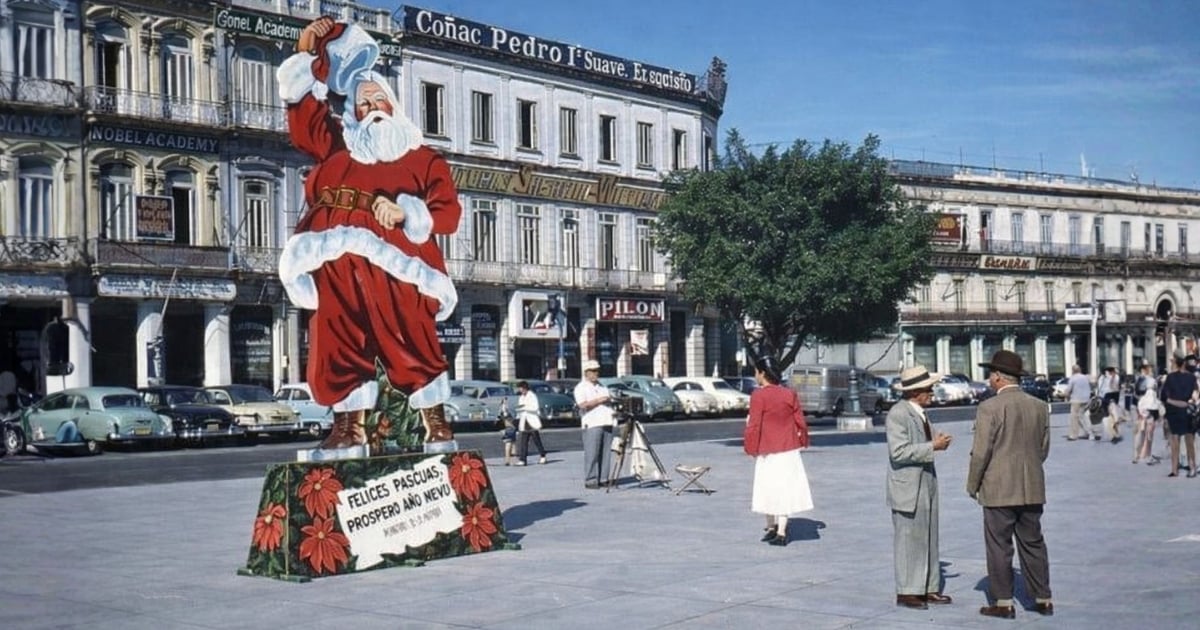
In the memories of many Cubans —and in the surviving photographs— there is a postcard that today seems to belong to another country: Havana in December, with illuminated shop windows, commercial streets adorned with garlands, Christmas advertisements, and families bustling about, caught up in shopping, new clothing debuts, and an atmosphere of anticipation that filled the air. Iconic stores like El Encanto were festooned with extraordinary flair during the holiday season, as recalled in historical accounts of that grand department store.
It wasn't a perfect Christmas—none are—but it was public, visible, and free. And that makes a difference when compared to what came next: a state that, in the name of ideology and economic campaigns, ended up relegating the celebration to the point of making it synonymous with suspicion.
Havana in December: storefronts, nativity scenes, and a city dressed for celebration
Before 1959, December was experienced in the streets. The shopping districts and department stores competed in decoration: nativity scenes in windows, little trees, lights, and shopping campaigns. In collected memories of those "Havana Christmases," names emerge that still carry weight for what they symbolize: El Encanto, Fin de Siglo, La Época, San Rafael, Obispo… the city in celebration mode.
And there was a detail that today feels almost subversive to say aloud: Christmas was not a clandestine act. One could decorate, gather, attend mass, and wish “happy holidays” without considering the consequences.
Christmas Eve: the Cuban table and the Rooster Mass
The Cuban Christmas Eve has —and continues to have— a clear focus: the family gathered around the table. A tree with a star on top, a nativity scene at the foot, and the tradition of attending the Midnight Mass as a spiritual start to Christmas.
In culinary terms, the image is known both on and off the Island: roast pork as the star dish of Christmas Eve, a tradition so deep-rooted that even in the diaspora it continues to be recognized as the Cuban Christmas food.
But the same historical memory that speaks of lights also recalls something important: those Christmases, like almost everything in republican Cuba, revealed social differences. There were neighborhoods where the celebration was more modest and others where the display was total; it is even mentioned that charitable houses were filled during that time.
After 1959: when ideology began to gain ground over faith
After the revolution, the relationship between the State and religion became increasingly strained. With the project of the “new man” and the promotion of an officially atheist country for years, religious expressions were suppressed and faith was pushed into the private sphere: expulsion of priests, nationalization of religious schools, and restrictions on the political participation of believers, among other documented episodes.
That context is important because Christmas was not just a date: it is a cultural and religious celebration. When a state decides that religion is an inconvenience, Christmas becomes a target.
1969: "the harvest is interrupted"... and Christmas escapes the calendar
The most remembered turning point comes with the Ten Million Harvest. In 1969, the government eliminated the Christmas holiday, justifying it by the need to support the sugarcane effort. The Christmas holiday officially disappeared with the argument that it interfered with the 1970 harvest.
The logic was so extreme that there are even accounts describing how those in power intended to "stretch the calendar" and postpone celebrations—including Christmas—so that nothing would interrupt the harvest. The practical consequence was devastating: Christmas ceased to exist as a public celebration.
Was it a formal prohibition? Perhaps not. Was it a real cancellation? Yes.
The official decision —along with the accompanying political climate— was enough for Christmas to be erased from public life for decades. Many Cubans continued to celebrate "in silence," fearful of being labeled for "ideological weaknesses."
In Cuba, when the power decides that something is “not convenient,” a law is not necessary for it to become dangerous: the stigma, the file, and the exclusion are sufficient.
1992–1998: the grip starts to loosen… and the holiday returns
In the 1990s, the regime began to change its stance. Constitutional reforms removed the atheistic character of the State and, with certain limits, opened spaces for religious practice. The reinstatement of the Christmas holiday came through a symbolically powerful channel: the Catholic Church and the visit of Pope John Paul II.
In a message dated December 20, 1997, the Pope celebrated that this day "has been restored as a civil holiday" in Cuba, allowing people to actively participate in the celebrations and reclaim a tradition deeply rooted in the hearts of the Cubans. The holiday was solidified following the papal visit.
Reading is inevitable: Christmas did not return as a spontaneous initiative of the power but due to moral pressure, political necessity, and image calculation.
2025: it is no longer "forbidden," but the crisis makes it an uphill battle
Today, December 24, 2025, Christmas in Cuba is no longer experienced under the shadow of a "counter-revolutionary act" as it was in past decades. However, the country faces a different kind of blackout: the literal one.
Thousands of families in Havana will face power outages on Christmas Eve, with schedules for rotating blackouts and expectations of several hours without electricity on the 24th and 25th. And if the lights go out, so does the table. The price of pork exceeds 1,000 CUP per pound in some markets, making the most symbolic dish of Christmas Eve a luxury for too many.
This is not nostalgia for consumption. It is a harsher reality: without material dignity, the celebration turns into resistance. And the Cuban people have been resisting for too long.
The "true Christmas" that was lost
When it is said that "Cuba had a true Christmas before 1959," it is not just referring to lights on San Rafael or displays at El Encanto. It speaks of something more fundamental:
- That celebrating wouldn't be suspicious.
- That faith would not be a stain.
- That the family wouldn't have to hide.
- That the State should not attempt to replace Christmas with slogans.
The Castro dictatorship—and its continuity—deprived Cubans of the right to live their traditions without fear. Christmas, with all it culturally signifies, became one of the most profound victims of that control.
Today, amidst blackouts and shortages, the question arises again: what does it mean to celebrate when the essentials are lacking? And yet, the Cuban persists: with a candle, a simple rice dish, a silent prayer, or a video call hug from exile.
That is also Christmas. Only it should be with freedom and with bread, not with surveillance and scarcity.
Filed under: