
Related videos:
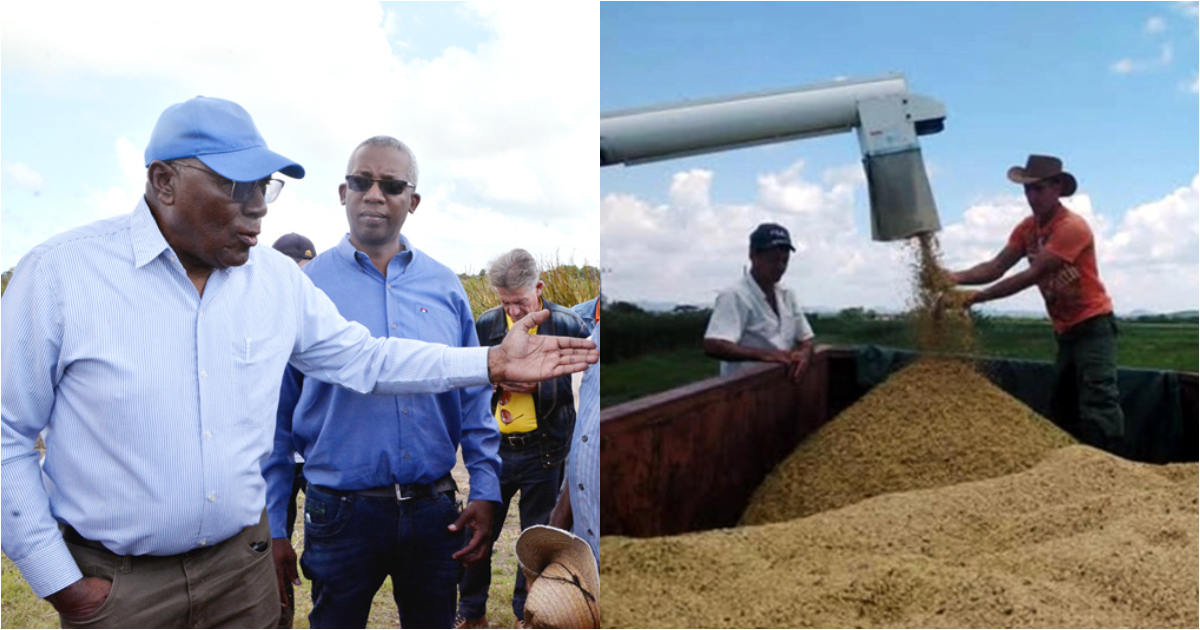
The vice president Salvador Valdés Mesa acknowledged this Friday that the expansion of rice cultivation depends on private producers financing machinery and supplies, amid a crisis that keeps the country producing only a fraction of the rice it consumes.
During a tour of potential rice cultivation areas in Holguín, Valdés Mesa admitted frankly that the State lacks the resources to expand production.
At the Agroindustrial Grain Base Business Unit in Mayarí, the vice president noted that there is sufficient water availability to cultivate more than 800 hectares.
But it "urged seeking alternatives in non-state management methods for issues such as financing and purchasing new machinery to modernize the industry and produce in greater quantities," reported the provincial newspaper ¡Ahora!
In his view, “we are experiencing a transformation process in management, and new economic players have emerged who possess financial resources, and we need to adapt and use this for the purpose of growth.”
The lack of fuel and harvesters was identified by local officials as one of the main obstacles to the campaign.
During his visit to Holguín, Valdés Mesa emphasized that “as long as we have water and land, anyone who wants to plant should plant,” and assured that the necessary supplies will be obtained in some way.
According to the source, as part of the exchange, “the creation of a small independent company for rice production in the territory was agreed upon,” further signaling a shift towards private actors to sustain a rice program that is struggling to recover.
The proposal to rely on economic actors with their own capital to cover part of the costs aligns with statements made in September in Cienfuegos, where the deputy head of state advocated for the allocation of large plots of land to individuals with the financial resources to purchase their own machinery.
On that occasion, the official acknowledged that over 400 million dollars are allocated each year to imports, while the country only produces about 11% of the rice it consumes.
However, the figures from provinces like Cienfuegos reflect a different reality: in 2023, only 10,000 tons were harvested, half of what is needed for self-sufficiency, and in cooperatives like Juan Manuel Márquez, in Aguada de Pasajeros, the fields are reduced to 17 hectares due to issues with drought, electricity, and a lack of cash to pay the laborers.
Rice, an essential food in the diet of Cubans, has become one of the scarcest and hardest products to obtain on the island.
In May, the pound of rice exceeded 300 pesos in four provinces and reached 340 pesos in Havana, while in Cienfuegos it was sold for 270 pesos despite official controls.
In the last 15 years, the island has increasingly relied on rice imports, a situation that has worsened in recent years and has forced the government to depend on donations and allocate hard currency resources to ensure the purchase of this food in the international market, where its price has increased significantly.
In 2024, rice production in Cuba only reached 30% of what was harvested in 2018, according to official data from the state newspaper Granma.
Filed under: