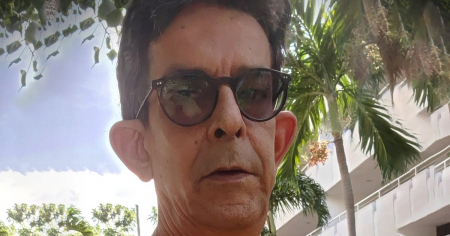
Carmelo Trujillo Machado, head of the International Sanitary Control Department of the Ministry of Public Health, stated this Saturday that government structures are functioning in Cuba and blamed the population for the spread of the aedes aegypti.
In the midst of the health crisis that the island is experiencing, the official stated on national television that “all the measures designed in a program for the control of arboviruses have been implemented and are functioning.”
"The complete government structure operates from the central level of our country, supported by all government structures and policies down to the grassroots level, that is, all the way to the popular councils and health sectors," he said.
After boasting about the clearly ineffective government management in a collapsing country, Trujillo Machado stated that "intense work is being done today in promoting and educating about health, emphasizing the importance of the population knowing how to eliminate the vector."
"We need to reach a point where our population takes action. Today, the mosquito Aedes aegypti, where it lives, is with us, inside our homes," he added.
This Friday, the Cuban leader Miguel Díaz-Canel Bermúdez assured that the actions of the Cuban government “are yielding results” in the face of the arboviral epidemic affecting Cuba.
"In a meeting of experts and scientists, mathematical models were presented indicating the containment of the arbovirus epidemic in the country. The measures are yielding results, and we will not let our guard down. We continue with the working system we have implemented," wrote the president.
The post generated critical responses, including one from a user who commented: “Those experts and scientists need to create a model that predicts how much longer this life that you have imposed on Cubans will last. How long will this unbearable existence continue? I need that mathematical-scientific model, or a fortune teller, or Nostradamus.”
Díaz-Canel's message followed a meeting held on the afternoon of December 24 with scientists and health system experts at the Palace of the Revolution, where they informed him that cases of dengue and chikungunya are showing a downward trend.
MINSAP experts claim that Cuba has recorded eight consecutive weeks of decline in arboviral disease diagnoses. However, most provinces, except for Matanzas, Granma, and Isla de la Juventud, remain within the endemic epidemic corridor.
The mathematician Raúl Guinovart Díaz stated that the forecasting models “indicate a trend towards improvement” and estimated that the situation could be controlled between January and February, provided that environmental conditions do not change.
Despite the optimism, the meeting's own data confirms that there are still over 2,800 cases of chikungunya in 134 municipalities, with incidence rates higher than the national average in provinces such as Guantánamo, Las Tunas, Santiago de Cuba, Pinar del Río, and Artemisa.
Filed under: