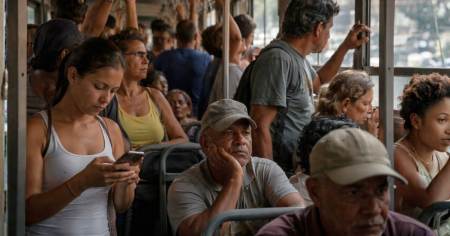
Cuba is facing its worst economic and social crisis in decades, characterized by miserable wages, daily blackouts, shortages of medicines, and unprecedented mass migration. The current situation surpasses even the darkest moments of the Special Period, resulting in 89% of Cubans living in extreme poverty, with 78% wishing to emigrate from the country.
In the midst of this collapse, the regime has attempted to implement timid reforms—from allowing small private businesses to attracting limited foreign investment—but none of this has resolved the crisis. Cosmetic changes and makeshift "patches" no longer have an effect, and even the citizens themselves acknowledge this: in a recent survey by CiberCuba, none believed in continuing with "patches and justifications" to get ahead.
Unprecedented crisis and insufficient reforms
Cuba is undergoing the worst economic crisis in the last 60 years, a deterioration that affects every aspect of daily life. The average state salary is around 14 dollars monthly on the informal exchange rate, which is insufficient given the skyrocketing prices— a carton of eggs costs about 3,600 pesos on the black market. Additionally, there are constant power outages, water shortages, and an under-resourced health system that provides only 3% of the necessary medications. The crisis has triggered a massive wave of migration: since 2020, 2.75 million Cubans have emigrated, a quarter of the population, leaving the country short of key professionals and worsening the demographic collapse.
In the face of this debacle, the Díaz-Canel government has implemented limited measures inspired by Chinese and Vietnamese models. More than 10,000 micro, small, and medium-sized enterprises (Mipymes) have been legalized in just two years, and today the private sector generates around 30% of employment and over half of retail trade. However, these openings are cautiously controlled. The regime views independent entrepreneurship as a "necessary evil" and shows a lack of commitment to free enterprise, tolerating it only because it has filled gaps left by the state.
Investment hindered by the lack of legal security
A basic rule for any investor is to have legal certainty: the guarantee that their property and rights will be respected. In Cuba, that certainty does not exist. National entrepreneurs and potential investors from the diaspora face immense helplessness against a totalitarian power that changes the rules at will. Even those wishing to invest from abroad must compete with the unfair advantages of the military conglomerate GAESA and endure harassment from State Security.
The Cuban dictatorship has a long history of abuses: from the mass expropriations without compensation in the 1960s to recent cases of swindled entrepreneurs. This is compounded by illegal confiscations, raids, and disregard for judicial rulings. Currently, several foreign companies have reported that they cannot repatriate their funds, which are blocked in bank accounts by the regime's decision. This currency “corralito” has outraged businesspeople and embassies and has destroyed the trust necessary for investment. Without legal security or respect for property rights, no serious capital will take risks in Cuba.
A market without freedoms does not attract development
Insecurity in the legal framework is compounded by the absence of a free market. Cuba maintains a centrally planned economy where the State — and especially GAESA — controls the majority of sectors. Although private Mipymes have proven to be the only dynamic sector, the regime suffocates them with taxes, price controls, and arbitrary regulations.
The distortion is complete: multiple exchange rates, a shortage of supplies due to the state monopoly on foreign trade, and a model that prioritizes luxury tourism over health or agricultural production. In 2024, 40% of the country's investments went to tourism, compared to just 2.7% for Public Health. The result: empty hotels and hospitals without medicines. The military conglomerate GAESA, led by relatives of Raúl Castro, has taken control of nearly the entire economy, building luxury hotels among crumbling buildings while millions of Cubans lack basic necessities.
A failed state in the hands of a military elite
The root of the problem is political. Cuba operates as a failed state, where institutions are subordinate to the military and family elite of the Communist Party. The real center of power is GAESA, a conglomerate of generals and entrepreneurs connected to the Castro family. While the population suffers from blackouts, inflation, and shortages, this elite accumulates privileges and controls the country's resources. The regime blames the "blockade" from the United States, but the crisis is due to the failure of the internal model, corruption, and the incompetence of the system itself.
Citizen protests continue unabated, and even traditionally loyal sectors, such as self-employed individuals and officials, are expressing their discontent. Political stagnation has left the country paralyzed and exacerbated misery. Raúl Castro, operating from the shadows, continues to obstruct any opening that might threaten the monopoly on power.
The path to reconstruction: economic freedom and democratic change
The way out requires a systemic change. Various organizations and analysts agree that Cuba can only overcome the crisis with a market economy, respect for private property, free enterprise, legal security, and democratic openness. Without these pillars, there will be no investments or development.
- Ensure a free and competitive market: eliminate barriers, free prices, and decentralize economic decisions.
- Legal security and respect for private property: enact laws that protect rights and prohibit arbitrary expropriations.
- Freedom to undertake and innovate: allowing Cubans to start businesses without fear of confiscation.
- Political openness and transparency: accompany economic liberalization with a democratic transition and free elections.
As long as there is no economic freedom or legal guarantees, Cuba will continue to sink into misery and lose its finest citizens to exile. The reconstruction of the country requires dismantling the authoritarian system and building a rule of law that serves its people.
Consulted sources
- CiberCuba (News and Opinion)
- The Economist
- Cuban Observatory of Human Rights
- Swissinfo/EFE
- Diario de Cuba
- Infobae
- AFD (French Development Agency)
Filed under:
Opinion article: Las declaraciones y opiniones expresadas en este artículo son de exclusiva responsabilidad de su autor y no representan necesariamente el punto de vista de CiberCuba.