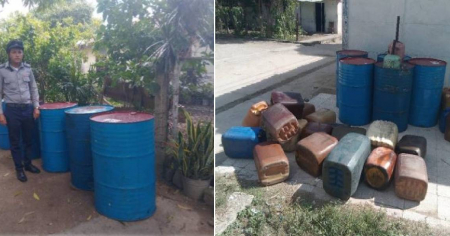
Cuba Petróleo Union (Cupet) announced that in 2025 it managed to reverse the historic decline in crude oil and gas extraction, although it admitted that the volumes are still insufficient to cover electricity generation and the basic needs of the country.
According to a report from the Cuban News Channel, executives from the state-owned company announced that national production of oil and gas will increase in 2025 compared to the previous year, following 13 consecutive years of decline since 2012.
The entity expects to close the year with 2.2 million tons of crude, approximately 80,000 tons above the plan and the production in 2024.
The authorities emphasized that nearly all national crude oil is allocated for electricity generation, although they acknowledged that it does not meet the full demand, which necessitates maintaining imports to sustain the power generation system and refining.
Sector experts acknowledged that, to achieve a supposed energy independence, Cuba would need to almost triple its current production.
In the case of natural gas, Cupet reported an increase supported by four new wells drilled over the past three years in Puerto Escondido and Canasí, in the municipality of Santa Cruz del Norte, in the province of Mayabeque.
These wells contribute more than one million cubic meters daily and would allow for a total of 1.13 billion cubic meters by the end of 2025, a figure not reached in the last nine years.
Nonetheless, the report itself acknowledges that this growth barely meets about a third of the national demand.
The official discourse attempts to answer a recurring question from the population: why do blackouts continue despite the increase in production? The explanation provided is simple and revealing: it is not enough.
Although more than 55% of the country's electricity is generated with domestic oil and gas, the current volumes are not sufficient to stabilize the electrical system.
The announcement contrasts with the everyday reality marked by generation deficits, prolonged blackouts, and dependence on imported fuels.
While Cupet insists on attributing the crisis to the U.S. embargo, the island continues to receive crude oil from allies like Venezuela and Mexico, and the company itself has acknowledged serious issues of corruption and fuel theft within its facilities.
The increase in production presented as a strategic achievement does not change the structural situation: Cuba continues to depend on imports to sustain its deteriorating energy infrastructure, for which it primarily uses heavy crude with a high sulfur content and low yield.
Filed under: