
Related videos:
Telling a people that rice is not Cuban is not a linguistic mistake nor a television anecdote. It is a political statement. It is the harshest way to acknowledge that basic necessities can no longer be guaranteed and that, instead of addressing the problem, the choice has been made to explain hunger.
When a power begins to justify scarcity instead of combating it, the discourse changes its function. It no longer serves to inform but to lower expectations. The problem shifts from poor management, neglect of the countryside, or chronic unproductivity to the people's habit of wanting to eat what they have always eaten. It is not the system that fails; it is the citizen for insisting on rice, potatoes, beans, and bread.
But these foods are not just sustenance. They are collective memory. They represent entire generations surviving on the bare minimum. They are survival turned into habit. Questioning them is not a cultural reflection; it is an attempt to re-educate hunger, to teach people that wanting the basics is a learned mistake.
The argument collapses only when taken to its conclusion. If being Cuban is defined by origin, the table is nearly emptied. Cuban cuisine is not indigenous in a biological sense; it is historical, mixed, built from what arrived and what the people made their own. Identity is not found in the origin of the grain, but in its rootedness. To deny this is not to rescue culture, but to erase reality.
And then the cruelest paradox emerges: an island surrounded by sea where the sea does not feed its people. Fish exist, lobsters are plentiful, but they have a destination, a price, and require permission. They are Cuban as a symbol, but not as a common food. The citizen learns to view abundance as something foreign, reserved, and unattainable. Everything is Cuban, except the right to consume it.
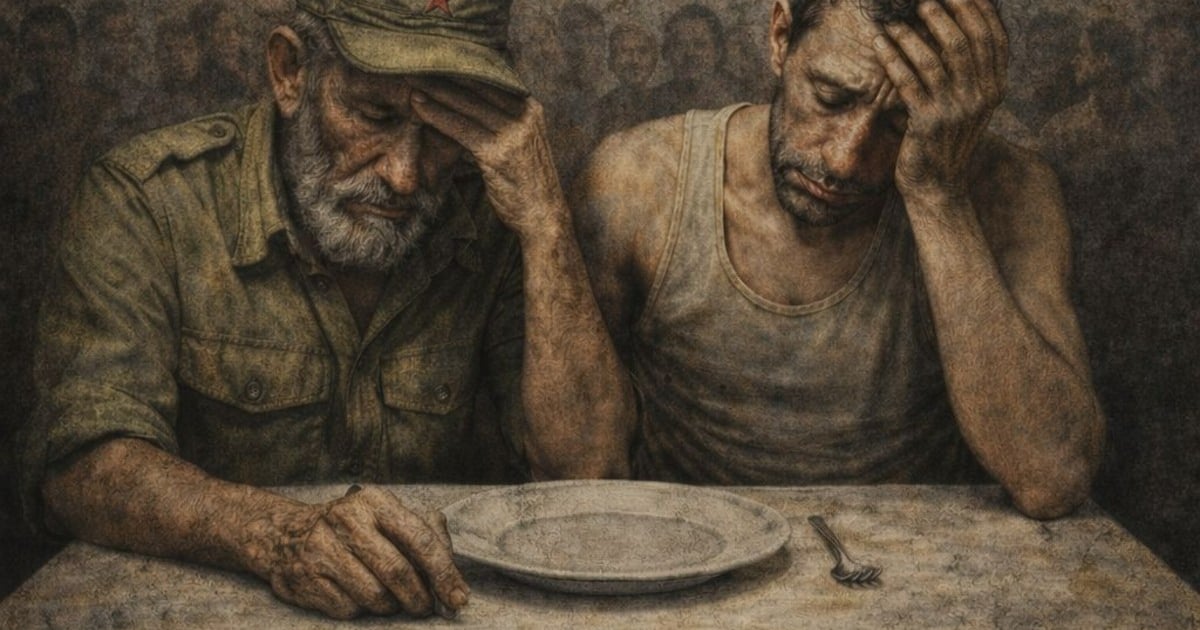
The table is not emptied by drought or war. It is emptied by decisions and speeches made from places where nothing is ever lacking. And when the plate is empty, the final narrative arrives: it is identity, it is culture, it is resistance. But no country can stand on words alone when bread is lacking, and no idea justifies the empty stomach of a child.
Hunger does not need explanations. It needs food. And when a power invests more energy in justifying its absence than in solving it, it ceases to govern people and begins to manage their human deterioration.
A people does not surrender when they protest. They surrender when they are explained hunger and begin to believe it.
Filed under:
Opinion article: Las declaraciones y opiniones expresadas en este artículo son de exclusiva responsabilidad de su autor y no representan necesariamente el punto de vista de CiberCuba.