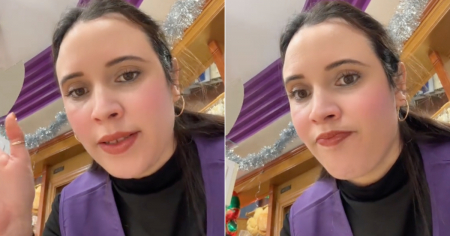
A Cuban resident in Galicia shared a video on TikTok where she talked about the things she still hasn't gotten used to after three years living in Spain. Her testimony sparked a broad exchange of opinions among Spanish and Latin American users.
"I am Cuban living in Galicia, and these are three things I haven’t gotten used to while living in Spain," explained @leyanetfrankedelp at the beginning of the recording, where she spoke in a friendly tone about her adaptation process.
Among the aspects mentioned was the climate in the north of the country: “I can't adjust to this climate, I can't adjust to the cold, to the rain... the cold doesn't bother me as much, but the rain goes on week after week after week; the sun shines for five minutes and then it starts to rain again. You have to get used to it here in Galicia that the umbrella is part of your outfit.”
He also commented on the mealtimes, which are very different from those in Cuba: “Here they have lunch at three in the afternoon and dinner at ten at night; I can’t adjust to that. I still have lunch at twelve in the afternoon and dinner at seven in the evening, and I don't think I'm going to adapt to it now.”
One of the difficulties, she said, is the language: “I don't understand anything; I don't understand Galician. If you speak slowly, I can catch a few things, but if you speak quickly, I don't understand anything at all. And the worst part is that my daughter is Galician and is now learning to speak; they speak to her entirely in Galician at daycare, and now she's starting to speak Galician to me. I either learn or I learn, because I have no other choice.”
Leya clarified that her intention was not to criticize Spain or the Galicians. “I don't mean to say that I don’t like things about Spain. I adore Spain, and I am extremely grateful to Spain for welcoming me and for giving me a wonderful daughter. But there are things that, as a Cuban, I have not been able to get used to since living here,” she expressed.
The video received numerous comments and sparked a debate about cultural adaptation and respect for local customs. Some users defended their right to share their experiences, while others criticized their lack of adaptation or the choice of Galicia as a destination.
Among the messages, phrases such as: "If you came to Spain and don’t like the weather, how did you choose Galicia?" or "If you’re in Galicia, you have no choice but to learn the language; we must preserve the culture," could be read.
Others recalled that "in Galicia, Galician is spoken, just as in the Basque Country Basque is spoken and in Catalonia Catalan is spoken," while several insisted that "Spanish is the official language of the State and all Spaniards have the obligation to know it."
There were also more conciliatory comments, such as those from individuals who emphasized that “loving a country does not mean you cannot express what bothers you.” Leya, for her part, responded briefly and directly: “I don’t need to move, because I never said I didn’t like it; I said I hadn’t gotten used to it.”
"The emigrant can only speak if it is to say that everything is perfect."
In response to the numerous messages received, the young woman published a second video days later in which she reflected on the reaction it had provoked. “Following the video I made about the three things I haven't gotten used to while living in Galicia for three years, I received a lot of these comments (‘you can pack your bags’, ‘go back to Cuba’, ‘to your country’, ‘leave’)”, she shared.
In his response, he defended the right of emigrants to express themselves: “An emigrant can only speak if it's to say that everything is perfect. If it's to say that something doesn't sit well with us, then it becomes bothersome. Being an emigrant does not mean losing one's voice, nor does it mean we have to silently applaud everything without expressing what we dislike. Sharing our opinions does not equate to disrespect.”
He also insisted that his message was misinterpreted: "At no point did I say that Galicia is bad; I simply mentioned three things that, as an emigrant, I have not gotten used to. And that does not make me ungrateful or any less from here."
In a calm tone, he concluded: "I didn't cross an ocean to live in silence. My experience matters too."
A voice that reflects the migratory experience
The case has resonated with many immigrants living in Spain who identified with the process of adapting to new customs. It has also sparked reflections on integration, cultural respect, and the differences between regions.
Leya, who had previously made headlines with another message on social media in response to an offensive comment about Cuban women —in which she stated: “I came to this country to work honestly and to have a dignified future”—, again brought attention to the reality of emigrants who share their daily lives outside the island.
Her most recent testimony places her once again at the center of the conversation about the adaptation of immigrants and the respect for the diversity of experiences in Spain.
Filed under: