
Related videos:
The affected families in Guantánamo receiving houses built from containers will not receive them as a donation, but rather at a higher price than the appraisal of conventional houses.
The beneficiary must cover the cost of the container "according to the approved budget," while the urbanization and other associated expenses are covered by the State, as highlighted by the official newspaper Venceremos.
The program estimates an expenditure of around 900,000 pesos (CUP) per unit, although the “final cost” is still being adjusted, and the payment mechanism —according to the source itself— will be defined “later” with the banking system, through “negotiation and mutual understanding,” following the usual procedures of the housing program.
The official report clarifies that these are not donations: they are "state-owned homes with public financing."
The beneficiary assumes the value of the container according to the budget.
However, it also acknowledges that the specific mechanism (how it will be financed, in how many installments, under what conditions) has not yet been publicly defined, as it will be established later with the banking system.
According to the information released, the initiative is designed as a solution for families facing total collapse and is part of the state investment plan for housing.
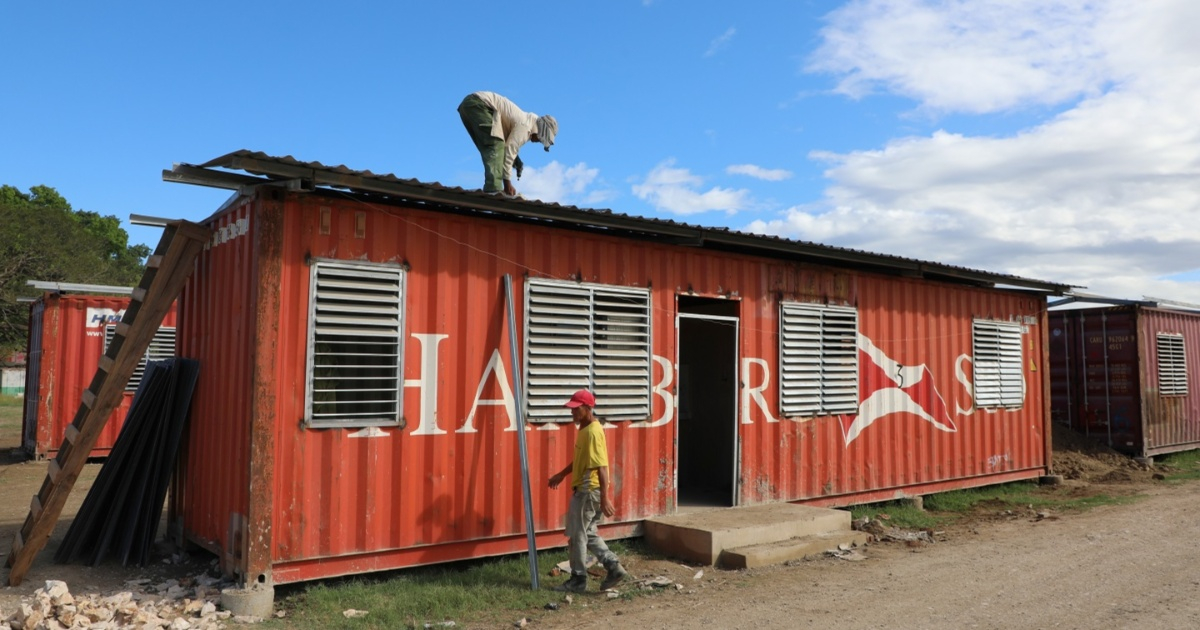
This arises from the reuse of used containers to import solar panels intended for photovoltaic parks, which are then made available for residential use.
Currently, the province is executing 70 container homes distributed across three municipalities:
- San Antonio del Sur: 15 homes (Buenavista settlement)
- Guantánamo: 20 homes (Cabaña Mariana community)
- Imías: 35 housing units (area near the "Airport")
All are intended —according to the text— for families affected by total collapses caused by hurricanes Óscar and Melissa, as well as heavy rains in September.
The amount of 900 thousand and the debate it sparked
A breakdown by the user Yulieta Hernández Díaz highlights the estimated price of 900,000 CUP as a reference point and presents calculations comparing it to a monthly average salary of 6,685.3 CUP, to illustrate the time it would take to pay it under different scenarios (allocating 100%, 50%, 30%, or 20% of the salary).
His text indicates that if a person were to allocate 100% of their salary to paying for housing, it would take 135 months (11 years and two months) to finish the payment.
Now, if 50% of the salary is allocated, it would take 22.5 years, and with 30% it would take 37.5 years.
"This is not an individual problem: it is a structural symptom of an economy where the prices of essential goods are completely disconnected from real incomes," he wrote.
As specified, the container housing is more expensive than the bank appraisal of conventional homes. According to the official resolution, the average base value for masonry houses with heavy roofing is 225,000 CUP.
What are the homes like and what does the project include?
The model is built from a 12-meter-long container, with an approximate usable area of 29 m², designed for family units of up to four people. It includes two bedrooms, an interior bathroom, a kitchen with a countertop, a living-dining area, natural ventilation, and hydrosanitary and electrical installations.
For the heat, the design includes interior insulation (wooden frames and melamine panels) and an independent roof that creates an air chamber; additionally, it is mentioned that there are eight windows for ventilation.
The homes are elevated and integrated into settlements with urban planning, drainage, access, and basic services, because —according to the official explanation— "the project is not limited to the house."
Furniture is not mandatory: each family decides whether to acquire it. In cases of social vulnerability, the State may cover that cost as part of the assistance, according to the report.
Filed under: