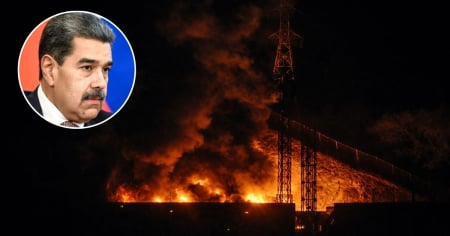
Blackouts intensified across Cuba on Saturday, with outages occurring from 5:18 a.m. until after 1:00 a.m. on Sunday, according to the latest report from the National Electric System (SEN).
The regime authorities attributed the crisis to the unexpected shutdown of several thermoelectric units, and interestingly, the spike coincides with the detention of Venezuelan dictator Nicolás Maduro, the primary supplier of subsidized fuel to the island.
Engineer Lázaro Guerra, General Director of Electricity at the Ministry of Energy and Mines, stated that "the impact was greater than expected because we had planned for Unit 3 of the Carlos Manuel de Céspedes thermoelectric plant in Cienfuegos to come online, but it was not possible during peak demand."
According to the official report from the Ministry of Energy and Mines, the maximum impact due to a generation capacity deficit reached 1,966 megawatts at 6:20 p.m., one of the highest in recent days.
The energy production from the 34 new photovoltaic solar parks was 2,643 MWh, with a maximum power of 535 MW, which is insufficient to meet the growing deficit of the system.
Serious flaws in the system
At 6:00 a.m. this Sunday, the availability of the national electrical system was only 1,495 MW against a demand of 1,650 MW. The technical report details that there are 150 MW affected since early due to a deficit, with a projected impact of up to 850 MW during the midday hours.
Among the main incidents reported are breakdowns in units 5 of the Mariel Power Plant, 1 and 2 of the Felton Power Plant, and 5 of the Diez de Octubre Power Plant, in addition to maintenance work on unit 2 of the Santa Cruz Power Plant and unit 4 of the Carlos Manuel de Céspedes Power Plant in Cienfuegos.
The report also indicates that there are 972 MW out of service due to lack of fuel and lubricant, including 93 distributed generation plants, the Melones truck (35 MW), and 142 MW unavailable due to lack of lubricant.
For the peak hours this Sunday, a deficit of 1,645 MW is expected, with a maximum estimated demand of 3,200 MW and a availability of only 1,555 MW. If these conditions persist, a general shortfall of 1,675 MW is forecasted, which suggests new blackouts across the country.
A delicate political and energy context
The increase in blackouts comes just after the capture in Caracas of Nicolás Maduro and his wife by U.S. forces, an event that jeopardizes the supply of Venezuelan oil to Cuba.
Meanwhile, the regime insists on presenting the causes as "technical failures," without mentioning the loss of logistical and financial support from its main ally.
Filed under: