
Related videos:
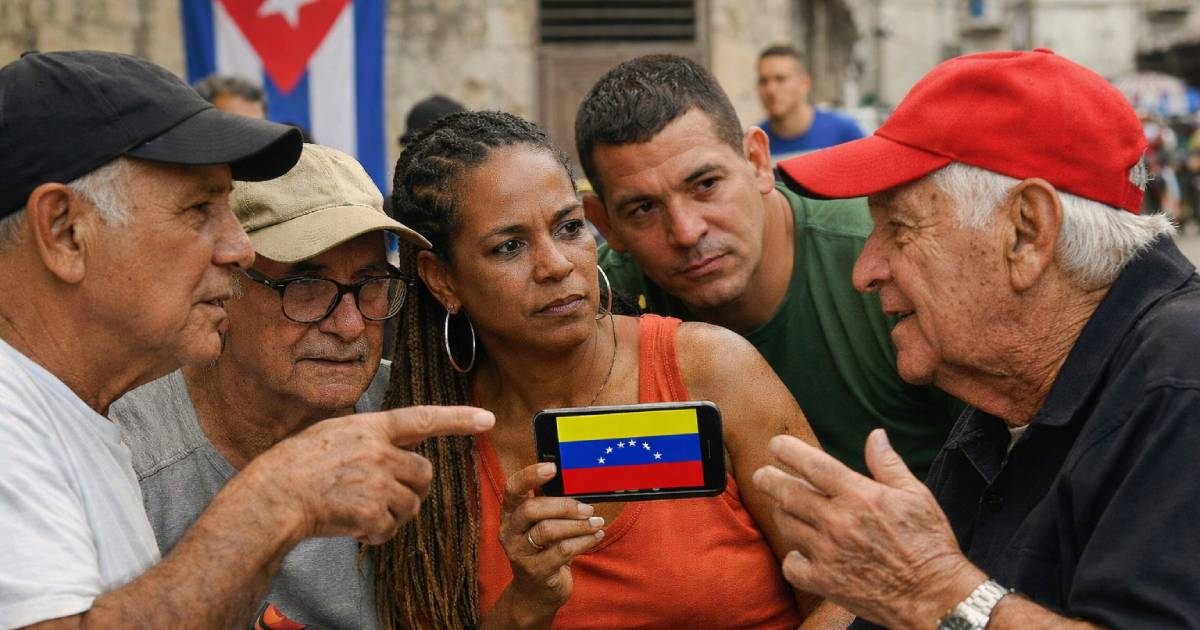
The news of the attack on Venezuela and Nicolás Maduro's forced departure from power sparked a wave of reactions among Cubans both on and off the island.
On social media, especially on Facebook, conflicting opinions have multiplied, from those who feel relief at the end of a dictator allied with Castroism to those who warn with distress that no bomb can bring democracy.
For many Cubans shaped by decades of authoritarianism, the first instinct was emotional. Maduro's downfall was seen as a crack in a power bloc that also includes Miguel Díaz-Canel, Daniel Ortega, and Vladimir Putin.
Some celebrated what happened with irony and sarcasm, convinced that the anti-imperialist rhetoric of Chavismo and the Cuban regime was once again laid bare by the absence of a real response. In those messages, there is a mix of relief and symbolic revenge, fueled by years of exile, poverty, and broken promises.
"Maduro has been one of the worst caricatures of a dictator produced by Latin America," wrote the Cuban intellectual José Manuel González Rubines, who described his exit from power as "good news." However, in the same message, he made his concern about the method clear: "That his departure took place through a military operation by a foreign power is not."
This ambivalence was echoed in many comments. For some Cubans, the bombing rekindled old historical fears. Humorist Ulises Toirac was unequivocal: “No. I do not applaud any invasion. Neither the one in Ukraine, nor the one in Venezuela. None. People pay for the ideals of politicians.”
In the same vein, the writer Jorge Fernández Era warned that "you can't give shine to the boot that one day could crush you," while comparing the event to other instances of violence that were later celebrated.
But not everyone viewed the situation from the same perspective. Amid the fatigue accumulated over decades of authoritarianism, there were Cubans who defended the intervention as an extreme solution in the face of regimes that do not relinquish power through peaceful means.
"Democracy does not begin with elections: it begins with the removal of the dictator," wrote Nora Núñez, who recalled that in totalitarian systems "collapse rarely happens without external force or violence."
The Cuban mirror appeared time and again in the debate. From Havana, the artist LaSai Dela Vida shared an image of a collapsed corner and posed a reflection that resonated strongly: “Cuba hasn't been hit by a missile, yet it seems to be at war with its leaders.” For her, violence does not begin with a bomb, but “when a people falls without noticing the silent attacks year after year.”
There were also those who celebrated the events without nuance, with sarcasm and relief. "Finally, that day has come when the lights of Nicolás Maduro, Vladimir Putin, and Miguel Díaz-Canel were turned off," wrote Jorge Enrique Rodríguez, convinced that the support from Moscow and Havana had been reduced to "barking that never bites."
Others, on the other hand, called for caution. Journalist José Raúl Gallego reminded us that the real power of chavismo remains intact and that “dictatorships with a Castro DNA do not relinquish power; they cling to it and buy time.” In his view, if the evil is not eradicated at the root, it tends to mutate or reproduce.
Amidst the fear of war and the weariness towards dictatorships, the debate revealed an uncomfortable truth: for Cubans, Venezuela is not just an international news story, but a reflection of their own wounds, expectations, and dilemmas.
As one of the users wrote, "the freedom that someone grants you is not true freedom," but the question that remains unanswered is how much pain it takes to achieve it.
Filed under: