
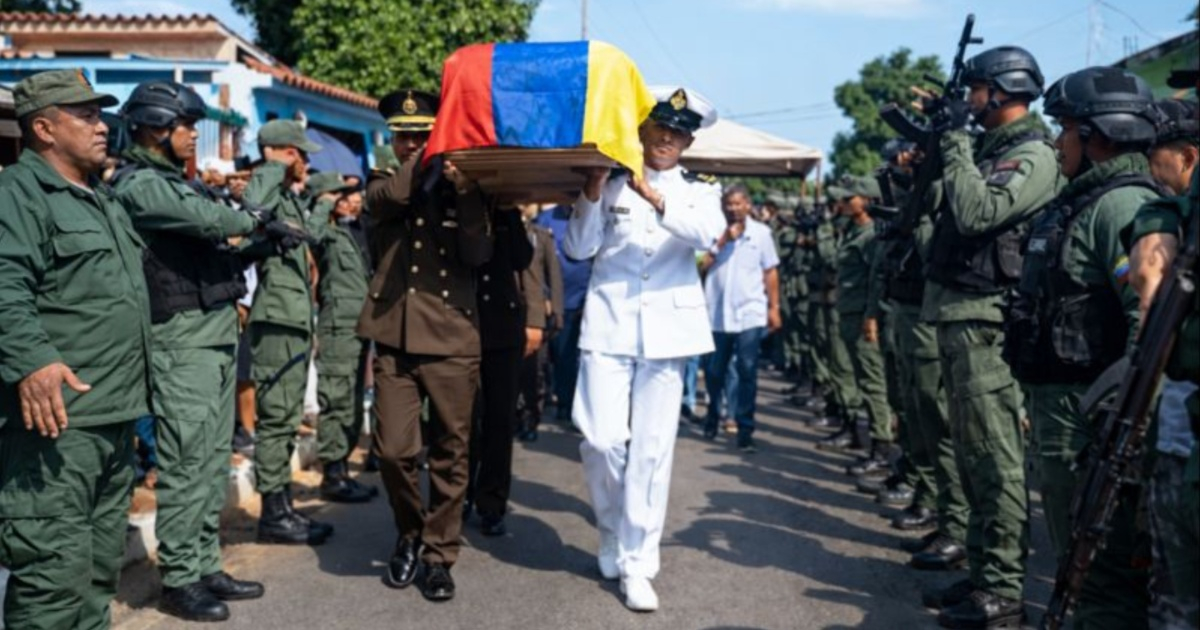
The government of Venezuela confirmed the death of 24 military personnel in the attacks by the United States last Saturday and declared seven days of mourning for the deceased members of the Armed Forces, according to reports from EFE published this week.
The Bolivarian National Armed Force (FANB) paid tribute at a funeral for 24 soldiers who died during the bombings in “various locations in Caracas and three neighboring states to the capital,” and shared a video of the ceremony on Instagram.
In the institutional message, the FANB described the attack as "disproportionate" due to its "volume of fire," "technology," and "surgical precision," and stated that the armed forces "never bowed down."
"Duelo, Honor y Gloria. Three words for those who are no longer here. For the patriots who on January 3 wrote a tragic page in our history with their blood. We remember them not for the cause, but for their sacrifice," said the official page.
The seven-day mourning decree was announced on Tuesday by interim president Delcy Rodríguez in response to the deaths of military personnel during the U.S. operation.
In parallel, Attorney General Tarek William Saab announced the appointment of three officials to investigate what he deemed “dozens” of deaths, both civilian and military, a number that he stated was still being tallied.
The crisis also had regional repercussions. Cuba reported on Sunday the death of 32 of its military personnel stationed in Venezuela during the attack and declared two days of mourning.
The ruler Miguel Díaz-Canel stated that those troops "were carrying out missions" in Caracas "at the request" of Venezuelan authorities.
The combatants —members of the Revolutionary Armed Forces (FAR) and the Ministry of the Interior (MININT)— “were fulfilling missions at the request of counterpart agencies in Venezuela,” officially confirming the Cuban military presence in the South American country, something Havana denied for years.
The list includes high-ranking officers, captains, lieutenants, and soldiers aged between 26 and 67 years old.
Among them are Colonels Humberto Alfonso Roca Sánchez and Lázaro Evangelio Rodríguez Rodríguez, as well as Majors Ismael Terrero Ge, Rodney Izquierdo Valdés, and Rubiel Díaz Cabrera.
The names were published alongside their official portraits, marking Cuba's first public acknowledgment of the extent of the casualties suffered during the operation.
According to the Ministry of the Interior, the Cubans “fell in direct combat or as a result of bombings” and were described as “heroes who knew how to elevate the spirit of solidarity of millions of compatriots.”
Filed under: