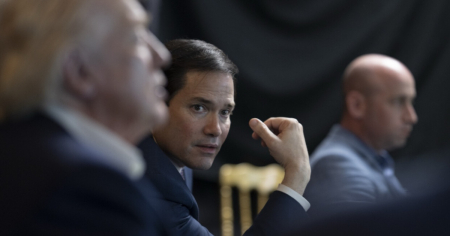
The U.S. Secretary of State, Marco Rubio stated that Washington plans to acquire “between 30 and 50 million barrels” of Venezuelan oil.
In a press conference, the Cuban-American official stated that they intend to sell it at market prices, and that they will then manage the proceeds so that —in his words— “benefit the Venezuelan people,” not “corruption” or “the regime.”
Rubio explained that the measure is part of a three-step process that he said he had described "in great detail" regarding Venezuela.
The first step, he pointed out, is the "stabilization of the country," with the aim of preventing it from "descending into chaos."
As a basis for that stabilization, he mentioned what he referred to as a "quarantine" and stated that, under that scheme, "two more ships were captured" that day.
In this context, Rubio indicated that his government was “about to execute an agreement” to “take all the oil” that, he said, is “trapped” in Venezuela and “cannot be moved” due to the quarantine and because it is sanctioned.
He added that the plan is to take between 30 and 50 million barrels and sell them "on the market" at "market prices," instead of the "discounts" that—he claimed—Venezuela was receiving.
Regarding the use of those funds, Rubio stated that "that money" would be managed in a way that the United States would control how it is distributed, with the goal of benefiting the Venezuelan population and not the "regime".
“That money will be managed in a way that allows us to control how it is distributed, in a manner that benefits the Venezuelan people, not corruption, not the regime,” he said.
The second step, Rubio continued, would be a phase of "recovery" aimed at ensuring that "American, Western, and other entrepreneurs" have access to the Venezuelan market "in a fair manner."
In parallel, he mentioned a process of national reconciliation so that opposition forces could be “granted amnesty,” released from prison, or return to the country and begin to rebuild civil society.
The third phase, according to Rubio, would be the "transition," about which he promised there would be "more details in the coming days," stating that his team feels they are progressing "in a very positive way."
The statement also comes amid a highly tense context between Washington and Caracas, which includes measures such as the complete blockade of sanctioned oil tankers to and from Venezuela announced by the Trump administration last December, as well as the pressure policy aimed at economically weakening the former Maduro regime.
For its part, sectors of the Venezuelan interim regime have maintained a defiant tone against the United States, with statements declaring that "there is no foreign agent that governs Venezuela," in reference to accusations of political or economic control by Washington.
Filed under: