
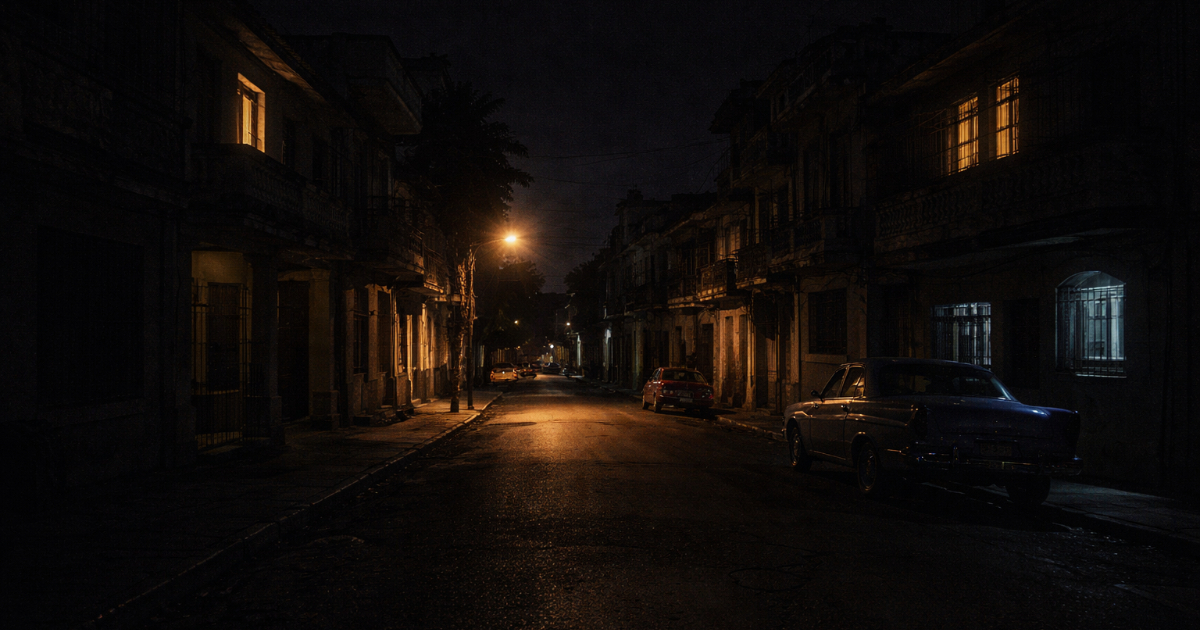
The year 2026 began with an explosive scenario for electricity generation in Cuba: the national power system is facing one of its worst moments just as Venezuela, its main oil supporter for more than two decades, is experiencing an unprecedented political and military crisis. The combination of an internal generation deficit, a collapse of fuel reserves, and a blockade on Venezuelan oil makes an increase in blackouts on the island practically inevitable
A new year starting with a record deficit in Cuba
In the early days of January, the Electric Union (UNE) has forecasted peak hour disruptions nearing 1,800–1,830 MW, a figure that represents a significant portion of the country's maximum demand. Official reports acknowledge that interruptions are no longer concentrated solely at night, but rather extend nearly around the clock in numerous areas
This deterioration is based on two pillars: on one hand, the chronic unavailability of old thermoelectric plants, with multiple units out of the system due to breakdowns and lack of maintenance; on the other hand, the increasing reliance on distributed generation (diesel engines and fuel oil) that can only operate if there is enough fuel. When both aspects fail simultaneously, the result is what Cuba is currently experiencing: prolonged blackouts, low circuit rotation capacity, and a rising level of social frustration
Venezuela: from benefactor to the epicenter of the storm
As Cuba enters this critical cycle, Venezuela is undergoing a historic upheaval: a military attack by the United States, the capture of Nicolás Maduro, and a reinforced naval blockade on Venezuelan oil. The new scenario has put a significant portion of the oil flows that were previously used as a geopolitical tool by Chavismo under the control of Washington and major oil companies, including the preferential agreements with Havana
For years, Venezuelan oil —which once exceeded 90,000 barrels per day at its peak— has decreased to around 11,000 to 27,000 barrels per day allocated to Cuba in 2025, according to estimates from shipping tracking firms. Nevertheless, these volumes remained essential for powering plants and fueling transportation on the island, and any loss or sudden interruption directly results in blackouts, fuel shortages, and halted production
Naval blockade, oil tankers pursued, and Cuba trapped
The new conflict has increased pressure on any vessel associated with Venezuelan oil: interceptions, boardings, and seizures have become routine in the Caribbean and the Atlantic. The United States is particularly wary of the so-called "ghost fleet," those tankers with flags of convenience, turned-off transponders, and opaque practices that for years transported sanctioned oil to markets like China, India... and, indirectly, to Cuba
In this context, any operation aimed at transporting Venezuelan crude to Cuban ports becomes extremely risky: ships can be pursued for weeks and often end up being seized and towed to ports controlled by the United States. At the same time, tankers that have already set sail from Venezuela have chosen to divert their route towards the United States, where the new scheme prioritizes the shipment of crude to American refineries over the traditional political allies of Chavismo
Reserves at a minimum and insufficient "lifelines"
The direct consequence for Cuba is that the country is facing the beginning of 2026 with fuel inventories at historic lows: independent analysts estimate reserves at around 360,000 barrels, equivalent to four days of consumption. This figure necessitates the rationing of diesel and gasoline, further reducing transportation and prioritizing certain sectors, leaving the rest of the country vulnerable to longer and more frequent power outages
Mexico has become the main "lifeline" for Havana, sending tankers like the Ocean Mariner with shipments of around 80,000 barrels (about 14 million liters) that provide just a few extra days of leeway. However, both the Mexican and Cuban press acknowledge that these shipments do not represent a sustained increase in supply compared to previous years and are far from replacing the regular flow that used to arrive from Venezuela
An electric system on the brink of paralysis
On the ground, all of this translates into an electrical system operating in survival mode, with a deficit exceeding 1,600 to 1,800 MW and a significant portion of the thermal capacity idle due to fuel shortages or breakdowns. Aging thermal plants, distributed generation unable to operate due to a lack of diesel, and the intermittency of renewable sources leave the UNE without the tools to prevent massive blackouts
The state-owned company itself acknowledges that daily disruptions will remain very high, while independent media emphasize that the system is starting 2026 “in worse conditions” than the previous year, due to both technical unavailability and a lack of fuel. The economy, already in deep recession, is suffering the direct impact: paralyzed industries, losses in refrigerated food, a decline in basic services, and a population exhausted after years of outages
Will blackouts increase?
All the factors point in the same direction: yes, blackouts will increase. On one hand, the external shock caused by the Venezuelan crisis reduces or almost cuts off an essential source of oil for Cuba at a time of extreme internal fragility. On the other hand, there is no equivalent substitute, at least for now: neither Mexico nor Russia are in a position to take on the role that PDVSA once had, and Havana lacks the foreign currency to purchase large volumes in the open market
In this new geopolitical environment, Cuba's electricity generation is being stretched to its limits, caught in a double bind of crises: one coming from Caracas, with a Chavismo under careful transition and oil increasingly controlled by Washington, and the other brewing within the island, marked by decades of technological backwardness, poor management, and absolute dependence on imported fuel. Until this equation changes structurally, "normalcy" in Cuba will consist of long, frequent, and very likely increasing blackouts
Filed under: