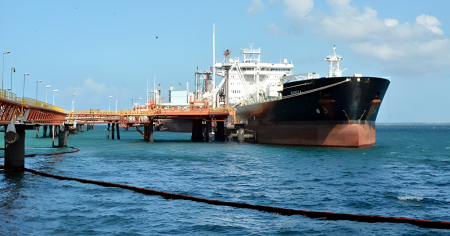
Cuba's already fragile economy could face one of its most critical scenarios if it stops receiving the oil that Venezuela has been supplying for over two decades. Analysts warn that a complete interruption of these shipments would have devastating consequences for daily life on the island, characterized by prolonged blackouts, inflation, shortages, and a continued decline in basic services.
According to an analysis published by CNN en Español, Cuba currently relies on about 30,000 barrels of Venezuelan crude oil per day, a figure that, although far from the peak reached a decade ago, remains vital to meet at least half of its energy needs.
The outdated infrastructure and lack of maintenance have left the electrical system on the brink of collapse, as evidenced recently when more than half of the country was without electricity for several hours.
"The scenario would be one of total paralysis," warned the Cuban economist Omar Everleny Pérez Villanueva, former director of the Center for Cuban Economy Studies at the University of Havana.
In his statements, the researcher was clear in saying that without that fuel supply, no economic sector could operate normally. The industry, transportation, and food production would be severely impacted in a country where blackouts already exceed 20 hours a day in some areas.
Everleny recalled that Venezuelan oil is not just a gesture of solidarity, but rather part of a political and economic exchange in which Cuba has sent doctors, professionals, and security personnel to the South American country for years.
“The Cubans who recently died in military operations in Venezuela died for oil,” he stated, emphasizing the human cost of that dependency.
For economist Pavel Vidal, a professor at the Pontificia Universidad Javeriana in Colombia, the immediate future of the island will largely depend on the decisions made in Washington and Caracas following the Venezuelan political crisis.
Vidal believes that the least harmful scenario would be for the United States to allow the continued shipments of crude oil to prevent a humanitarian and migratory crisis just 150 kilometers from Florida. He warns that an energy collapse in Cuba would have an immediate regional impact.
An even harsher perspective is provided by Jorge Piñón, director of the Energy Program for Latin America and the Caribbean at the University of Texas. The expert notes that if Venezuelan supply drops to zero, the Cuban economy would simply come to a halt. “It would be a total collapse,” he stated.
Piñón explains that Cuba lacks the financial capacity to purchase oil on the international market, and that the few allies still sending crude oil, such as Mexico or Russia, do so in insufficient and irregular volumes.
The possibility of replacing that dependency with other productive sectors also seems distant.
Vidal argues that the Cuban economy does not generate enough foreign currency and that neither tourism nor medical missions can offset the loss of the energy agreement with Venezuela.
This is compounded by the lack of credibility of the Cuban economic model and the country's high levels of debt, factors that have limited support from other potential allies.
While the government of Miguel Díaz-Canel maintains its discourse of resistance and blames the U.S. embargo for the crisis, experts agree that there are no clear signs of profound reforms that would allow for addressing a shock of this magnitude.
For Everleny, the population is beginning to hold the authorities directly responsible for the lack of concrete solutions.
With almost ten million inhabitants caught between power outages, shortages, and salaries that are insufficient, the potential end of Venezuelan oil is not just a geopolitical issue. For many Cubans, both on and off the island, it represents the threat of an even harsher crisis, with no clear way out.
Filed under: