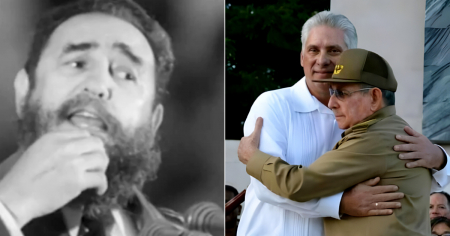
The United States Secretary of State, Marco Rubio, stated this Friday that “those who control Cuba” must make a decision between “having a real country, with a real economy, where their people can prosper” or “continuing their failed dictatorship.”
His statements were made during a joint press conference with Donald Trump, where they described the situation on the Island as critical and characterized by economic collapse following the loss of external support.
Rubio asserted that the "fundamental problem" in Cuba is that it is “surrounded by incompetent people” who "do not understand what an economy is, let alone one that works," and he claimed that the regime has prioritized political control over a functioning economy for decades.
In his argument, the official stated that the Cuban system has been sustained for more than "60 something years" thanks to external donors, first the Soviet Union and more recently Venezuela, but he emphasized that this support "is no longer there," which places Cuban leaders in a dilemma, according to his words.
Rubio warned that if the regime insists on "continuing with its dictatorship"—which he also described as "false" in the same discussion—this "will lead to a systemic and social collapse." "It's a very strong and dramatic choice," he added, while emphasizing that the United States "does not" have an interest in "destabilizing" Cuba, but he attributed that potential destabilization to the Cuban government's refusal to allow "economic or political freedom" for its population.
Rubio's statements came after President Donald Trump claimed that "Cuba is in bad shape" and that the Island relied on Venezuela "for oil and money", but that now "they are not going to receive any money," describing Cuba as a "third world country" and expressing uncertainty about what will happen.
In the same exchange, Rubio emphasized that there is potential support from the diaspora in the United States: he stated that there are "many people" who "want to return to Cuba and help Cuba," and mentioned those who left "with nothing" and thrived in the U.S., presenting it as an advantage that Cuba has and that "many other places do not have."
Also this Friday, Donald Trump promised that his administration will look for ways to support Cubans residing in the United States who suffered under the Castro regime.
Trump addressed the political and economic situation in Cuba and its historical dependence on Venezuela, reiterating his intention to directly assist Cubans living in the United States and the exile communities that have reported persecution and human rights violations on the island for decades.
Although he did not provide specific details about programs or concrete support policies, his statement conveyed a tone of support for the Cuban diaspora and their suffering under the Castro regime.
His statements arise within the current context of intervention in Venezuela, a long-time ally of Havana.
"Cuba has always depended on Venezuela for money and oil, and it provided protection to Venezuela. That has always been the deal," said the leader during the program, in which he criticized the energy dependency that has defined the Cuban regime in recent years.
The U.S. president also emphasized that this dynamic has changed in the context of the current intervention in Venezuela, where the United States has taken on a dominant role following the capture of former president Nicolás Maduro, and traditional energy relationships are under review.
Filed under: