Miguel Díaz-Canel shared a video on his social media this Monday with the message "Fidel lives," accompanied by a segment of a speech by the historic leader of the so-called "Cuban revolution," delivered in the 1980s.
“There's something we don't like, and we don't like being threatened. We don't like being intimidated: we don't like it. Moreover, our people have long since lost the concept of fear,” said an empowered Fidel Castro supported by the “socialist camp.”
The publication from the leader appointed by Raúl Castro comes at a time of maximum tension on the continent, just days after the American military operation that culminated in the capture of Nicolás Maduro in Caracas, and following a series of warnings from Washington to Havana regarding its role in supporting the Chavista regime.
Warnings from Washington
Díaz-Canel's message subtly responds to a climate of increasing diplomatic pressure on Cuba.
In recent days, key figures in the U.S. government have hinted that Havana could be the next target of sanctions or actions of "strategic containment" due to its military and intelligence involvement in Venezuela.
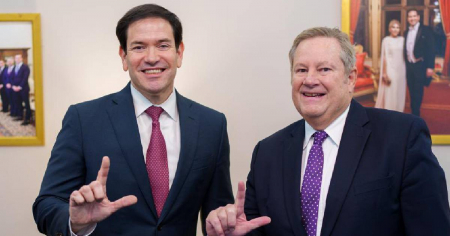
The Secretary of State Marco Rubio was one of the first to suggest it publicly, stating that “Cuba must be very concerned” following Maduro's downfall, reminding us that the Cuban regime “has been the hand that has supported chavismo for two decades.”
For his part, Donald Trump —who oversaw the operation from Mar-a-Lago— asserted that “without Cuban support, the Venezuelan regime would have fallen years ago” and added that “Havana will be held responsible for the consequences of its interference.”
During a conversation with journalists on Air Force One, Trump stated that "the Cuban government should be very concerned" and that "the regime in Havana has maintained the repressive machinery of Venezuela for years."
In later statements, he insisted that “Cuba is ready to fall,” linking Maduro's capture with a supposed “domino effect” on Castroism.
For his part, Rubio stated in an interview with NBC that "Maduro's security apparatus was controlled by Cubans," pointing to Havana as "the true brain of Venezuelan repression." He added that "the liberation of Venezuela fatally weakens Cuba" and that Washington "will not allow that axis to consolidate again."
The underlying message is clear: Washington associates the survival of Castroism with the support network for Maduro and believes that a "neutralized Cuba" is essential to prevent the resurgence of Chavismo.
The return of the myth
In that context of pressure and "psychological warfare," the Cuban regime clings to the discourse of resistance that characterized Fidel Castro's era.
Díaz-Canel's post is not coincidental: the chosen video—a defiant Fidel, with a strong voice, during the Cold War years—aims to revive the narrative of the heroic people who are unafraid of the empire and stand firm in the face of threats.
But, as the old saying goes, "Tell me what you boast about, and I will tell you what you lack." Behind the defiant message lies a deep political insecurity.
The Cuban government is facing an unprecedented economic crisis, subdued social protests, a massive exodus, and the isolation of former allies in Latin America.
Unlike in the 80s, when Fidel could count on the support of the socialist bloc and a tacit guarantee of non-invasion negotiated with the USSR after the missile crisis, Díaz-Canel governs without a safety net.
Today, Cuba is no longer the romantic epicenter of Latin American resistance, but an exhausted country, with an ideological apparatus that echoes gestures from a crumbling past and a leadership that clings to totalitarian power, unable to connect with the desires and needs of Cubans.
Filed under: