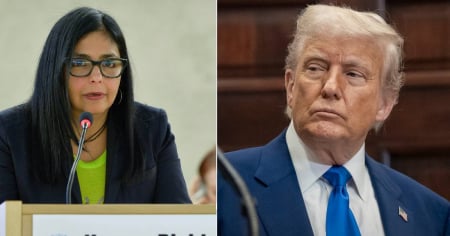
The acting president of Venezuela, Delcy Rodríguez, asserted that her government will not act out of "revenge" against the United States, but will seek to respond to the recent military operation that culminated in the capture of Nicolás Maduro through diplomatic means.
During a tribute to fallen Venezuelan soldiers on January 3rd, Rodríguez addressed the American people in a message where he spoke of "lessons in Bolivarian diplomacy."
"The people of Venezuela did not deserve this vile, warlike aggression from a nuclear power," he said.
The leader stated that this episode has become "a stain" in the history of relations between the two countries. However, she insisted that her response will not be vindictive.
"It is not revenge, but vindication, that will come when we leave him and give him lessons and examples of what Bolivarian diplomacy of peace looks like in international action," he announced.
Rodríguez linked his approach to the figure of Simón Bolívar, whom he presented as a doctrinal source for his foreign and military policy and a reference in human rights, and asserted that his principles will guide his government's actions in the new landscape opened up after Maduro's fall.
In his speech, he praised the armed resistance of Chavismo against the U.S. attack and portrayed the deaths of Venezuelan and Cuban military personnel as a heroic sacrifice in defense of national sovereignty.
No one surrendered here, there was combat here… for Venezuela. That is our greatest satisfaction and that is the answer," she said before the families of the deceased.
In the act, Delcy pointed out that both the Venezuelan military and the 32 Cuban soldiers who died in the operation should be considered "heroes and heroines of the homeland".
"The brothers of Cuba, children of Martí and Fidel, are also heroes and heroines of the homeland, because as one people they fought in defense against illegal and illegitimate aggression," he added.
The public acknowledgment of the presence of Cuban military personnel in Venezuelan territory marked a turning point, after Havana disclosed the identities of the deceased and admitted that they were carrying out "missions" at the request of Venezuelan authorities.
This was the first official recognition of a Cuban military deployment in the Andean country, a reality that had been denied for years.
In his speech, Rodríguez also reiterated his loyalty to Nicolás Maduro and his wife Cilia Flores, whom he again labeled as "hostages," and promised not to rest until he sees them "free."
With this, he reaffirmed his alignment with a leader accused by U.S. justice of drug trafficking, at a time when various sectors are calling for the need for a political transition that allows for institutional reconstruction and the return of Venezuela to democracy.
The exaltation of armed sacrifice and the rhetoric of resistance stand in stark contrast to the growing debate about the urgency of deep reforms to put an end to years of authoritarianism, economic collapse, and international isolation.
In this context, the call for a "Bolivarian diplomacy" emerges as part of an effort to reshape the official narrative and strengthen political alliances, particularly with Cuba, whose foreign minister, Bruno Rodríguez, was present at the tribute.
Filed under: