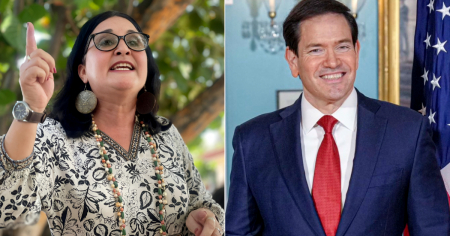
Donald Trump's public support for the idea that his powerful Secretary of State, Marco Rubio, could become president of Cuba following a political change on the island has revived an old debate: is it legally possible, politically viable, or merely a way to pressure the regime in Havana?
Marco Rubio, "nightmare" of Castroism
Rubio, the son of Cuban emigrants born in Miami and the current Secretary of State of the United States, is one of the most hostile figures toward the regime in Havana and has systematically linked the fate of Cuba with that of Venezuela, advocating for sanctions and operations that culminated in the capture of Nicolás Maduro.
In recent interviews, he has described Cuba as "a major problem," insisted that Maduro's security apparatus is controlled by Cuban agents, and warned that the island could be the next target of pressure from Washington.
When Trump says, "Sounds good to me"
President Donald Trump reshared a message from a user on his social media, which fantasized about seeing Marco Rubio as “president of Cuba” following a potential collapse of the regime, accompanying it with the phrase: “Sounds good to me!”
That simple gesture, amidst the escalation against Havana following Maduro's capture and the announcement that "there will be no more oil or money for Cuba," sparked speculation on social media and in exile forums about a potential Washington-led transition in which Rubio would play a central role.
What the Cuban constitutions say
The current Constitution of 2019 requires that the president be a Cuban citizen by birth, a member of the National Assembly, and, crucially, that they do not hold any other citizenship. This disqualifies someone like Rubio, who is a natural-born American and fully integrated into U.S. politics, right from the start.
The 1940 Constitution, on the other hand, recognized the children of Cubans born abroad as Cubans by birth if they resided in Cuba and did not prohibit dual nationality, which at least theoretically opens the possibility for a descendant of Cubans born in Miami to aspire to the head of state in a scenario of democratic restoration.
Between speculation and the political message
Although the idea of a "President Marco Rubio" in Havana today seems more like a rhetorical device than a real plan, it acts as a message of maximum pressure on the Cuban regime: its main international enemy not only takes away its Venezuelan ally but also appears in the imaginary betting to occupy the Palace of the Revolution.
For that fantasy to come even slightly close to reality, much more than a tweet would be needed: a regime change in Cuba, a new Constitution that opens the door to the diaspora, a redefinition of citizenship, and, above all, the will of the Cubans themselves.
Filed under: