
Related videos:
The U.S. Southern Command has issued a stern warning to vessels associated with the so-called "dark fleet," used to transport Venezuelan oil and support networks for illegal financing.
The warning comes at a time of increasing military and diplomatic pressure on the countries allied with the Caracas government, particularly following the capture of Nicolás Maduro.
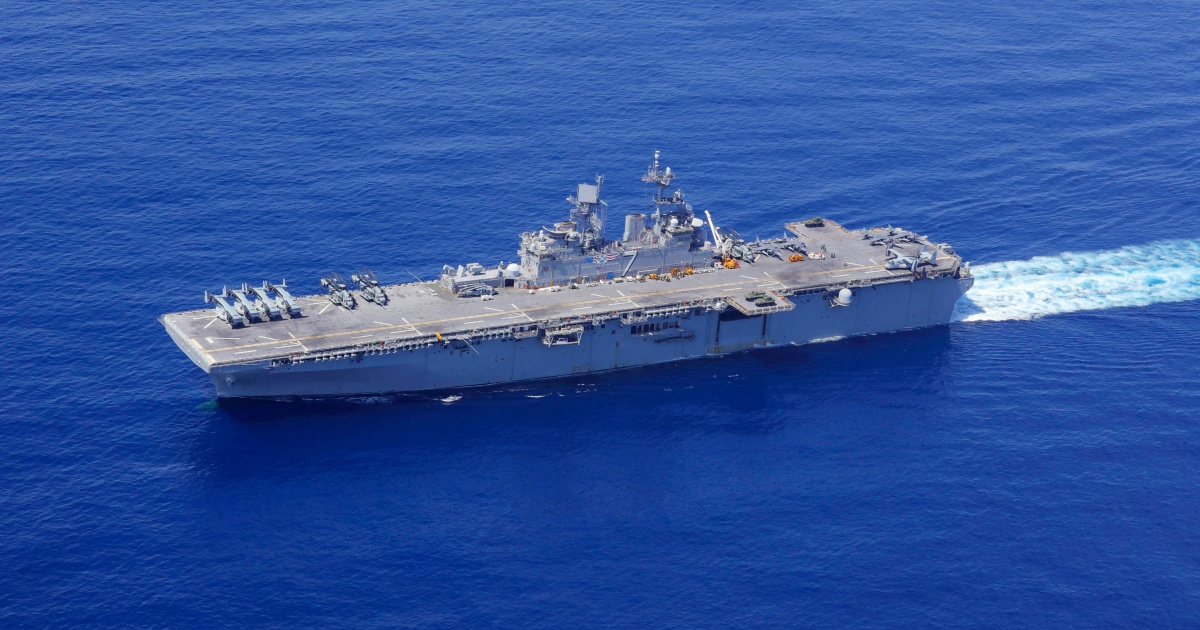
“The largest aircraft carrier in the world, the USS Gerald R. Ford, and the amphibious warships USS Iwo Jima, USS Fort Lauderdale, and USS San Antonio remain deployed in the Western Hemisphere. The Marines and sailors from these formidable platforms are ready to provide support,” stated South Command in an official statement.
The warning was accompanied by images of the significant naval deployment that remains active in the Caribbean.
All remain deployed in the Western Hemisphere as part of Operation Lanza del Sur (Southern Spear), a strategic initiative driven under the orders of President Donald Trump.
The mission is supported by the Department of Homeland Security, the Department of State, and the Department of Justice of the United States, as part of a coordinated response to dismantle illicit vessels operating in the region, particularly those involved in the trafficking of Venezuelan crude oil.
"Ready to support operations against malign actors."
In his message, Southern Command was emphatic:
"The sailors and soldiers aboard these lethal vessels are ready to support operations against boats and illicit shipments that benefit malicious actors and cartels."
U.S. military forces have been deployed specifically in the area of responsibility of Southern Command, and interdictions at sea are expected to increase in an effort to disrupt the logistics chain of the "dark fleet."
What is the "dark fleet" and why is it under scrutiny?
The "dark fleet" refers to a group of oil tankers that operate outside traditional maritime tracking systems, turning off their transponders, sailing under flags of convenience, or changing names and ownership to evade sanctions.
According to a Washington Post investigation, satellite images indicated that at least 11 sanctioned ships managed to leave Venezuela with a combined cargo of 9.4 million barrels of crude oil, in clear violation of the blockade imposed by the U.S.
Of those eleven vessels, six were located more than 70 nautical miles from the Venezuelan coast, while three others managed to venture over 450 miles toward the Atlantic.
Some were located off the coast of Granada or near Colombia, and one of them had recently switched to the Russian flag to try to evade detection.
Three identified vessels – Verónica III, Bertha, and Aquila II – are sanctioned due to ties with Iran and Russia, according to the Office of Foreign Assets Control (OFAC) of the Department of the Treasury.
Seizures and persecutions: The U.S. intensifies interdictions
In parallel with the military deployment, U.S. forces have increased seizure operations. This week alone, at least two additional vessels were captured: the Sophia, intercepted in the Caribbean, and the Marinera, a Russian-flagged ship, stopped after a prolonged chase in the Atlantic.
Moscow reacted strongly, accusing Washington of "violating international maritime law", in what could escalate into a broader diplomatic conflict.
An additional analysis cited by The Washington Post suggests that a U.S. vessel, possibly the guided missile cruiser USS Lake Erie, may have closely followed some of these vessels, although the Pentagon has not confirmed either the identity or the exact location.
Repositioning towards Cuba and message to Havana
In a gesture that analysts interpret as a direct warning to the Cuban regime, two American vessels were repositioned last week north of Cuba.
The maneuver, which occurred following the capture of Nicolás Maduro, highlighted Washington's suspicions regarding the ties between Havana and Caracas in sanctioned oil operations.
An effective or symbolic blockade?
Although the operation aims to be a show of strength, energy analysts have questioned the actual effectiveness of the blockade. The ability of eleven ships to evade the encirclement in recent weeks indicates that the restrictions have cracks.
"The main objective is to deter through seizures and a deterrent presence," noted an expert consulted by the Post. However, he acknowledged that "it is extremely difficult to impose a total, seamless blockade in open waters."
Since the Trump administration, however, it has been emphasized that these actions increase the "strategic leverage" over Venezuela.
Secretary of State Marco Rubio noted that the quarantine represents "the highest level of pressure possible" to isolate the regime of Delcy Rodríguez, the current head of the government in Caracas following Maduro's capture.
A warning on multiple fronts
The new phase of Operation Southern Spear not only aims to stop illegal oil shipments but also to send a broader geopolitical message to Venezuela's allied governments in the Caribbean.
The repositioning of vessels near Cuba and the intensification of interdictions reveal a strategy of encirclement: to deter, isolate, and financially strike the actors involved in the illicit oil trade.
As the confrontation escalates, the Caribbean becomes a new front of tension between Washington and its regional adversaries, with a shadow fleet that, far from remaining in the shadows, has become a priority target of the military and diplomatic strategy of the United States.
Filed under: