
Related videos:
The fall of Nicolás Maduro has had an immediate effect beyond Caracas. In Havana, the political tremors from that capture have revived old ghosts: the Cuban regime's fear of losing control over information and, along with it, over the population.
In the days following the U.S. operation that resulted in the arrest of the Venezuelan ruler, alarms were raised in the Palace of the Revolution. As much as a political shift in Venezuela, the regime fears a disruption in the flow of data that supports a significant portion of internet access on the Island.
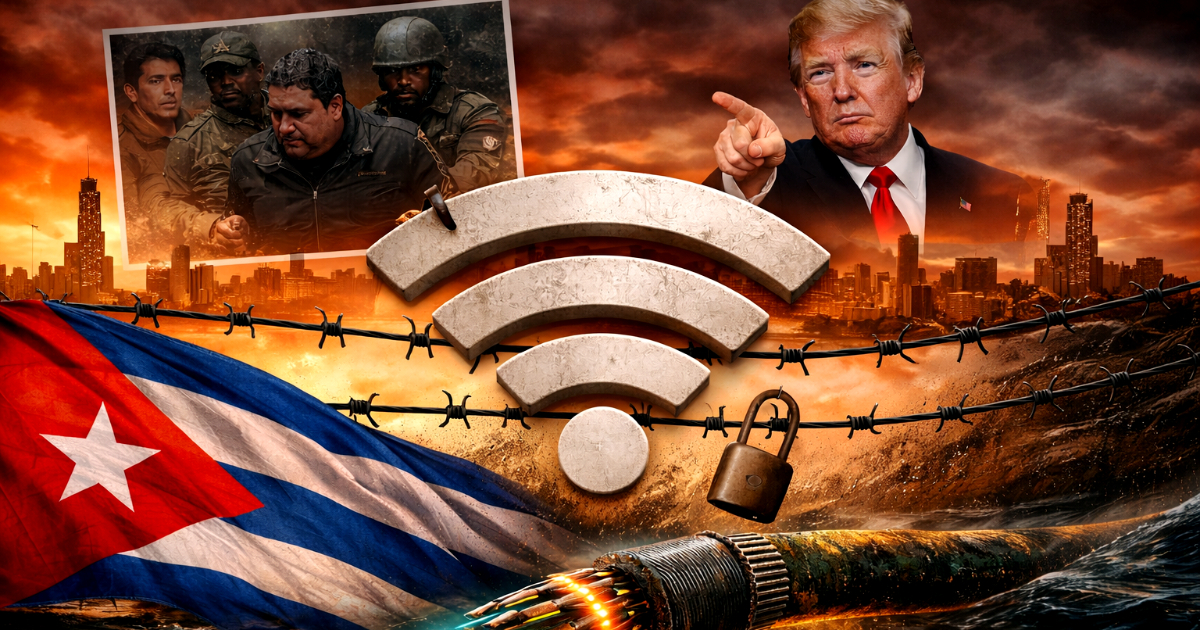
For more than a decade, Cuba's international connectivity has heavily relied on the ALBA-1 submarine cable, a fiber optic infrastructure connecting Santiago de Cuba with La Guaira, Venezuela.
Financed by chavismo and inaugurated in 2013, the cable was presented as a symbol of "technological sovereignty" against the United States. In practice, it became a tool of power: it allowed the regime to collect millions of dollars from data traffic, improved access to the global network, but also strengthened state control over digital traffic and censorship.
Now, with chavismo wobbling and Washington overseeing the Venezuelan transition, ALBA-1 could become a point of vulnerability for the Cuban regime.
The possibility that Cantv, the Venezuelan state operator that manages the ALBA-1 cable, could fall into private hands is one of the main concerns in Havana.
If the new Venezuelan government decides to sell part of the company or open it to foreign investment, as several analysts suggest, the preferential connectivity conditions that Cuba has enjoyed since 2013 could disappear.
So far, the agreement between Caracas and Havana has been political: Cuba pays symbolic fees or compensates through medical cooperation and technical assistance. But a privatized Cantv would operate based on profitability criteria, not ideological affinities.
In this scenario, Cuba would have to bear market costs for data traffic or renegotiate the contract from a position of weakness, which could result in bandwidth cuts, new delays, or even temporary service interruptions.
Analysts cited by international media such as Kentik and 14ymedio agree that the future of the cable will depend on the decisions of the new power in Caracas.
Although traffic between Cuba and Venezuela continues to operate normally, Havana knows that U.S. control over Venezuelan infrastructure could, if necessary, extend to that link.
In addition to the cut in oil supply, U.S. control over telecommunications infrastructure would exacerbate the crisis that Havana is already experiencing.
This is not the first time that the Cuban regime has linked regional instability with digital restrictions. In July 2021, during the largest protests in decades, the regime cut off internet access nationwide for several days.
The tactic was repeated in subsequent demonstrations and during moments of political or economic tension. Cutting off the internet is, for those in power in Cuba, a defensive reflex: a way to silence public discourse and isolate people from independent information.
Therefore, after Maduro's fall, the fear is not only of losing a political partner but also of losing control. If Washington decided to review the Venezuelan communication systems or demand transparency in the management of ALBA-1, the Cuban regime would be exposed to unprecedented external oversight.
Havana knows that it can no longer blindly trust Caracas, and that its most important connection could come under the scrutiny of the United States.
Meanwhile, internet access on the Island remains expensive, limited, and monitored. Digital blackouts, the blocking of independent sites, and traffic tracking on networks are common practices.
Cuba has invested in expanding coverage, but not in guaranteeing digital freedom. Each technological advancement—from Wi-Fi parks to mobile access—has been accompanied by new control mechanisms. In this context, any threat to ALBA-1 is perceived as a political risk, not just a technical one.
The paradox is that the cable which once represented "sovereignty" against Washington could end up being the Achilles' heel of Cuban censorship. If the flow of data between the two countries is affected by the new situation in Venezuela, the regime would have two options: to seek an alternative —such as the new Arimao cable to Martinique— or to resort to what it knows best: shut off the tap.
In this context, some observers do not rule out a bolder move by Washington. If there were to be a cutoff or a serious degradation of the ALBA-1 operations, the Trump administration could turn to Elon Musk and activate open and free access to Starlink for Cubans, as was already done in Ukraine or Iran.
For Havana, it would be a nightmare: millions of citizens connected without going through ETECSA's servers, without censorship or surveillance. More than a technical challenge, it would be a direct political blow to the information monopoly that the regime has built over decades.
For now, there are no signs that ALBA-1 is in immediate danger. However, Maduro's capture has highlighted the fragility of a model that relies on allies in crisis. In a country where connectivity is power, any threat to the network translates into panic in the offices of Havana.
And although no one says it openly, the question that lingers in the air is not only what will happen to the internet in Cuba, but whether the regime will turn it off again before losing control of the narrative.
Filed under: