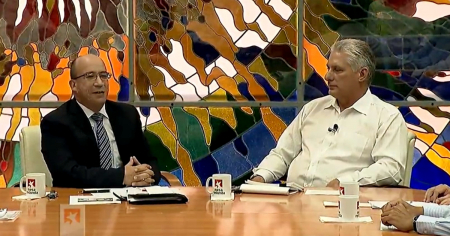
The Prime Minister Manuel Marrero Cruz dedicated the closing of the Fourth National Cybersecurity Day to warning about the alleged "subversive use" of social media, which he attributed to attempts of aggression against the revolution.
Accompanied by Yudi Mercedes Rodríguez Hernández, a member of the Secretariat of the Central Committee of the Communist Party and head of its Services Attention department, the head of government once again positioned the digital debate within the context of external "threats," as reflected in a report from state television.
The prime minister stated that the event took place under “exceptional conditions” due to the intensification of the embargo and the impact of Hurricane Melisa, placing both factors as the backdrop for his call to “combat the fake news that is generated daily.”
According to Marrero, raising the cultural awareness of the population to identify risks should become an essential part of civic behavior.
He insisted that the State and the Government pay "special attention" to cybersecurity and that he trusts in the readiness of the participants in the meeting to ensure a "safe and responsible" use of digital technologies.
During the closing event, the general rapporteur highlighted the presentation of 34 papers and the discussion of technological solutions and best practices aimed at strengthening the defense of the nation's digital space.
Marrero's intervention reinforced the official line of turning any critical content into an expression of political hostility, while also reinforcing the government’s narrative on the need for increasing control over the digital environment in Cuba.
The Cuban government has launched an aggressive campaign of defamation against independent media and journalists, using its state propaganda apparatus to criminalize the practice of free journalism.
On November 26, an article from the official portal Cubadebate identified 30 social media accounts as part of an alleged "cognitive war organized by the international far-right," a message amplified by Foreign Minister Bruno Rodríguez Parrilla, official media such as Granma, and the program "Razones de Cuba" hosted by Humberto López.
The digital media elTOQUE has become the main target, among other elements, for publishing the Representative Rate of the Informal Market which highlights the economic failure of the regime and its inability to establish an official, orderly, and transparent market for the buying and selling of foreign currency.
“Razones de Cuba” published personal files of 18 supposed “directors” of the outlet, complete with photographs and information, accusing them of being “mercenaries” and threatening them with criminal investigations, possible extradition, and imprisonment.
The strategy aims to equate journalism with treason to the homeland by using labels such as "media terrorists" and "international far-right," recalling the Black Spring of 2003 when 27 communicators were imprisoned.
CiberCuba, also mentioned in the attacks, rejected the accusations stating that "denouncing repression, hunger, and inequality is not far-right; it is resistance against the dictatorship."
The media reaffirmed that independent journalism is a public service and will continue to report on the reality that the regime tries to hide through digital media lynchings that aim to create a climate of fear to justify its political and economic failures.
Filed under: