
Related videos:
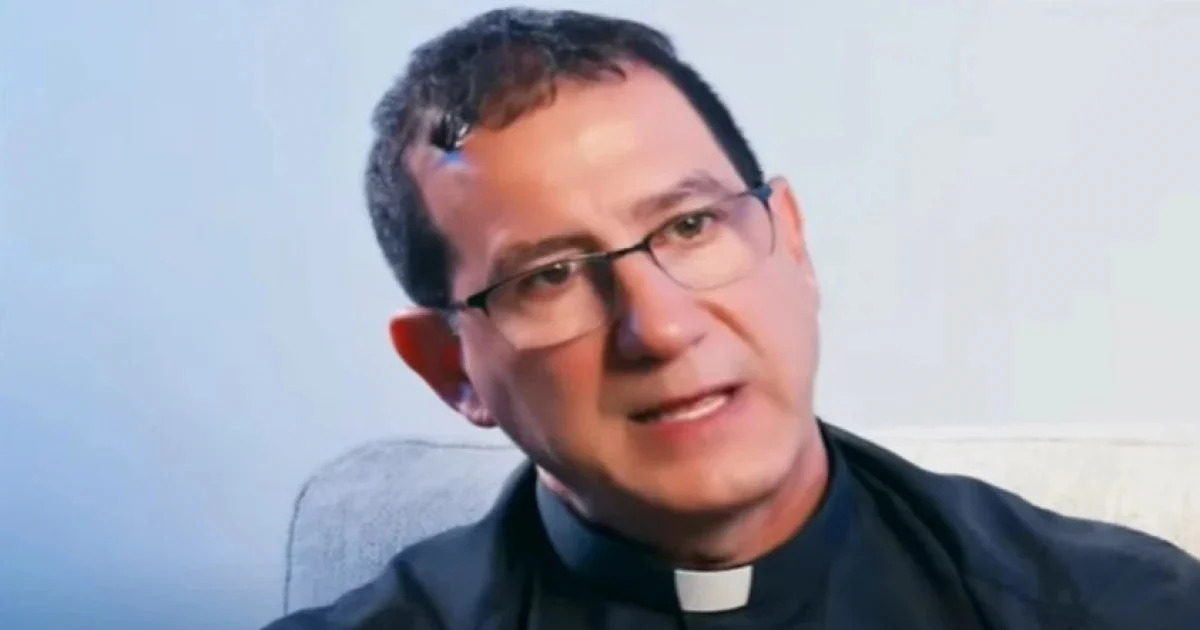
The Cuban priest Alberto Reyes Pías has gone viral again after posting a profound reflection on his Facebook profile, in which he questions one of the pillars of Marxism-Leninism and, implicitly, the political logic that has supported the Cuban government for more than six decades.
In his text, Father Reyes begins with a memory from his childhood: a television scene where young revolutionaries lament that a couple might "get lost to the cause."
What once seemed to a child almost like a romantic image became a source of profound alarm over time: the idea that for that ideology "the individual does not matter" in comparison to the revolutionary ideal.
The person as a disposable figure
Reyes interprets that scene as a direct metaphor for what he sees as the ideological foundation of Marxism-Leninism, and how the regime has subordinated people to a cause that has not brought real welfare or dignity to most citizens.
"The ideal of the revolution as the supreme good for which it was worth sacrificing everything. (...) It does not matter their life, or their personal project, or their present, or their future," he writes.
"It doesn't matter about your family, your children, your parents, or even your partner. What matters is 'the cause', the ideal of a revolutionary society that, on the contrary, does nothing but drain all your energy, all your vitality..." he adds.
For the religious individual, this absolute subordination ultimately serves to utilize the individual as long as they are helpful in sustaining the system and then discards them afterward.
In his analysis, he connects this ideological abstraction with concrete facts: the long list of Cubans who have devoted decades of their lives to the revolution without receiving anything substantial in return.
Mention the dead in international missions promoted by the State, from Algeria to Angola, Nicaragua, or more recently, Venezuela, where 32 Cubans fell in combat under flags that were not their own.
"Those who sent them to die from the safety of their own homes and their children's will no longer be able to bring them back, but they will not offer their families—partners, parents, children—any support to lead a better life. They will congratulate them for the 'courage' of those who died, and they will forget all about it..." he noted.
The human cost of missions
The text denounces that, beyond the official speeches glorifying sacrifices, the reality for many Cubans who accepted to serve in missions in search of economic benefit is filled with pain and neglect.
Families are irreparably affected: broken marriages, absent parents, and emotionally wounded children, wounds that the official narrative never acknowledges or compensates for.
This criticism also extends to what is referred to as an "empty cause": a dictatorship that claims to defend the people but, in practice, only seeks to maintain power for those who already hold control.
A radical invitation to say No
Far from succumbing to resignation or ambiguous appeals, the priest concludes his reflection with an invitation that carries an almost simultaneous spiritual and political tone: "I will not play their game, I will not let myself be used, I will not put myself in a position where I can be manipulated..."
That firm denial, summed up in a simple "No," is for him an act of critical thinking and a defense of personal dignity in the face of a logic that, he claims, has demanded the complete surrender of the individual in exchange for nothing.
This kind of reflection is not isolated in Reyes' trajectory.
In recent years, the priest has been a persistent voice on social media denouncing the lack of freedom, repression, and social paralysis that Cuba is experiencing, as well as the need for the people to stop waiting for solutions from above to realize their aspirations for justice and progress.
In a context where open criticism of the dominant political model remains delicate and risky, his words have become, for many, a brave expression of what many Cubans feel: that it is necessary to think for oneself, to refuse to be used as a political tool, and to claim human dignity as a value that cannot be subordinated to any ideological cause that does not ensure the real well-being of people.
Filed under: