
Related videos:
The General Customs of the Republic of Cuba announced this Tuesday the entry into force starting April 2026 of a new legal framework that redefines its structure, operation, and powers.
The Decree-Law 108 “On Customs”, its Regulations (Decree 134), and nine complementary resolutions were published in the Official Gazette No. 7 of 2026, forming a regulatory package that, according to the authorities, aims to “modernize” customs procedures and “ensure a more agile, transparent, and professional foreign trade.”
In its official statement, the institution stated that the measures are part of a "continuous process of institutional improvement," and that the new regulatory compendium "is in harmony with constitutional principles and the international standards promoted by the World Customs Organization."
The Customs Agency promises “greater facilitation of international trade and new border security requirements”, in the context of an economic crisis, declining production, and the country's dependence on personal imports and family shipments.
Absolute centralization of customs control
The new Decree-Law repeals the previous regulations (Decree-Law 162 of 1996 and its amendments of 2019) and centralizes all competencies at the top of the state administration.
The head of the General Customs Authority will have the power to create or eliminate customs units, authorize special regimes, retain or confiscate goods, and arrange for the legal or voluntary abandonment of property in favor of the State.
Article 14 grants it extensive powers, including:
"Implement customs control over premises, offices, warehouses, vehicles, and other means of transport, packaging materials, individuals, and other goods and locations, which includes registration."
In addition, the official may authorize "the precautionary measure of retention or seizure of goods, assets, values, documents in any form, and means of transportation" until the investigation is concluded or the corresponding sanction is applied.
This provision grants Customs almost police-like powers in an area where economic oversight previously prevailed over direct intervention.
It is also established that the actions of the customs authority will have "the validity corresponding to those carried out by any primary investigative body" when allegedly criminal acts are detected.
Between "modernization" and surveillance
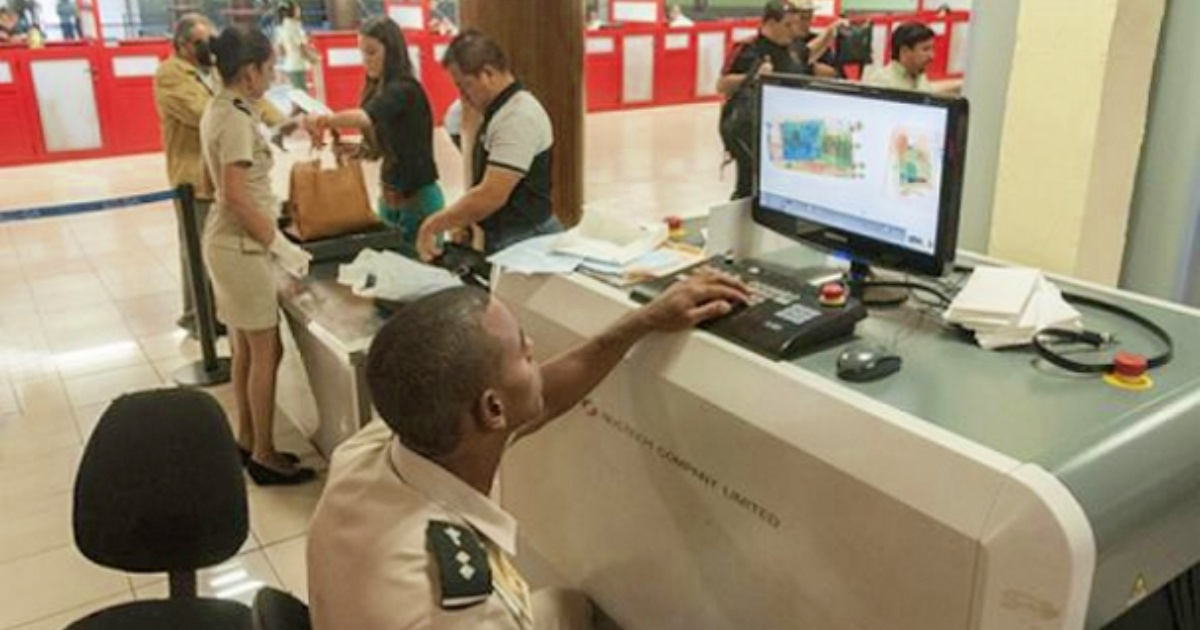
The legal text also establishes a permanent technological control system, which includes "radiological checks on individuals, their luggage, cargo, and means of transport," "canine inspections of goods, means of transport, and individuals," and "the closed-circuit television system in customs facilities."
These provisions are justified in the name of security, but in practice, they institutionalize the mass inspection of people and goods at the border.
Additionally, the Decree-Law explicitly authorizes Customs to prevent a passenger from boarding if they refuse to undergo inspection
"The Customs Authority has the power to prevent a person from entering a sterile area or boarding an international means of transport if they refuse to undergo security checks."
The measure reinforces the discretion of customs authority and paves the way for arbitrary actions in everyday practice, especially against travelers carrying non-commercial goods or humanitarian aid.
The legal package is part of a broader strategy for recentralizing economic control at a time of deterioration of the state system.
In a country where the population relies on remittances, international shipments, and personal imports, the new legislation could worsen bureaucracy and increase costs for those trying to bring essential goods or supplies for small businesses.
The Government, for its part, asserts that during the 90 days prior to the entry into force of the Decree-Law, training and outreach actions will be carried out to "clarify doubts, criteria, or proposals that arise from individuals through the established communication channels."
A strengthened power in the name of "socialism"
Although the official discourse focuses on modernization and efficiency, the text of Decree-Law 108, which spans over 250 pages, reinforces the political and fiscal control of the State over foreign trade, travelers, and international packages.
Article 12 of the new text makes this clear:
"The General Customs of the Republic is responsible for directing, controlling, and implementing state policy in customs matters and ensures, within its jurisdiction and authority, the facilitation of trade and the security of socialist society."
The concept of "security of the socialist society" repeatedly emerges throughout the document, subordinating commercial and logistical functions to a logic of surveillance and ideology.
Article 13 also defines that the institution has the duty to:
"To direct, control, and confront, within its jurisdiction and authority, the events that threaten the security of socialist society, the economy, and international relations."
In practice, this approach turns Customs into a political instrument of state control, rather than a public service aimed at facilitating trade or supporting economic actors.
Nine resolutions to strengthen control
Decree-Law 108 is accompanied by a package of nine resolutions, all published in the same edition of the Official Gazette, which strengthen its operational structure
Resolution 529/2025: establishes the rules for customs control of merchandise.
Resolution 530/2025: regulates the supply of ships, vessels, and aircraft.
Resolution 531/2025: establishes the regime for the temporary deposit of goods.
Resolution 532/2025: regulates the application of different customs regimes.
Resolution 533/2025: regulates the customs clearance of goods.
Resolution 534/2025: defines the procedures for declaring or accepting the abandonment of property in favor of the State.
Resolution 535/2025: establishes the Authorized Economic Operator (OEA) system, through which Customs will certify companies deemed "safe and reliable."
Resolutions 536 and 537/2025: expand control over naval vessels and aircraft, as well as cargo and supply operations.
In the case of the Authorized Economic Operator, this framework represents a step towards professionalization. However, the decree itself states that it will only be granted to entities that demonstrate a “satisfactory history of tax and customs obligations,” a requirement that excludes most entrepreneurs and private cooperatives.
A "modern customs" with a 1970s mindset
Despite its rhetoric of modernization, Decree-Law 108 replicates the classic mechanisms of total control by the Cuban state: surveillance, sanctions, and the subordination of economic activity to political power.
The announced “modernization” seems more like an administrative reform of control than a genuine move towards efficiency or transparency.
While the country remains immersed in a deep economic crisis, the creation of a more powerful and bureaucratic customs apparatus could further hinder the flow of resources that support thousands of Cuban families.
Filed under: