
Related videos:
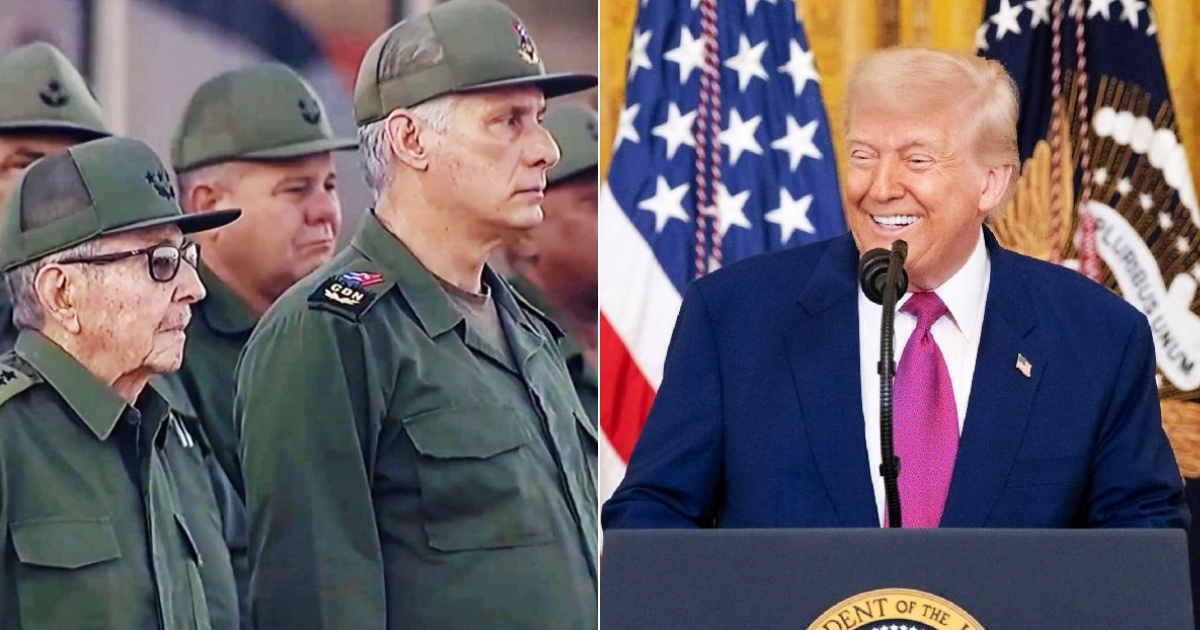
The administration of President Donald Trump is reportedly working actively to provoke a political change in Cuba before the end of the year, according to an in-depth investigation published by The Wall Street Journal.
According to U.S. officials cited by the newspaper, Washington sees a "historic window of opportunity" to pressure the Cuban government into collapse, amid unprecedented economic deterioration and increasing regional isolation.
Although there is no declared military plan or official timeline, the White House's strategy aims to intensify economic, diplomatic, and symbolic pressures on the Cuban regime, while seeking internal interlocutors willing to negotiate a potential transition.
Discreet contacts and searching for interlocutors in Havana
In parallel to the public pressure measures, the U.S. government has intensified its discreet contacts with the Cuban community in exile and with civic leaders in cities like Miami and Washington.
¿The objective?: Identify potential figures within the Cuban state apparatus who “see what’s coming” and are willing to negotiate a negotiated exit.
According to the Wall Street Journal, multiple private meetings have been held in which information was reportedly requested about Cuban officials or military personnel "willing to understand the historical moment" and break away from the leadership.
An economy "on the brink of collapse" and without the Venezuelan lifeline
U.S. intelligence assessments describe a bleak outlook in Cuba: chronic shortages of basic goods, lack of medicine, prolonged blackouts, and a severe production contraction.
This is compounded by the loss of Venezuelan support following the capture of Nicolás Maduro by U.S. forces on January 3, an event that, according to high-ranking officials, left Cuba without its main supplier of subsidized oil.
"Cuba seems to be on the brink of collapse. I don’t know how they will be able to stay afloat; they don't have any income. They received all their revenue from Venezuela, from Venezuelan oil," Donald Trump stated recently in an interview aboard Air Force One.
The U.S. government believes that this extreme weakening of the Cuban model creates favorable conditions to promote a political exit.
“The island's economy is close to collapse”, individuals familiar with the internal discussions told the Journal.
The operation in Venezuela as a warning model
Officials from the Trump administration acknowledge that the military operation in Caracas—which resulted in the capture of Maduro and the death of at least 32 soldiers and Cuban agents—served as a “successful model” of covert action involving informants from within the regime.
According to the Journal, the White House expects to replicate a similar strategy in Cuba.
"The rulers of Cuba are incompetent Marxists who have destroyed their country," stated a high-ranking official from the White House, emphasizing that "they must make a deal before it is too late."
The warning was also reflected on social media. On January 11, Trump posted on his Truth Social platform: "I strongly suggest you reach an agreement, BEFORE IT'S TOO LATE."
Economic sanctions and symbolic punishments
Washington's strategy also relies on a tightening of economic sanctions. Among the most recent measures are:
- Immigration restrictions against Cuban officials involved in medical missions abroad, which the U.S. considers a form of state-sponsored forced labor.
-Diplomatic pressure on countries receiving Cuban doctors to limit the scope of the program.
-Threat of total oil cutoff through enhanced naval surveillance and pressure on potential alternative suppliers.
The State Department stated in a statement that it is of strategic interest to U.S. national security that Cuba "has a democratic government and does not harbor military or intelligence services from adversarial powers."
The reaction of Havana and external support
From Cuba, Miguel Díaz-Canel firmly rejected any negotiation under pressure.
"There is no surrender or capitulation possible," he stated at a recent event.
The regime has also mobilized official demonstrations and messages of unity in response to what it describes as an "imperialist aggression."
At the international level, Russia expressed its support for Havana and labeled Washington's strategy as "blackmail and threats," in line with its strengthened geopolitical alliance with the island.
A political legacy for Trump and his allies in Florida
According to the Journal, Trump believes that ending the Cuban regime would solidify his historical legacy in foreign policy.
The cause of anti-Castroism has been a constant theme in his discourse, in alignment with influential sectors of the Cuban exile community and key figures in his administration, such as Secretary of State Marco Rubio.
"The anti-communist hawks in the administration have always felt that this place is so small and so close that it is a true humiliation to allow it to remain as it is," stated David Smith, an expert on foreign policy at the University of Sydney, in an interview with Al Jazeera.
A "tougher nut to crack" than Venezuela?
Despite the optimism in Washington, some analysts caution about the structural differences between Cuba and Venezuela. Ricardo Zúñiga, a former official in the Obama administration who participated in the bilateral thaw between 2014 and 2017, emphasized: “The Cuban regime is a much tougher nut to crack.”
Unlike Caracas, there is no organized opposition or frequent protests in Cuba that could foster a negotiated internal resolution.
Additionally, as Smith pointed out, the Cuban regime has survived six decades of sanctions, assassination attempts, diplomatic isolation, and deep economic crises.
The loyalty of the repressive apparatus and the opacity of the internal workings of power on the island continue to be factors that hinder any external efforts for collapse.
The White House appears determined to play its most ambitious card in Latin America: to force the end of Cuban communism, something that numerous U.S. presidents have failed to achieve.
In the words of an official cited by the Wall Street Journal: “This is the moment. If we don’t act now, we may not have another opportunity for decades.”
Filed under: